
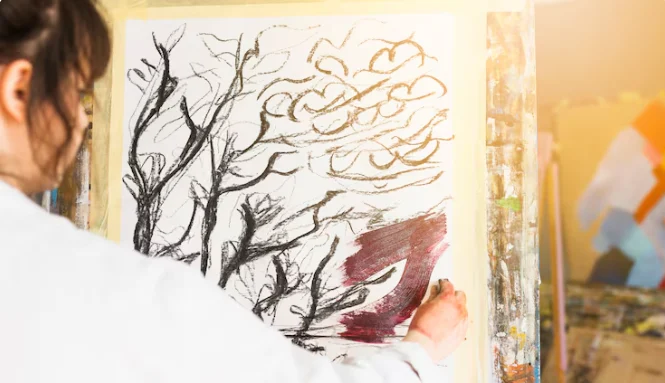
In a world filled with constant movement, visual noise, notifications, advertisements, and endlessly changing digital images, minimalist painting offers something increasingly rare: silence.
Minimalist art does not compete for attention through complexity. It does not depend on crowded compositions, dramatic detail, or an explosion of color. Instead, it invites viewers to slow down and notice what remains when everything unnecessary has been removed.
A single line, a restrained color palette, an empty section of canvas, or one carefully placed brushstroke can sometimes communicate more than an elaborate composition.
This is the quiet power of minimalist painting.
Although minimalism became widely recognized as an artistic movement during the twentieth century, the ideas behind it are much older. Artists across different cultures have long explored simplicity, balance, negative space, and restraint.
Today, as creative culture increasingly rewards speed, abundance, and immediate impact, rediscovering minimalist painting can offer both artists and viewers a refreshing way to experience art.
Understanding Minimalist Painting
Minimalist painting is often misunderstood as simply creating artwork with fewer elements. While simplicity is certainly important, true minimalism involves much more than reducing the number of objects or colors on a canvas.
The central idea is intentionality.
Every element must have a reason to exist.
A minimalist painter might use only two colors, but the relationship between those colors becomes extremely important. A single geometric form may appear simple, yet its position, scale, texture, and surrounding empty space can completely change the emotional experience of the work.
Minimalist painting encourages the viewer to focus on fundamental visual elements such as:
- Color
- Shape
- Line
- Texture
- Proportion
- Rhythm
- Balance
- Space
When unnecessary details disappear, these basic elements become more noticeable.
The viewer begins to see not only what has been painted but also what has deliberately been left untouched.
The Importance of Negative Space
One of the most powerful tools in minimalist painting is negative space.
Negative space refers to the areas around and between visual elements. In traditional compositions, empty areas may sometimes be treated as background. In minimalist artwork, however, empty space often becomes an active part of the composition.
Imagine a large white canvas containing a single dark brushstroke.
The brushstroke immediately becomes important, but so does the surrounding white space.
The emptiness gives the mark room to exist.
Without that space, the brushstroke might simply become another visual element among many others. With space around it, the viewer has time to study its direction, texture, pressure, and emotional quality.
Negative space can create feelings of calm, isolation, openness, tension, or contemplation.
This is why minimalist painting often feels surprisingly emotional despite containing relatively few visual elements.
Simplicity Requires Discipline
Creating simple artwork is not necessarily easier than creating complicated artwork.
In many cases, it can be more difficult.
When a painting contains dozens of objects, textures, colors, or decorative elements, small mistakes may disappear within the overall composition. Minimalist art offers fewer places to hide.
Every decision becomes visible.
The artist must carefully consider questions such as:
Where should the line begin?
How much empty space should surround the shape?
Should the color be warm or cool?
Should the brushstroke appear controlled or spontaneous?
Should the surface remain smooth or reveal the texture of the paint?
Minimalist painters often spend considerable time making decisions that may appear effortless to viewers.
The finished painting may look simple, but achieving that simplicity frequently requires patience, editing, experimentation, and restraint.
The artist must know when to continue and, perhaps more importantly, when to stop.
The Emotional Power of a Single Brushstroke
A brushstroke is more than paint applied to a surface.
It can reveal movement, speed, pressure, hesitation, confidence, and emotion.
A thick, energetic stroke can feel bold and aggressive. A thin, delicate line may appear fragile or meditative. A broken brushstroke can suggest uncertainty, while a smooth continuous mark may communicate calmness or control.
Minimalist painting places enormous attention on these small gestures.
Because there are fewer visual distractions, viewers can notice details that might otherwise be overlooked.
They may see where the brush first touched the canvas.
They may notice how the paint gradually became thinner as the brush moved.
They may observe small imperfections along the edge of a line.
These subtle details create a sense of human presence.
The brushstroke becomes evidence of the artist’s physical movement.
Minimalism and the Beauty of Imperfection
Modern visual culture often promotes perfection.
Digital design allows creators to produce perfectly straight lines, identical shapes, flawless gradients, and endlessly repeatable patterns.
Minimalist painting offers something different.
A hand-painted line is rarely perfect.
Its thickness changes.
Its edges may become uneven.
Paint may collect heavily in one area and appear transparent in another.
Rather than seeing these variations as mistakes, minimalist artists often allow them to remain visible.
These imperfections remind viewers that the artwork was created through physical action.
A brush moved across a surface.
A hand applied pressure.
Paint responded unpredictably.
This interaction between control and uncertainty gives minimalist painting much of its character.
The result can feel more personal than technically perfect imagery.
Color Becomes More Meaningful
When an artwork uses many colors, individual shades often become part of a larger visual system.
In minimalist painting, a single color can dominate the entire experience.
A deep blue field may create a feeling of quiet reflection.
Soft beige tones can suggest warmth and natural simplicity.
Black against white can create dramatic contrast and visual tension.
Muted greens may produce a sense of balance and connection with nature.
Because minimalist artists often work with restricted palettes, choosing the right shade becomes extremely important.
Small changes in tone can completely alter the atmosphere of the painting.
For example, a bright red may feel energetic and urgent, while a darker red can appear emotional, serious, or contemplative.
Minimalist painters therefore often explore color with remarkable sensitivity.
The Influence of Eastern Artistic Traditions
Although modern minimalism developed within particular twentieth-century art movements, similar principles can be found in much older artistic traditions.
Japanese ink painting, for example, frequently emphasizes simplicity, controlled brushwork, balance, and empty space.
A few carefully placed marks may suggest mountains, trees, water, or atmosphere without describing every detail.
The viewer participates by completing the image mentally.
Traditional calligraphy also demonstrates how a single stroke can contain rhythm, energy, personality, and meaning.
These traditions show that artistic power does not depend on visual abundance.
Sometimes suggestion is stronger than description.
Minimalist painting continues this idea by allowing viewers to interpret what they see rather than explaining everything directly.
Why Minimalist Art Feels Relevant Today
Modern life is visually crowded.
People move between phones, laptops, television screens, advertising displays, social media platforms, and constant digital communication.
The average person encounters thousands of images every day.
Against this background, minimalist painting can feel almost radical.
Instead of asking viewers to process more information, it asks them to experience less.
There is no endless stream of content.
There is no need to scroll.
There may simply be a canvas, a color, a shape, and a moment of stillness.
This simplicity creates space for reflection.
For some viewers, minimalist art becomes almost meditative.
It encourages observation rather than consumption.
Minimalist Painting in Interior Spaces
Minimalist paintings have also become popular in contemporary interior design because they can create visual interest without overwhelming a room.
A large abstract painting with muted colors can complement modern furniture while maintaining a calm atmosphere.
Simple geometric compositions often work well in offices, living rooms, bedrooms, galleries, hotels, and creative studios.
However, minimalist artwork should not merely match furniture.
Good art creates its own presence.
Even a restrained painting can become the emotional center of a room when its scale, color, and placement are carefully considered.
Sometimes one large minimalist painting can have greater visual impact than a wall filled with smaller decorative pieces.
Learning to Paint With Less
Artists interested in minimalist painting can begin by experimenting with limitations.
Instead of using a full palette, choose two or three colors.
Instead of filling the entire canvas, leave large areas untouched.
Instead of creating multiple shapes, explore variations of a single form.
These limitations can actually encourage creativity.
When options are reduced, artists begin paying closer attention to subtle differences.
The width of a line matters.
The distance between two shapes matters.
The transparency of the paint matters.
Even the texture of the canvas can become part of the composition.
Minimalism teaches artists to become more aware of every decision they make.
Knowing When the Painting Is Finished
One of the most difficult questions in painting is knowing when to stop.
Artists often continue adding details because they fear the artwork appears incomplete.
Minimalist painting challenges this instinct.
Sometimes the strongest decision is to leave the canvas alone.
Removing an element can improve the work more than adding another one.
This requires confidence.
The artist must trust that the existing elements are enough.
A painting does not need to explain everything.
It only needs to create a meaningful visual experience.
Minimalism Is Not Emptiness
Minimalist painting is sometimes dismissed as empty or overly simple.
But simplicity should not be confused with a lack of meaning.
A quiet room is not necessarily empty of experience.
A short sentence can carry enormous emotional weight.
A single musical note can create tension depending on what comes before and after it.
Visual art works in similar ways.
Minimalism removes distraction so that subtle relationships can become more powerful.
The distance between two shapes can create tension.
A slight shift in color can change the mood.
An uneven brushstroke can reveal emotion.
The viewer becomes more sensitive to details because there are fewer elements competing for attention.
Rediscovering the Quiet Brushstroke
Perhaps the greatest lesson of minimalist painting is that artistic expression does not always need to be loud.
Great art can whisper.
It can exist through restraint.
It can communicate through absence as much as presence.
The quiet brushstroke represents this philosophy perfectly.
It reminds artists that every mark carries weight and that a canvas does not need to be completely filled to feel complete.
In an age where creativity is often measured by speed, volume, and visibility, minimalist painting offers another possibility.
It encourages patience.
It encourages observation.
Most importantly, it reminds us that simplicity can contain extraordinary depth.
Sometimes the most powerful part of a painting is not the color that was added, the shape that was drawn, or the brushstroke that was made.
Sometimes it is the space the artist had the courage to leave untouched.
Read More : What Does Fawk Mean in Text? The Real Meaning May Surprise You


Pingback: The Moon Cycle Method: Aligning Skincare with Your Body's Rhythm
Pingback: Skin Minimalism: Why Less Product Might Be Your Best Routine Yet