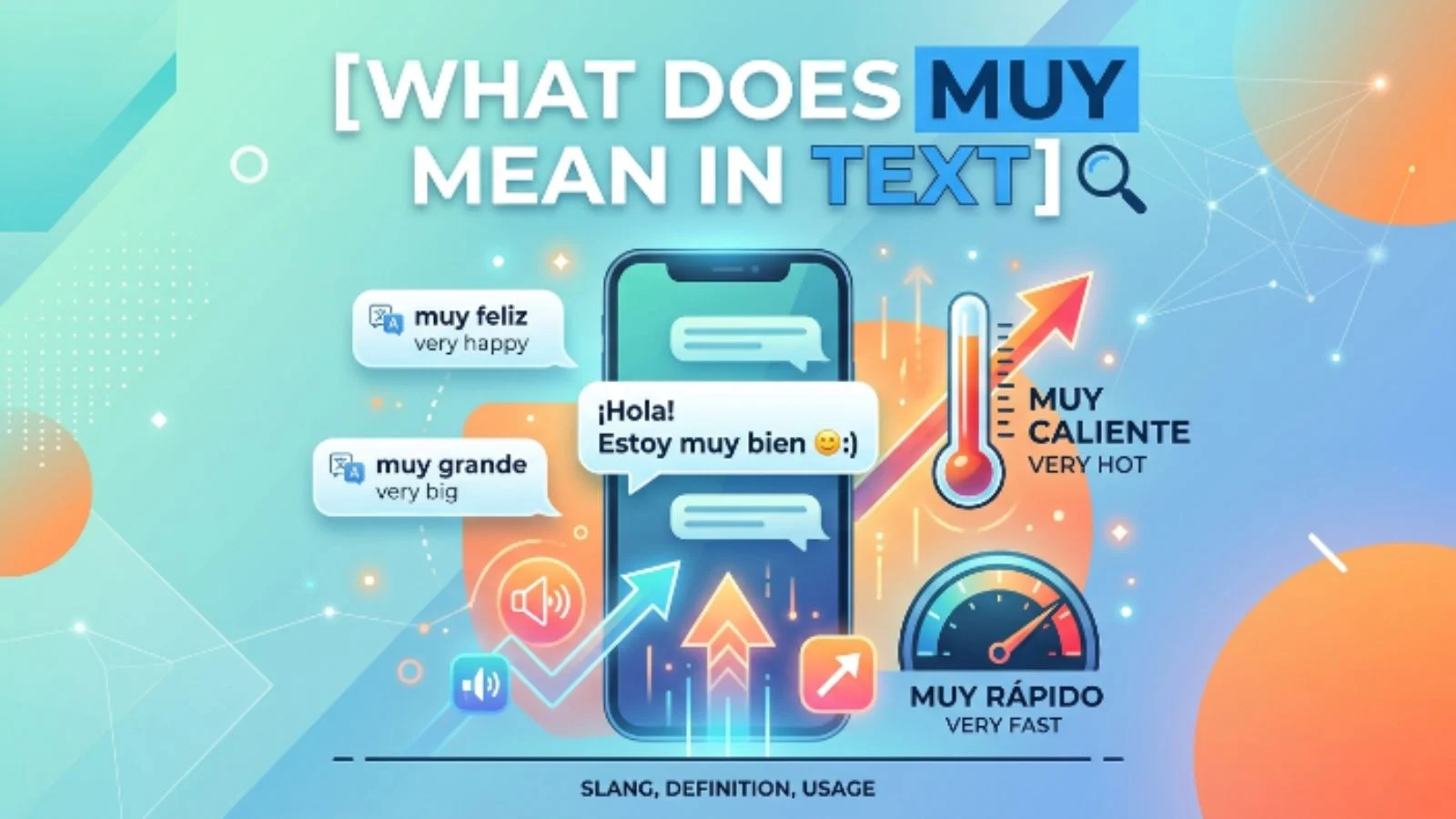
Have you ever received a text that says “muy cute,” “muy good,” or simply “muy” and wondered what the person actually meant?
You are not alone. MUY is a Spanish word that sometimes appears in English texts, social media captions, comments, and casual online conversations. Its meaning is usually simple, but the exact interpretation depends on the words around it.
In this guide, you will learn exactly what does muy mean in text, how people use it, what it means in Spanish, and how to understand it in real conversations.
What Does MUY Mean in Text?
MUY usually means “very” or “really” in Spanish.
For example:
- Muy cute = Very cute
- Muy good = Very good
- Muy importante = Very important
- Muy feliz = Very happy
In Spanish, muy is used to make an adjective or adverb stronger. When someone uses it in an English text, they may be intentionally mixing Spanish and English for a casual, funny, stylish, or expressive effect.
Quick Definition
MUY means “very” or “really.” It is a Spanish word commonly used in texting, social media, and casual conversations to emphasize a description or feeling.
For example, if someone texts “That outfit is muy cute,” they mean “That outfit is very cute.”
Simple Meaning of MUY in Text
The easiest way to understand muy is to replace it with very or really.
| Text | Meaning |
|---|---|
| Muy cute | Very cute |
| Muy nice | Really nice |
| Muy tired | Very tired |
| Muy funny | Very funny |
| Muy important | Very important |
The word itself is Spanish, but people often use it in English sentences as a playful language mix.
For example:
“Your new haircut is muy good.”
This simply means:
“Your new haircut is very good.”
The person may not be speaking completely in Spanish. They may just be adding muy to make the message sound more expressive or humorous.
What Does MUY Mean in Spanish?
In standard Spanish, muy means “very.”
It is commonly placed before adjectives and adverbs.
Examples in Spanish
- Muy bonito = Very beautiful
- Muy rápido = Very fast
- Muy fácil = Very easy
- Muy difícil = Very difficult
- Muy interesante = Very interesting
The word muy is different from mucho, which generally means much, a lot, or many, depending on the sentence.
For example:
- Muy bonito = Very beautiful
- Mucho dinero = A lot of money
This distinction matters if someone is using Spanish correctly.
Why Do People Use MUY in Text Messages?
People use muy in texts for several different reasons. Sometimes it is genuine Spanish. Other times, it is simply a fun way to add personality to a message.
1. To Mean “Very”
The most direct reason is simple: muy means very.
Someone might write:
“I am muy tired today.”
They mean:
“I am very tired today.”
This can be especially common among people who speak Spanish or are familiar with the language.
2. To Mix Spanish and English
Many people naturally combine languages when texting.
For example:
“That movie was muy good.”
This is a mix of Spanish and English. The sentence is not completely standard Spanish, but it can be perfectly understandable in casual online communication.
This type of language mixing is often called code-switching.
3. To Sound Playful or Funny
Sometimes muy is used simply because it sounds more dramatic than very.
Compare:
“That is very impressive.”
with:
“That is muy impressive.”
The second version may sound more playful, exaggerated, or humorous.
4. To Add a Stylish or Social Media Feel
On platforms like TikTok, Instagram, Snapchat, and X, people often play with language.
A caption such as:
“Muy obsessed with this outfit.”
can feel more creative than simply saying:
“Very obsessed with this outfit.”
The meaning is still basically the same.
5. To Express Cultural Identity
For Spanish speakers and bilingual users, using muy may be a natural part of how they communicate.
A person may switch between Spanish and English without thinking about it.
For example:
“I’m muy cansada today.”
This means:
“I’m very tired today.”
The use of muy may be part of the person’s normal bilingual communication style.
Where Is MUY Used Online?
You may see muy in several digital spaces.
Text Messages
Friends may use muy in casual conversations:
“That restaurant was muy good.”
Social Media Captions
People may use it for humor or emphasis:
“Muy ready for the weekend.”
TikTok and Instagram Comments
It may appear in comments such as:
“Muy cute!”
or:
“This is muy accurate.”
Memes
Memes often combine Spanish and English for comedic effect.
For example:
“Me after one cup of coffee: muy energetic.”
The phrase is not necessarily formal Spanish. The humor comes from the unusual combination of languages.
Online Chats
Gamers, friends, and online communities may use muy casually to mean very.
The exact tone depends on the conversation.
Real-Life Examples of MUY in Text
The best way to understand texting slang and informal language is through examples.
Example 1: “That dress is muy cute.”
Meaning: That dress is very cute.
Here, muy is being used as a direct replacement for very.
The tone is casual and positive.
Example 2: “I’m muy tired after work.”
Meaning: I am very tired after work.
The person is mixing English and Spanish to add a playful tone.
Example 3: “This food is muy spicy.”
Meaning: This food is very spicy.
The speaker is emphasizing how spicy the food is.
Example 4: “Your idea is muy smart.”
Meaning: Your idea is really smart.
This may be a friendly or humorous way to compliment someone.
Example 5: “That was muy awkward.”
Meaning: That was very awkward.
The word muy adds extra emphasis to the description.
Example 6: “Muy importante.”
Meaning: Very important.
This phrase is actually standard Spanish.
Unlike some mixed-language examples, this phrase is grammatically correct Spanish.
Example 7: “Muy good, I see what you did there.”
Meaning: Very good, I understand your clever idea.
This example intentionally mixes Spanish and English.
The person may be joking or trying to sound playful.
Is MUY Slang or a Real Word?
MUY is a real Spanish word, not originally internet slang.
Its standard meaning is “very.”
However, when English speakers use it in an otherwise English sentence, the usage can become informal, playful, or slang-like.
For example:
“This is muy interesting.”
The word muy itself is not slang. The unusual combination of Spanish and English is what gives the sentence its casual or humorous feeling.
This is an important distinction.
MUY vs VERY: What Is the Difference?
The basic meaning is almost identical when muy is used to mean very.
| Word | Language | Meaning | Example |
|---|---|---|---|
| Muy | Spanish | Very | Muy bonito |
| Very | English | Very | Very beautiful |
The main difference is language and context.
Very is the normal English word.
Muy is the Spanish equivalent and may be used in English texts for cultural, humorous, or stylistic reasons.
Example
- Very cute = Standard English
- Muy cute = Spanish-English mix, often casual or playful
MUY vs MUCHO
These two words are sometimes confused because both are Spanish.
MUY
Muy generally means very.
Examples:
- Muy bonito = Very beautiful
- Muy rápido = Very fast
- Muy interesante = Very interesting
MUCHO
Mucho generally means much, a lot, or many, depending on the context.
Examples:
- Mucho dinero = A lot of money
- Trabajo mucho = I work a lot
- Muchas personas = Many people
A simple way to remember the difference is:
MUY = very
MUCHO = much, a lot, or many
What Does “Muy Cute” Mean in Text?
“Muy cute” means “very cute.”
It is a casual combination of Spanish and English.
Someone might comment:
“Your puppy is muy cute!”
They are simply saying:
“Your puppy is very cute!”
The phrase often sounds playful, friendly, or slightly humorous.
What Does “Muy Good” Mean in Text?
“Muy good” means “very good.”
This is a mixed-language expression.
For example:
“You did muy good on that project.”
The intended meaning is:
“You did very well on that project.”
However, in standard English, “very good” is the grammatically correct phrase.
In standard Spanish, you would say:
Muy bien
So “muy good” is mainly an informal English-Spanish combination.
What Does “Muy Bien” Mean in Text?
“Muy bien” is a standard Spanish phrase meaning “very well” or “very good.”
Depending on the context, it can be used in different ways.
Example
“How did your exam go?”
“Muy bien!”
This means:
“Very well!”
Someone might also say:
“Muy bien, let’s start.”
This could mean:
“Very good, let’s start.”
The phrase is commonly understood even by many people who do not speak fluent Spanish.
What Does MUY Mean in a Romantic Text?
The meaning does not automatically become romantic just because muy appears in a message.
The surrounding words determine the tone.
For example:
“You look muy cute today.”
This could be:
- A friendly compliment
- A romantic compliment
- A playful comment
You need to consider the relationship and the rest of the conversation.
Example
“You’re muy cute when you get excited.”
This could sound flirtatious depending on who sent it.
However:
“That puppy is muy cute.”
is obviously not romantic.
The word muy itself does not have a romantic meaning.
What Does MUY Mean in a Comment?
If someone comments:
“Muy cute!”
they probably mean:
“Very cute!”
If they write:
“Muy accurate.”
they mean:
“Very accurate.”
If they say:
“Muy relatable.”
they mean:
“Very relatable.”
On social media, muy is often used to add humor, emphasis, or a bilingual style to a short comment.
How Should You Reply to MUY in a Text?
Your response depends on the message.
If Someone Says “Muy Cute”
You can reply:
- “Haha, thank you!”
- “I know, right?”
- “Very cute, indeed.”
- “Gracias!”
If Someone Says “Muy Good”
You can say:
- “Thank you!”
- “Haha, I’ll take that as a compliment.”
- “Gracias!”
- “Glad you liked it.”
If Someone Uses Spanish Naturally
You can respond in a similar style if you understand the language.
For example:
“Muy bien!”
You could reply:
“Gracias!”
or:
“Sí, exactamente!”
You do not need to respond in Spanish, though. A simple English reply is completely fine.
Common Misunderstandings About MUY
Although muy is simple, people sometimes misunderstand it.
Misunderstanding 1: MUY Always Has a Special Slang Meaning
Not necessarily.
In most cases, muy simply means “very.”
There is no hidden meaning automatically attached to the word.
Misunderstanding 2: MUY Is an Acronym
Usually, no.
Unlike texting abbreviations such as LOL, BRB, or IMO, muy is normally a Spanish word.
Its meaning comes from the Spanish language.
Misunderstanding 3: MUY Always Means the Person Is Flirting
This is incorrect.
The phrase:
“You look muy cute”
could be flirtatious, but the word muy itself is not romantic.
The context matters more than the word.
Misunderstanding 4: Every Use of MUY Is Correct Spanish
Not always.
A phrase such as:
“Muy bonito”
is standard Spanish.
But:
“Muy cute”
is a Spanish-English mixture.
It may be perfectly acceptable in casual texting while not being standard Spanish grammar.
Misunderstanding 5: MUY and MUCHO Mean the Same Thing
They do not.
Muy usually means very.
Mucho usually means much, a lot, or many.
When Should You Use MUY?
You can use muy in casual conversations when you want to:
- Add emphasis
- Mix Spanish and English
- Sound playful
- Show familiarity with Spanish
- Make a social media caption more expressive
- Communicate naturally with bilingual friends
For example:
“That movie was muy good.”
This can work well in a casual conversation.
However, if you are writing a formal email, academic assignment, or professional document, it is usually better to use very in English.
Casual Context
“This is muy exciting!”
Professional Context
“This is very exciting.”
The second version is more appropriate for formal communication.
Pro Tips for Understanding MUY in Text
Look at the Words Around It
The surrounding words usually reveal the meaning.
“Muy cute” = Very cute
“Muy tired” = Very tired
“Muy important” = Very important
Consider Who Sent the Message
A bilingual friend may use muy naturally.
Another person may use it as a joke or internet-style expression.
The same word can have slightly different tones depending on the speaker.
Pay Attention to the Overall Tone
Is the conversation:
- Serious?
- Funny?
- Flirty?
- Casual?
- Bilingual?
The meaning of muy is usually stable, but the emotional tone can change.
Do Not Overthink It
In most texts, muy simply means “very.”
If someone writes:
“That is muy funny.”
they almost certainly mean:
“That is very funny.”
There is usually no secret code behind it.
Is MUY Common in Texting?
The Spanish word muy is common in Spanish communication.
Its use inside English texting is less formal and depends on the person, culture, and online community.
You may see it more often in:
- Bilingual conversations
- Spanish-speaking communities
- Social media
- Memes
- Casual chats
- Humorous posts
It is not usually treated like a traditional texting acronym such as LOL or OMG.
Frequently Asked Questions
What does MUY mean in text?
MUY usually means “very” or “really.” It is a Spanish word that people may use in English texts to emphasize a description, such as “muy cute,” meaning “very cute.”
Is MUY an English texting abbreviation?
No. MUY is normally a Spanish word, not an English acronym or abbreviation. When people use it in English texts, they may be mixing Spanish and English for fun or emphasis.
What does “muy cute” mean?
“Muy cute” means “very cute.” It is an informal combination of the Spanish word muy and the English word cute.
What is the difference between MUY and MUCHO?
Muy means “very,” while mucho can mean “much,” “a lot,” or “many,” depending on the sentence. For example, muy bonito means “very beautiful,” while mucho dinero means “a lot of money.”
Final Thoughts: What Does MUY Mean in Text?
So, what does muy mean in text?
In most cases, muy means “very” or “really.” It is a Spanish word that can appear in Spanish sentences or in casual English-Spanish combinations such as “muy cute,” “muy good,” or “muy funny.”
The word itself is simple. The main difference is the tone. Someone may use muy naturally because they speak Spanish, or they may use it playfully to make a message sound more expressive.
When you see muy in a text, look at the words around it and consider the conversation’s context. In most situations, you can simply translate it as “very.”