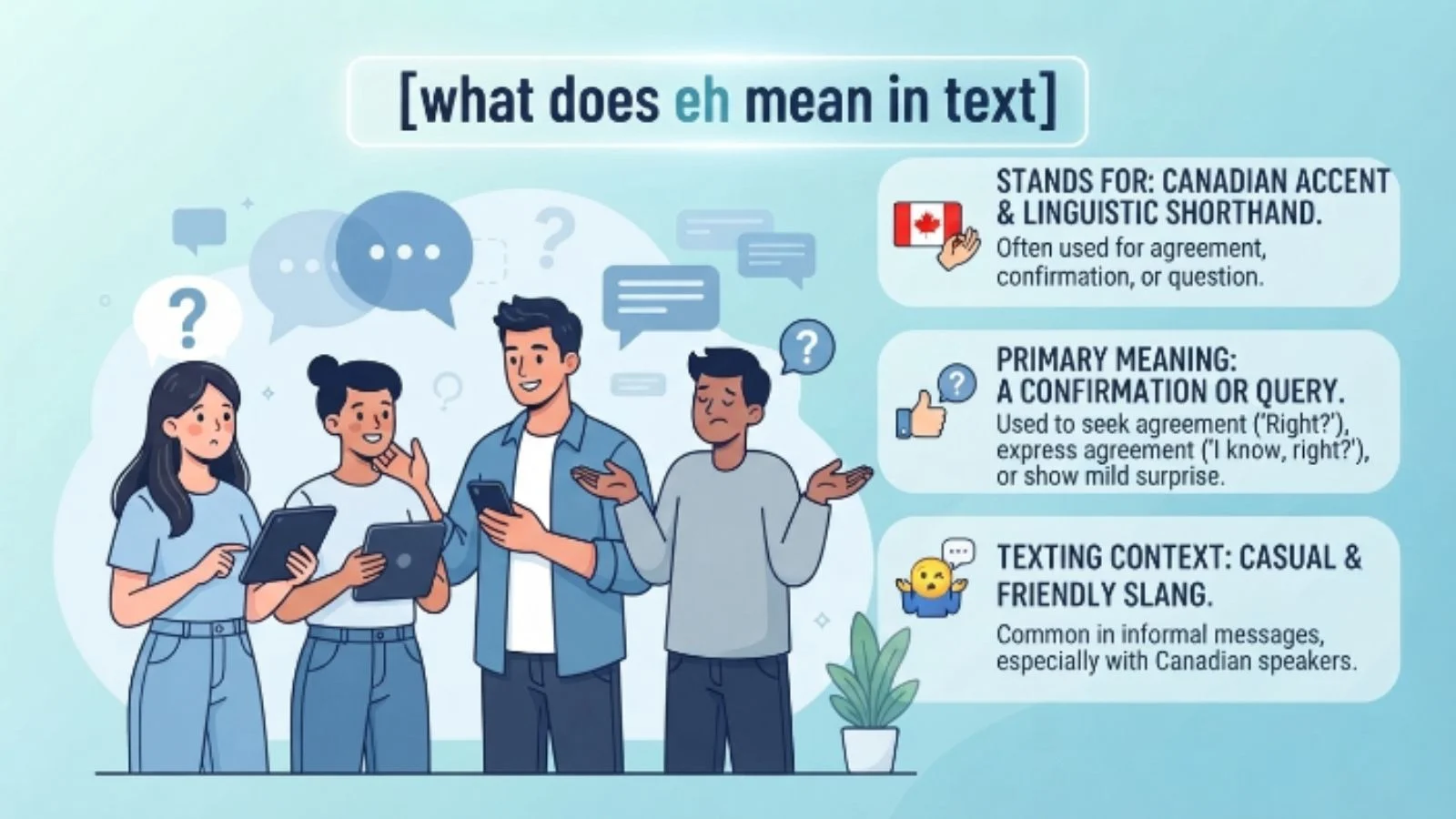
Have you ever received a text that simply says “eh” and wondered what the person actually meant?
It may look like a tiny, meaningless word, but “eh” can express several different feelings depending on the conversation, tone, and context. Sometimes it means “I don’t know.” Other times, it can show uncertainty, indifference, surprise, confusion, or even a request for agreement.
That is why understanding what does eh mean in text is not always as simple as looking up one definition. The same two letters can communicate completely different emotions.
In this guide, you will learn what “eh” means in texting, how people use it in conversations, what it means in different situations, and how to respond when someone sends it to you.
What Does “Eh” Mean in Text?
In text messages, “eh” usually expresses uncertainty, indifference, hesitation, or a lack of strong opinion.
Depending on the context, it can mean:
- “I don’t know.”
- “I’m not sure.”
- “It doesn’t really matter to me.”
- “That’s okay, but not amazing.”
- “Huh?”
- “Do you agree?”
- “What do you think?”
The meaning of “eh” depends heavily on the surrounding conversation. Unlike abbreviations such as “LOL” or “BRB,” it does not have one fixed definition.
Simple Definition
“Eh” in text is a casual expression used to show uncertainty, indifference, hesitation, mild disagreement, or to ask for agreement.
For example:
Friend: “Do you want pizza or burgers?”
You: “Eh, either one is fine.”
Here, “eh” means you do not have a strong preference.
But:
Friend: “Did you like the movie?”
You: “Eh.”
In this case, “eh” probably means the movie was average or disappointing.
What Is the Basic Meaning of “Eh”?
The simplest meaning of “eh” is “not really” or “I’m not sure.”
People often use it when they do not want to give a strong answer. It can make a message sound relaxed, casual, or emotionally neutral.
For example:
“How was your day?”
“Eh, it was okay.”
This means the person’s day was neither very good nor very bad.
Another example:
“Are you excited about the party?”
“Eh, not really.”
Here, “eh” shows a lack of excitement.
In many conversations, it is similar to saying:
- “Meh.”
- “I guess.”
- “Whatever.”
- “Not really.”
- “I’m not sure.”
However, these words are not always exact replacements. The specific meaning depends on the tone of the conversation.
Why Does Context Matter So Much?
Text messages do not include facial expressions, voice tone, or body language. Because of this, a short word like “eh” can be interpreted in several ways.
Consider this example:
“Eh, maybe.”
This could mean:
- The person is genuinely unsure.
- They do not want to commit to a plan.
- They are not very interested.
- They are being casual.
Now compare it with:
“Eh?”
This often sounds more like:
- “What?”
- “Huh?”
- “What did you say?”
The punctuation can completely change the meaning.
“Eh” vs. “Eh?”
“Eh” usually expresses a feeling or reaction.
“Eh?” can be a question asking for clarification, agreement, or confirmation.
For example:
“That restaurant was pretty good, eh?”
Here, “eh?” means “don’t you agree?”
But:
“Eh?”
could simply mean:
“What did you say?”
Where Is “Eh” Used in Texting?
People use “eh” in many informal digital conversations, including:
- Text messages
- iMessage
- Facebook Messenger
- Instagram Direct Messages
- Snapchat
- TikTok comments
- Discord
- Reddit discussions
- Online gaming chats
It is especially common in casual conversations with friends, family members, classmates, and online communities.
You may also see it in social media comments when someone wants to express a mild reaction without writing a full sentence.
For example:
“The new update is eh.”
This means the update is average, unimpressive, or not particularly exciting.
Why Do People Use “Eh” in Text Messages?
There are several reasons people use this short expression.
1. To Show Uncertainty
Someone may use “eh” when they are unsure what they think or what they want to do.
“Are you coming with us tonight?”
“Eh, I might.”
The person is not giving a definite yes or no.
2. To Show Indifference
Sometimes, “eh” means that something does not matter much to the person.
“Which movie should we watch?”
“Eh, you choose.”
This shows that the person has no strong preference.
3. To Describe Something Average
People often use “eh” to describe something that is neither terrible nor excellent.
“How was the concert?”
“Eh. It was okay.”
The speaker probably did not hate it, but they were not impressed either.
4. To Express Mild Disagreement
In some conversations, “eh” can suggest that the person is not completely convinced.
“This is definitely the best restaurant in town.”
“Eh, I don’t know about that.”
Here, “eh” communicates a soft disagreement.
5. To Ask for Agreement
When written as “eh?”, it can mean:
“Right?”
or
“Don’t you agree?”
For example:
“That was a crazy game, eh?”
The speaker is inviting the other person to agree.
What Does “Eh” Mean in Different Texting Situations?
The meaning changes depending on the situation.
When Someone Says “Eh” After a Question
You: “Do you want to go shopping?”
Them: “Eh.”
This may mean:
- “Not really.”
- “I’m not sure.”
- “I don’t care either way.”
If you want to understand their meaning, you can ask:
“You don’t feel like going?”
When Someone Says “Eh, Maybe”
“Are you going to the party?”
“Eh, maybe.”
This usually means the person is uncertain or not very enthusiastic.
They may go, but they have not made a firm decision.
When Someone Says “Eh, Whatever”
“Should we order pizza or Chinese food?”
“Eh, whatever.”
This suggests indifference.
The person is saying that either option is acceptable.
When Someone Says “Eh?” Alone
“Eh?”
This can mean:
- “What?”
- “Huh?”
- “Can you repeat that?”
- “I don’t understand.”
For example:
You: “The meeting starts at 6:30.”
Them: “Eh?”
You: “I said the meeting starts at 6:30.”
When Someone Says “Eh, It’s Fine”
“Did you enjoy the event?”
“Eh, it’s fine.”
This usually means the event was acceptable but not impressive.
The speaker may be trying to avoid being too negative.
Real-Life Text Examples of “Eh”
Example 1: Showing No Strong Preference
Alex: “Do you want coffee or tea?”
Sam: “Eh, either is fine.”
Meaning: Sam does not strongly prefer one drink over the other.
Example 2: Showing Uncertainty
Alex: “Are you going to the game tonight?”
Sam: “Eh, maybe.”
Meaning: Sam has not decided yet.
Example 3: Describing Something as Average
Alex: “How was the new restaurant?”
Sam: “Eh. Nothing special.”
Meaning: The restaurant was not terrible, but it was not impressive either.
Example 4: Showing Mild Disagreement
Alex: “That was the best episode of the show.”
Sam: “Eh, I liked the previous one better.”
Meaning: Sam politely disagrees.
Example 5: Asking for Agreement
Alex: “The weather is finally getting better, eh?”
Sam: “Definitely.”
Meaning: “Eh?” is being used like “right?” or “don’t you agree?”
Example 6: Showing Confusion
Alex: “I told you about the new schedule.”
Sam: “Eh?”
Meaning: Sam probably did not hear or understand what was said.
“Eh” vs. Similar Texting Expressions
Although several words can look similar to “eh,” their meanings are not always exactly the same.
| Expression | Common Meaning |
|---|---|
| Eh | Uncertainty, indifference, mild reaction, or agreement-seeking |
| Meh | Something is average, boring, or unimpressive |
| Huh? | Confusion or asking someone to repeat something |
| Whatever | Stronger indifference or dismissal |
| I guess | Uncertainty or reluctant agreement |
| Maybe | Uncertainty about a decision |
| IDK | “I don’t know” |
| Hmm | Thinking, hesitation, or uncertainty |
“Eh” vs. “Meh”
These two expressions are often confused.
“Meh” usually means:
“I’m not impressed.”
Example:
“How was the movie?”
“Meh.”
“Eh” can have a wider range of meanings.
Example:
“Do you want to watch a movie?”
“Eh, maybe later.”
Here, “eh” shows hesitation rather than simply saying the movie was average.
“Eh” vs. “Huh?”
“Huh?” usually signals confusion or a request for repetition.
“Huh? What did you say?”
“Eh?” can sometimes have the same meaning, but it may also ask for agreement.
“Pretty cold today, eh?”
In this sentence, it means:
“Pretty cold today, right?”
“Eh” vs. “Whatever”
“Whatever” can sound more dismissive or annoyed.
“Which one do you want?”
“Eh, either one.”
This sounds relatively casual.
“Which one do you want?”
“Whatever.”
This may sound irritated, depending on the conversation.
When Should You Use “Eh” in Text?
You can use “eh” in casual conversations when you want to express uncertainty, indifference, or a mild reaction.
It works well when talking to:
- Close friends
- Family members
- People you know casually
- Online friends
- Gaming teammates
- Social media contacts
For example:
“Eh, I might go later.”
or:
“Eh, it wasn’t that bad.”
The expression is natural in informal communication.
When Should You Avoid Using “Eh”?
You should generally avoid using “eh” in formal or professional communication unless you clearly understand the tone and relationship.
For example, avoid writing:
“Eh, maybe.”
to a client, manager, or professional contact.
It may sound:
- Uncertain
- Uninterested
- Unprofessional
- Dismissive
Instead, say:
“I’m not certain yet, but I will confirm shortly.”
The meaning is clearer and more appropriate.
Common Misunderstandings About “Eh”
Misunderstanding 1: “Eh” Always Means “I Don’t Care”
Not necessarily.
Sometimes it means uncertainty, mild disagreement, or confusion.
You need to consider the entire conversation before deciding what the sender means.
Misunderstanding 2: “Eh” Is Always Negative
It can be negative, but not always.
For example:
“Nice weather today, eh?”
This is not negative. It is simply a casual way of inviting agreement.
Misunderstanding 3: “Eh” and “Meh” Are Exactly the Same
They can overlap, but they are not always interchangeable.
“Meh” more strongly suggests boredom or disappointment. “Eh” has a broader range of meanings.
Misunderstanding 4: A Short “Eh” Means Someone Is Angry
Not necessarily.
Text messages are often short because people are busy, distracted, or casually responding.
If the conversation already feels tense, however, “eh” might sound dismissive or uninterested.
Context matters more than the word alone.
How Does Punctuation Change the Meaning?
Punctuation can make a significant difference.
“Eh.”
This may sound:
- Uninterested
- Unimpressed
- Final
- Slightly dismissive
Example:
“Did you like the movie?”
“Eh.”
“Eh?”
This may mean:
- “What?”
- “Huh?”
- “Really?”
- “Do you agree?”
“Eh, maybe.”
This shows uncertainty.
“Eh…”
The three dots can suggest:
- Hesitation
- Doubt
- Awkwardness
- Uncertainty
For example:
“Are you sure you want to do that?”
“Eh…”
The person may be reconsidering their decision.
How Should You Respond When Someone Texts “Eh”?
Your response depends on the context.
If they seem uncertain, ask:
“Not sure yet?”
If they seem uninterested, ask:
“You don’t really want to?”
If they seem confused, clarify:
“I mean, what do you think?”
If they are describing something as average, you could say:
“So, not great?”
A simple follow-up question can help you understand the intended meaning without making assumptions.
Pro Tips for Understanding “Eh” in Text
Look at the Previous Message
The message before “eh” often reveals its meaning.
“Want to come over?”
“Eh.”
This probably means hesitation or lack of interest.
Pay Attention to Punctuation
“Eh?” and “Eh.” can communicate very different feelings.
Punctuation gives you clues about the sender’s tone.
Consider Your Relationship
A close friend may use “eh” playfully.
A coworker may use it to express uncertainty.
Someone you are arguing with may use it dismissively.
Look for Additional Words
“Eh, maybe” is different from “Eh, whatever.”
The words that follow “eh” usually make the meaning clearer.
Do Not Overanalyze One Short Message
Sometimes “eh” simply means:
“I’m not sure.”
Not every short response has a hidden emotional meaning.
If you are confused, ask directly and politely.
Is “Eh” Considered Slang?
“Eh” is generally considered an informal expression rather than a traditional texting abbreviation.
Unlike abbreviations such as LOL, BRB, TBH, or IDK, it is a spoken expression that people also use in digital communication.
Its meaning can vary between regions and cultures.
In some English-speaking communities, “eh?” is commonly used to ask for agreement, similar to:
“Right?”
or:
“Don’t you agree?”
In other conversations, people use it more like:
“Meh.”
Because of these variations, the context is especially important.
Frequently Asked Questions
What does “eh” mean in a text message?
“Eh” usually means “I’m not sure,” “not really,” or “I don’t have a strong opinion.” It can also express mild indifference, hesitation, or a neutral reaction.
Does “eh” mean someone is annoyed?
Not automatically. “Eh” can sound dismissive or annoyed depending on the conversation, but it may simply show uncertainty or indifference.
What does “eh?” mean in texting?
“Eh?” can mean “What?” or “Huh?” when someone is confused. It can also mean “Right?” when the sender is asking for agreement.
Is “eh” the same as “meh”?
Not exactly. “Meh” usually means something is average, boring, or unimpressive, while “eh” can express several different feelings, including uncertainty and indifference.
Final Thoughts
So, what does eh mean in text? The answer depends on the context, but it commonly expresses uncertainty, indifference, hesitation, or a mild reaction. Sometimes it means “I don’t know,” while other times it means “not really” or “do you agree?”
The surrounding words, punctuation, and relationship between the people texting all help reveal the intended meaning.
If someone sends you “eh,” do not immediately assume they are angry or uninterested. Read the conversation as a whole. In many cases, the best response is simply to ask a quick follow-up question.
Understanding small expressions like “eh” can make online conversations easier and help you avoid unnecessary misunderstandings.