Have you ever received a text that says “AI” and wondered what the person actually meant?
You are not alone. “AI” is a short abbreviation that can mean different things depending on the conversation. In most modern texting and online conversations, it refers to artificial intelligence, but context can completely change its meaning.
So, what does AI mean in text? Let’s break it down in simple language, with real examples, common uses, and tips for understanding it correctly.
What Does AI Mean in Text?
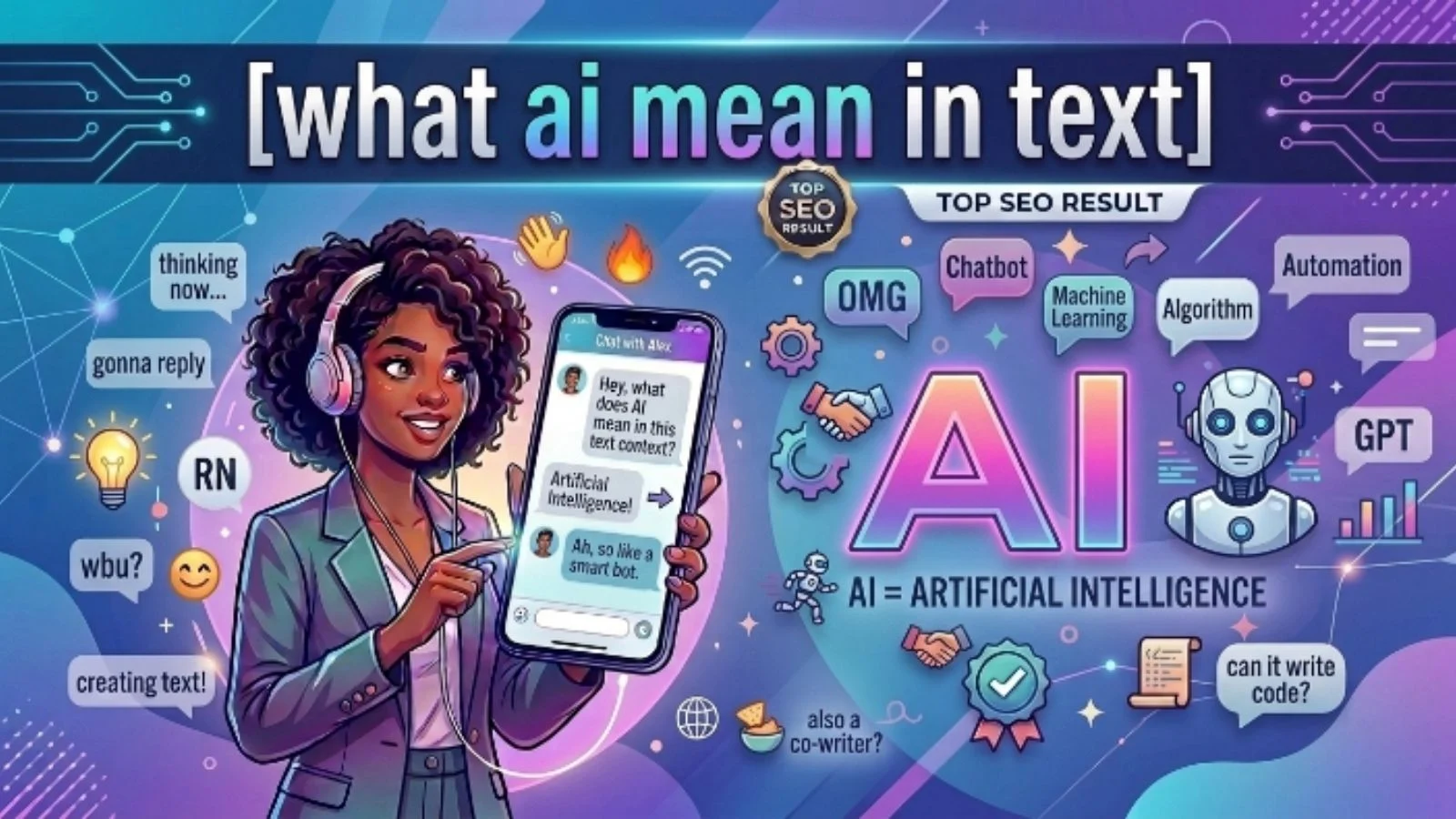
In text messages, AI most commonly means “artificial intelligence.”
Artificial intelligence refers to computer systems or software that can perform tasks that normally require human intelligence, such as answering questions, recognizing images, translating languages, or generating content.
For example:
“I asked AI to help me write this message.”
Here, AI clearly means artificial intelligence.
However, the exact meaning can depend on the conversation. If someone uses “AI” in a casual message without discussing technology, you should look at the surrounding words before deciding what they mean.
AI Meaning in Simple Words
The simplest meaning of AI in texting is “artificial intelligence.”
People use the abbreviation because it is much quicker to type AI than the full phrase.
Think of it like other common abbreviations:
- AI = Artificial Intelligence
- IDK = I Don’t Know
- BTW = By The Way
- TBH = To Be Honest
- IMO = In My Opinion
Unlike many texting abbreviations, however, AI is not only slang. It is also a standard abbreviation used in technology, education, business, social media, and everyday conversations.
Where Is AI Used in Texting?
You may see AI almost anywhere people communicate online.
1. Text Messages
Friends may mention AI while talking about technology or something they have seen online.
Example:
“AI is getting crazy good at writing.”
The person is talking about artificial intelligence.
2. Social Media
AI appears frequently in posts, comments, captions, and discussions on platforms such as Instagram, TikTok, Facebook, X, Reddit, and other social networks.
Example:
“Was this picture made with AI?”
Here, the person is asking whether artificial intelligence was used to create the image.
3. Group Chats
People may discuss AI when sharing interesting websites, pictures, videos, or new technology.
Example:
“Has anyone tried that new AI app?”
The sender is referring to an application that uses artificial intelligence.
4. Online Communities
Technology, gaming, education, business, and creative communities often use “AI” as a normal abbreviation.
Example:
“The game uses AI for the enemies.”
In this case, AI refers to artificial intelligence controlling or influencing the behavior of characters in a game.
5. Casual Conversations
Even people who are not technology experts may use AI in everyday conversations.
Example:
“I used AI to translate the paragraph.”
The meaning is still artificial intelligence.
Why Do People Use AI in Text?
There are several reasons people use AI instead of writing the full phrase.
It Is Short and Easy
“Artificial intelligence” takes considerably longer to type than two simple letters.
Instead of:
“I think artificial intelligence is changing everything.”
Someone can simply write:
“I think AI is changing everything.”
It Is Widely Recognized
AI has become a common term in everyday language. Most people understand that it refers to artificial intelligence when the conversation involves technology.
It Makes Messages More Natural
In conversations about technology, using “AI” sounds more natural than repeatedly writing “artificial intelligence.”
It Saves Time
Texting is usually fast and informal. Short terms make communication quicker.
Real-Life Examples of AI in Text
The best way to understand what AI means in text is to see how people actually use it.
Example 1
Person A: “How did you make that picture?”
Person B: “I used AI.”
Meaning: Person B used artificial intelligence to create or modify the picture.
Example 2
Person A: “Can AI really write essays?”
Person B: “Yes, it can help generate text.”
Meaning: The conversation is about artificial intelligence and its ability to produce written content.
Example 3
“This video looks like AI.”
Meaning: The sender believes artificial intelligence may have been used to create or alter the video.
Example 4
“I asked AI for some ideas.”
Meaning: The person used an artificial intelligence system to generate suggestions.
Example 5
“Do you think AI will change jobs?”
Meaning: The person is discussing how artificial intelligence could affect employment or workplaces.
Example 6
“That voice sounds like AI.”
Meaning: The speaker thinks the voice may have been generated or modified using artificial intelligence.
What Does AI Mean in a Text From a Friend?
If a friend simply sends:
“AI”
the meaning is not always obvious.
It could be:
- A reference to artificial intelligence
- A response related to something previously discussed
- A typo
- A context-specific abbreviation
The surrounding conversation matters.
For example, if you were discussing a computer-generated image and your friend replies:
“AI”
they probably mean artificial intelligence.
But if the conversation has nothing to do with technology, you should not automatically assume that meaning.
AI vs. Similar Terms
Several terms can appear similar to AI, but they do not mean exactly the same thing.
| Term | Meaning | Common Use |
|---|---|---|
| AI | Artificial Intelligence | General technology discussions |
| Bot | Automated software that performs tasks | Chat, gaming, social media |
| ML | Machine Learning | A field related to AI |
| Chatbot | Software designed to communicate with users | Customer service and conversations |
| Automation | Using technology to perform tasks automatically | Business and everyday tasks |
| Algorithm | A set of instructions used to solve a problem or process information | Software, websites, apps |
AI vs. Bot
A bot is a type of software designed to perform automated actions.
AI is a broader concept.
For example, a chatbot may use AI to understand and respond to messages, but not every bot necessarily uses advanced AI.
AI vs. ML
ML means machine learning.
Machine learning is a major area within artificial intelligence where systems learn patterns from data.
So, while AI and ML are related, they are not exactly interchangeable.
AI vs. Automation
Automation means having technology perform a task automatically.
AI can be used for automation, but automation does not always require artificial intelligence.
For example, an automatic email reminder can be simple automation without being an AI system.
When Should You Use AI in a Text?
You can use AI when the conversation is clearly about artificial intelligence or related technology.
It works naturally when discussing:
- Computer-generated images
- AI writing
- Chatbots
- Machine learning
- Voice generation
- Translation
- Recommendation systems
- Technology trends
- AI-powered apps
- Gaming systems
- Automated tools
For example:
“I think AI is going to change how people work.”
That is a perfectly natural use.
You can also use it casually with friends if they already understand the topic.
When Should You Avoid Using AI?
Although AI is widely understood, you may want to spell it out in more formal situations when your audience may not know what it means.
For example, in a formal document, you could write:
“Artificial intelligence (AI) is becoming increasingly important.”
After introducing the full term once, you can use AI throughout the rest of the document.
In casual texting, however, simply saying “AI” is usually enough.
Common Misunderstandings About AI in Text
Misunderstanding 1: AI Always Means Artificial Intelligence
Usually, yes, especially in technology-related conversations. But context still matters.
If the conversation is unrelated to technology, consider whether the person might be using the letters differently.
Misunderstanding 2: AI Is Just Internet Slang
Not exactly.
AI is a widely accepted abbreviation for artificial intelligence. It is used in casual texts, professional conversations, academic writing, news, and technology discussions.
Misunderstanding 3: AI and Bots Mean the Same Thing
They do not.
A bot is software that carries out automated tasks. AI is a broader concept involving systems that can perform tasks associated with human intelligence.
Misunderstanding 4: AI Always Means Something Negative
Not necessarily.
People may use AI neutrally or positively when discussing helpful applications, creative work, education, business, accessibility, or productivity.
The tone depends on the message.
For example:
“AI helped me understand this topic.”
This is positive.
But:
“That entire video is obviously AI.”
could be skeptical or critical.
How to Understand AI From Context
If someone sends a message containing “AI” and you are unsure what they mean, look at the conversation around it.
Ask yourself:
- Are we talking about technology?
- Did they mention computers, images, writing, or apps?
- Are they discussing something generated or automated?
- Does the sentence make sense if AI means artificial intelligence?
- Could AI have another meaning in this particular conversation?
Context usually gives you the answer.
Pro Tips for Understanding AI in Text
Pay Attention to the Topic
If the conversation involves technology, “AI” almost certainly refers to artificial intelligence.
Look at the Words Around It
Compare:
“AI made this image.”
with:
“I don’t know what AI means here.”
The surrounding language helps clarify the intended meaning.
Don’t Assume Every Short Message Is Slang
Some abbreviations, such as AI, are standard terms rather than internet slang.
Ask If You Are Unsure
There is nothing wrong with asking:
“What do you mean by AI?”
A quick question can prevent confusion, especially when the context is unclear.
Is AI a Slang Word?
AI is generally not considered traditional texting slang.
It is better described as an abbreviation or initialism for “artificial intelligence.”
People may use it casually in texts and social media, but the term itself is also widely used in formal and professional settings.
That makes AI different from highly informal expressions such as “LOL,” “BRB,” or “IDK.”
Does AI Have Different Meanings on Social Media?
The most common social media meaning remains artificial intelligence.
You may encounter it in conversations about:
- AI-generated photos
- AI-generated videos
- AI-generated voices
- Chatbots
- Digital art
- Technology news
- Online privacy
- Content creation
- Education
- Gaming
However, unusual abbreviations can sometimes have niche meanings within particular communities. When that happens, context is especially important.
Frequently Asked Questions
What does AI mean in text messages?
AI usually means “artificial intelligence” in text messages. It refers to computer systems or software designed to perform tasks that normally require human-like intelligence.
Is AI texting slang?
Not exactly. AI is a common abbreviation for artificial intelligence, rather than traditional internet slang. It is used in both casual conversations and formal discussions.
What does AI mean on social media?
On social media, AI usually means artificial intelligence. People commonly use it when discussing generated images, videos, voices, chatbots, or other technology.
What should I do if I don’t understand AI in a message?
Check the surrounding conversation first. If the meaning is still unclear, simply ask the sender what they mean. Context is the best way to determine whether “AI” refers to artificial intelligence or something else.
Final Thoughts
So, what does AI mean in text? In most cases, it means artificial intelligence.
You will commonly see it in conversations about technology, generated content, chatbots, apps, gaming, social media, and digital tools. Unlike many texting abbreviations, AI is not simply internet slang. It is a widely recognized term used in both casual and professional communication.
The key is context. If someone says, “AI made this picture,” they are clearly talking about artificial intelligence. If the conversation is unrelated to technology, take a moment to consider whether the letters could have another meaning.
When in doubt, look at the surrounding message or ask the sender. A little context can make the meaning completely clear.