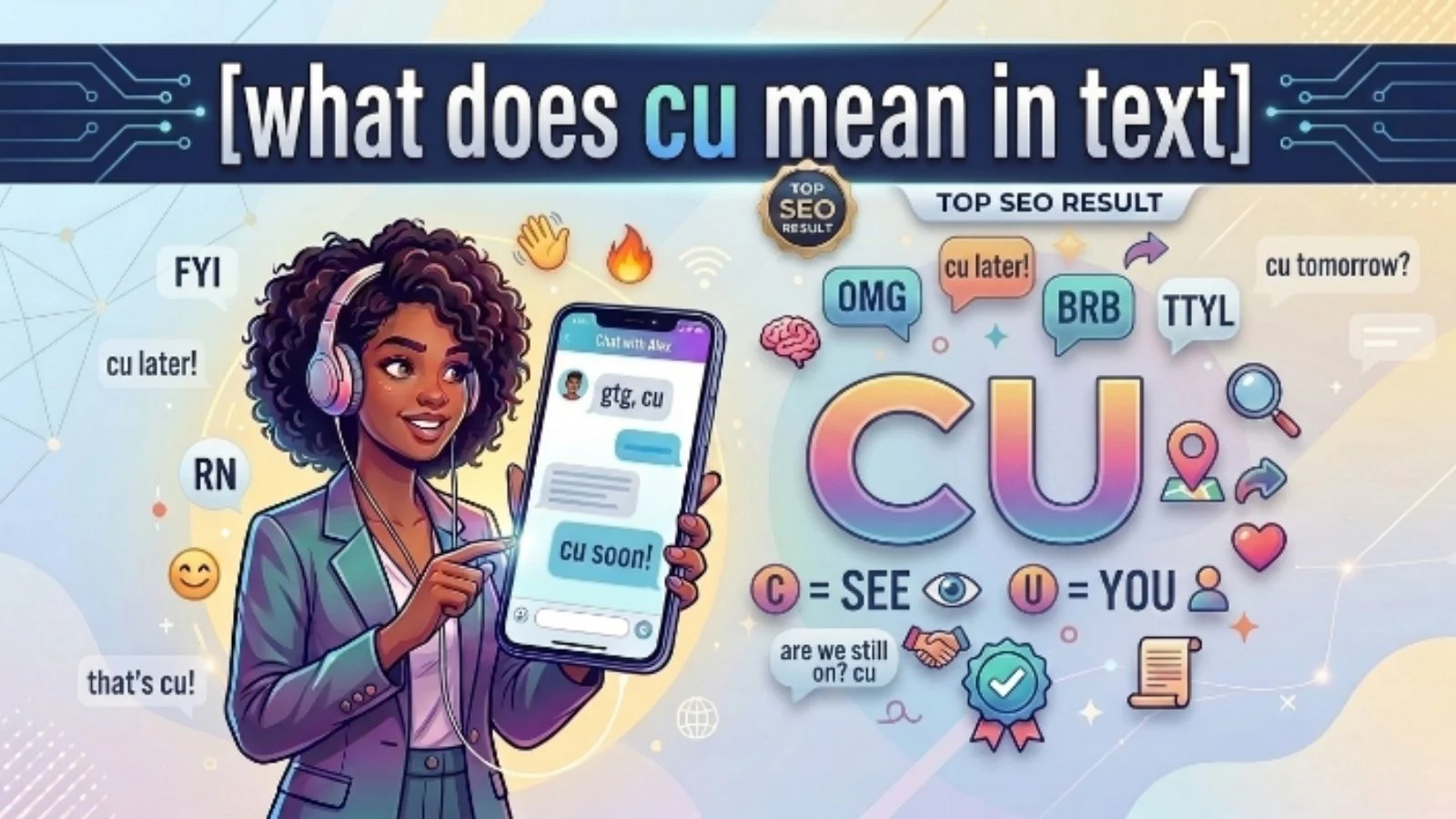
Have you ever received a text that simply says “CU later” or “CU tomorrow” and wondered what those two letters actually mean?
You are not alone. Texting has made communication faster, and people often replace entire words with short forms. “CU” is one of the classic texting abbreviations that can look confusing if you have never seen it before.
The good news is that its meaning is very simple. In most casual conversations, CU means “see you.” It is commonly used when someone is saying goodbye or talking about meeting or talking again later.
In this guide, you will learn exactly what CU means in text, how people use it, what it means in different situations, and how it compares with similar abbreviations.
What Does CU Mean in Text?
CU means “see you” in text messages, chats, and online conversations.
It is a shortened version of the phrase “see you,” where “C” sounds like “see” and “U” sounds like “you.”
For example:
“CU tomorrow!”
This means:
“See you tomorrow!”
The abbreviation is usually casual and friendly. You may see it when someone is ending a conversation, saying goodbye, or referring to seeing another person in the future.
Quick Definition
CU = See You
It is generally used in informal texting and online communication to say goodbye or indicate that you will see or talk to someone again.
What Is the Simple Meaning of CU?
The simplest meaning of CU is “see you.”
Think of it as a faster way to type the same phrase. Instead of writing:
“Okay, see you later!”
Someone might write:
“Ok, CU later!”
The meaning does not really change. The difference is simply that the second version is shorter and more casual.
Depending on the context, CU can refer to seeing someone physically or simply talking to them again.
For example:
“CU at school tomorrow.”
This normally means the person expects to see you at school.
“CU online tonight.”
This can mean the person expects to see or chat with you online later.
“Okay, CU!”
This is simply a casual way to say goodbye.
Where Is CU Used?
You can find CU in many forms of informal digital communication.
Common places include:
- Text messages
- Facebook Messenger
- Instagram DMs
- Snapchat
- Discord
- Online gaming chats
- Group chats
- Casual emails
- Social media comments
It is most appropriate when people are already communicating casually.
You are less likely to see CU in formal business communication, academic writing, official documents, or professional correspondence.
For example, sending your manager:
“CU later!”
may sound overly casual.
A more professional option would be:
“See you later.”
Why Do People Use CU?
There is one obvious reason: it saves time.
Texting abbreviations became popular because people wanted to communicate quickly, especially when mobile keyboards were less convenient than they are today.
CU is also easy to understand because it relies on the sound of the letters.
C = see
U = you
Together:
CU = see you
People may also use it because it feels relaxed and friendly.
It Makes Messages Shorter
Instead of:
“I have to go now. See you tomorrow.”
Someone might write:
“Gotta go. CU tomorrow.”
The message communicates the same basic idea with fewer characters.
It Creates a Casual Tone
“See you later” sounds completely normal, while “CU later” can feel more playful or informal.
That makes it useful among friends, family members, classmates, gaming friends, and other people who already have a relaxed relationship.
Real-Life Examples of CU in Text
Understanding examples is one of the easiest ways to learn texting slang.
Example 1: Saying Goodbye
Person A: I need to finish my homework.
Person B: Okay, CU later!
Meaning: Person B is saying, “Okay, see you later.”
The person is ending the conversation but expects to communicate or meet again later.
Example 2: Meeting Tomorrow
Person A: Are you coming to school tomorrow?
Person B: Yeah, CU tomorrow.
Meaning: “Yes, see you tomorrow.”
Here, CU refers to physically seeing the other person the next day.
Example 3: Online Conversation
Person A: I’m logging off now.
Person B: Alright, CU tonight.
Meaning: “Alright, see you tonight.”
The phrase could mean meeting online or continuing the conversation later.
Example 4: After Making Plans
Person A: I’ll meet you outside the restaurant at 8.
Person B: Sounds good. CU then!
Meaning: “Sounds good. See you then!”
This is a natural way to confirm plans in a casual conversation.
Example 5: Short Goodbye
Person A: I have to go.
Person B: CU!
Meaning: “See you!”
The person is simply saying goodbye.
CU vs Similar Texting Terms
Several texting abbreviations can have similar meanings. However, they are not always interchangeable.
| Text Term | Meaning | Typical Use |
|---|---|---|
| CU | See you | Casual goodbye or future meeting |
| CYA | See ya / see you | Casual goodbye |
| TTYL | Talk to you later | Ending a conversation |
| GTG | Got to go | Saying you need to leave |
| BBL | Be back later | Saying you will return later |
| L8R | Later | Casual way to say goodbye |
| SYL | See you later | Saying goodbye until later |
CU vs CYA
CU and CYA can both mean “see you.”
For example:
“CU tomorrow.”
and:
“CYA tomorrow.”
Both communicate a similar idea.
However, CYA can sometimes be interpreted differently depending on context, so CU is often more straightforward.
CU vs TTYL
These are close but not identical.
CU = See you.
TTYL = Talk to you later.
If you are physically meeting someone later, CU can be particularly natural.
If you are ending an online conversation and expect to message again, TTYL may fit better.
CU vs GTG
GTG means “got to go.”
It focuses on leaving the current conversation.
CU focuses more on seeing or communicating with the person again.
You can even combine them:
“GTG, CU tomorrow!”
This means:
“Got to go, see you tomorrow!”
When Should You Use CU?
You can use CU when the conversation is informal and you want to say goodbye or refer to seeing someone again.
It works especially well with:
- Close friends
- Family members
- Classmates
- Gaming friends
- Online friends
- Casual group chats
- People who already use texting slang
For example:
“I’m heading home now. CU tomorrow!”
is perfectly natural in a casual conversation.
When You Should Avoid CU
There are situations where writing the full phrase is better.
Avoid CU in:
- Formal business emails
- Job applications
- Cover letters
- Academic assignments
- Official letters
- Professional reports
- Formal customer communication
Instead of:
“CU next week.”
write:
“See you next week.”
The full phrase sounds more polished and professional.
Is CU Rude?
No, CU is not normally rude.
It is simply an informal abbreviation.
However, tone always depends on the conversation.
For example:
“CU.”
could sound very brief if someone normally writes longer messages.
But:
“Thanks for everything! CU tomorrow!”
sounds warm and friendly.
The surrounding words, punctuation, and relationship between the people can change how a short message feels.
Does CU Always Mean “See You”?
Not necessarily.
Context matters because CU can have other meanings outside ordinary texting slang.
For example, in certain professional, educational, technical, or organizational contexts, CU could represent something completely different.
However, when you see CU in a casual text message, especially near words such as “later,” “tomorrow,” “soon,” or “then,” “see you” is usually the intended meaning.
Consider:
“CU later.”
There is very little ambiguity here. It almost certainly means:
“See you later.”
But if someone simply writes:
“CU”
without any surrounding context, you may need to look at the rest of the conversation to determine what they mean.
Common Misunderstandings About CU
1. Thinking CU Is a Typo
Some people initially think “CU” is a typing mistake.
It usually is not.
In casual texting, it is an intentional abbreviation based on how the letters sound.
2. Assuming It Is Always Romantic
CU is not inherently romantic.
A friend can say:
“CU tomorrow!”
A sibling can say:
“CU later!”
A classmate can say:
“CU at school.”
The abbreviation itself does not indicate romantic interest.
The relationship and surrounding conversation provide that context.
3. Thinking CU Means “Call You”
This is another possible misunderstanding.
If someone writes:
“CU later.”
they almost certainly mean “see you later,” not “call you later.”
For “call you later,” people generally write CYL or simply spell out the phrase.
4. Assuming It Is Only Used for Face-to-Face Meetings
Not always.
Someone might say:
“CU tonight.”
while talking about meeting in an online game or joining a video call.
The basic idea is still “see you,” but the meeting does not necessarily have to be physical.
Pro Tips for Understanding CU
Look at the Words Around It
Context is the best clue.
If you see:
“CU tomorrow”
the meaning is almost certainly “see you tomorrow.”
If you see:
“CU at 7”
it likely means “see you at 7.”
Consider the Relationship
If a close friend uses CU, it is probably casual slang.
If a professional contact uses it, they may simply have a very informal communication style.
Look at the Conversation Tone
If the entire conversation contains abbreviations such as LOL, BTW, IDK, TTYL, and CU, then CU is clearly being used as casual texting shorthand.
Do Not Overthink It
One of the biggest mistakes people make with texting abbreviations is searching for a hidden meaning when there isn’t one.
In most everyday conversations:
CU simply means “see you.”
How to Reply When Someone Says CU
You do not need a special response.
You can respond naturally with:
- “CU!”
- “See you!”
- “See you later!”
- “Yep, CU tomorrow!”
- “Sounds good!”
- “Later!”
- “Talk soon!”
Choose your response based on how casual the conversation is.
If someone writes:
“CU tomorrow!”
you could simply reply:
“See you tomorrow!”
There is no need to use another abbreviation unless that matches your normal texting style.
Is CU Still Common Today?
CU is an older but still recognizable texting abbreviation.
Modern messaging has changed considerably, and many people now type complete words because smartphone keyboards, predictive text, voice typing, and messaging apps make it easier.
Still, abbreviations such as CU can appear in casual conversations, social media, gaming, and messages between friends.
Its meaning remains easy to understand because it is based on the pronunciation of the letters.
Frequently Asked Questions
What does CU mean in a text message?
CU usually means “see you.” It is a casual texting abbreviation commonly used when saying goodbye or talking about seeing someone later.
What does CU mean from a girl or guy?
If a girl or guy texts you “CU,” it generally means “see you.” By itself, it does not indicate flirting or romantic interest. The surrounding conversation provides the real context.
Is CU the same as “see you later”?
Not exactly.
CU means “see you,” while CU later means “see you later.” The abbreviation can be combined with other words to create a longer phrase.
Can I use CU in a professional message?
It is better to avoid it in formal or professional communication. Write “see you” instead unless you already have a very casual relationship with the recipient.
Final Thoughts
So, what does CU mean in text?
In most casual conversations, CU means “see you.” It is a short, informal abbreviation created from the sounds of the words “see” and “you.”
You may see it in messages such as “CU later,” “CU tomorrow,” or “CU then.” The meaning is usually straightforward: the person is saying goodbye while suggesting that you will meet or communicate again.
The most important thing is context. CU is generally friendly, casual, and not automatically romantic. Use it with people who are comfortable with informal texting, but choose “see you” in professional or formal situations.
Once you know this simple abbreviation, a message like “CU tomorrow” becomes easy to understand: “See you tomorrow.”