
Education has always tried to balance two competing needs: teaching large groups efficiently while still giving individual students the attention they need. For generations, that balance has been difficult to achieve. A teacher may have thirty students in a classroom, each with different strengths, weaknesses, interests, and learning speeds.
Artificial intelligence is beginning to change that equation.
With AI-powered learning tools becoming available on smartphones, tablets, and laptops, students can now carry something that resembles a personal tutor almost everywhere they go. These systems can explain difficult concepts, generate practice questions, adjust lessons based on performance, and provide feedback within seconds.
The result is a new educational frontier where personalized learning may no longer be limited to students who can afford private tutoring.
From One-Size-Fits-All to Individual Learning Paths
Traditional classrooms usually follow a shared curriculum and timetable. Everyone studies the same chapter, completes similar assignments, and moves to the next topic at roughly the same time.
The problem is that students rarely learn at the same pace.
One learner may understand fractions immediately but struggle with geometry. Another may excel at writing essays while having difficulty remembering vocabulary. In a traditional setting, teachers often have limited time to provide completely different learning experiences for every student.
AI tutoring systems can respond differently.
They can analyze how a learner answers questions, identify patterns of mistakes, and adjust the difficulty or type of explanation accordingly. A student who understands a topic quickly can move forward, while someone who needs additional support can receive extra examples and practice.
This creates a more flexible learning path rather than forcing every student through the same sequence at exactly the same speed.
Instant Help When Students Get Stuck
One of the biggest advantages of an AI tutor is availability.
Students do not always encounter difficulties during school hours. Confusion can appear while completing homework late in the evening, revising before an exam, or working independently during the weekend.
An AI learning assistant can provide immediate guidance.
A student might ask why a mathematical formula works, request a simpler explanation of photosynthesis, or ask for help understanding the structure of a history essay. Instead of simply providing an answer, well-designed educational AI can break the problem into smaller steps.
That immediate feedback can prevent small misunderstandings from becoming larger learning gaps.
It also allows students to ask the same question several times without worrying about embarrassment or feeling that they are slowing down the rest of the class.
Different Explanations for Different Learners
Students often struggle not because a subject is impossible, but because the explanation does not match how they understand information.
One student may prefer a short definition. Another may need a real-world example. A third might understand better through a comparison, diagram, story, or step-by-step process.
AI systems can potentially provide all of these approaches.
For example, a student struggling with electricity could ask for the concept to be explained using household appliances. Another could request an explanation suitable for a ten-year-old. Someone preparing for an advanced examination could ask for a more technical version.
This ability to reshape explanations quickly gives learners more ways to approach difficult subjects.
Turning Practice Into Personalized Feedback
Practice is an essential part of learning, but traditional worksheets often provide the same questions to everyone.
AI tutoring platforms can create practice activities based on individual performance.
If a learner repeatedly struggles with a specific type of algebra problem, the system can generate similar questions until the concept becomes clearer. When the learner improves, the difficulty can gradually increase.
The feedback can also become more detailed.
Instead of simply showing that an answer is incorrect, an AI tutor may explain where the reasoning went wrong and suggest which concept the learner should review.
This creates a continuous cycle:
Learn, practice, receive feedback, adjust, and try again.
That process can make study sessions more focused and efficient.
The Changing Role of Teachers
The rise of AI tutors does not necessarily mean replacing teachers.
In many cases, the technology may make teachers even more important.
Teaching involves far more than delivering information. Teachers motivate students, understand emotional challenges, manage classroom relationships, encourage curiosity, and recognize problems that technology may overlook.
AI can assist with repetitive or highly individualized tasks while teachers focus on areas that require human judgment.
For example, an AI system might help students practice grammar or multiplication independently. The teacher can then spend more time discussing ideas, supporting struggling learners, organizing collaborative projects, or providing deeper feedback.
The classroom could gradually move from a model where teachers primarily deliver information toward one where teachers guide students through learning experiences.
Learning Beyond the Classroom
Portable AI tutors could also expand where education happens.
A student reading a science article on a bus could instantly ask for unfamiliar terms to be explained. Someone visiting a museum could ask an AI assistant questions about an exhibit. A learner practicing a foreign language could have interactive conversations at home.
Education becomes less dependent on a particular location or schedule.
This could be especially valuable for independent learners, homeschooling families, adult students, and people studying in regions where access to specialized teachers is limited.
However, the benefits depend heavily on access to reliable devices and internet connectivity.
The Digital Divide Still Matters
AI tutoring has the potential to make personalized education more accessible, but it could also create new inequalities.
Students with modern devices, fast internet connections, and premium educational platforms may receive advanced learning support. Others may have limited access or no access at all.
Schools and governments therefore face an important challenge.
If AI becomes a significant part of education, access must not depend entirely on family income.
Affordable devices, reliable school connectivity, public digital resources, and accessible educational software may become increasingly important parts of educational infrastructure.
Without thoughtful planning, personalized learning technology could widen the gap between students instead of reducing it.
Accuracy Cannot Be Taken for Granted
AI systems can produce impressive explanations, but they can also make mistakes.
A confident-sounding answer is not always a correct answer.
This is particularly important in education because students may not yet have enough knowledge to recognize inaccurate information.
AI tutors therefore need strong safeguards, reliable educational sources, and systems for checking important information. Students should also learn how to question AI-generated answers rather than treating technology as an unquestionable authority.
Digital literacy will increasingly include knowing how to verify information produced by artificial intelligence.
The Risk of Becoming Too Dependent on AI
Convenience can create another challenge.
If students use AI to solve every difficult problem immediately, they may avoid the productive struggle that helps build deeper understanding.
Learning sometimes requires uncertainty, experimentation, and persistence.
A good AI tutor should therefore guide rather than simply complete tasks.
Instead of writing an entire essay when a student is struggling, it might ask questions that help the learner develop an argument. Instead of immediately solving a mathematics problem, it might provide a hint and allow the student to attempt the next step.
The best educational AI will encourage thinking rather than replace it.
Privacy in Personalized Learning
Personalization depends on data.
An AI tutor may learn which subjects a student struggles with, how quickly they answer questions, what types of mistakes they make, and which learning strategies appear most effective.
That information can be educationally useful, but it also raises privacy concerns.
Schools, parents, technology companies, and regulators must consider how student data is collected, stored, shared, and protected.
Children’s educational records are particularly sensitive.
Clear privacy policies, limited data collection, strong security measures, and transparent parental controls will become increasingly important as AI enters classrooms.
AI Tutors and Academic Integrity
Schools are already debating how students should use generative AI for assignments.
The difference between tutoring and cheating is not always obvious.
Using AI to explain a difficult concept can support learning. Asking it to complete an entire assignment and submitting the result as original work can undermine education.
Schools may need to redesign assessments.
More emphasis could be placed on classroom discussions, presentations, project work, personal reflection, and demonstrations of understanding rather than assignments that can easily be completed automatically.
Students will also need clear guidance about acceptable AI use.
The goal should not necessarily be to ban the technology, but to teach students how to use it responsibly.
A More Inclusive Learning Environment
AI tutoring may also help students with different learning needs.
Text can be simplified, translated, summarized, or read aloud. Instructions can be broken into smaller steps. Learners can repeat lessons without pressure.
Students learning a new language may receive explanations in both their native language and the language they are studying.
Those who need additional practice can receive it privately without feeling singled out.
When thoughtfully designed, AI tools could make learning environments more flexible and inclusive.
Education Becomes More Adaptive
Traditional textbooks remain largely unchanged once printed.
AI-powered learning environments can respond continuously.
If a student masters a concept quickly, the next activity can become more challenging. If performance suddenly drops, the system can return to earlier concepts.
Over time, these platforms could build detailed learning profiles that help students and teachers understand progress.
A dashboard might show that a learner is strong in mathematical calculation but weak in interpreting word problems. Another student may have excellent historical knowledge but struggle to organize written arguments.
These insights can help teachers target support more effectively.
Curiosity Could Become the New Classroom Engine
Perhaps the most interesting possibility is what happens when students can ask unlimited questions.
In traditional classrooms, time is limited.
A curious student may have five questions after a lesson, but the teacher may only have time to answer one.
AI removes much of that limitation.
A student learning about space could begin with a question about Mars, move to gravity, then ask about black holes, spacecraft engineering, and the possibility of life beyond Earth.
Learning becomes more exploratory.
Instead of education being limited to what appears on the next page of a textbook, curiosity can guide students toward deeper investigation.
Human Connection Will Still Matter
Technology can personalize information, but education is also social.
Students learn through collaboration, discussion, competition, friendship, disagreement, and shared experiences.
A digital tutor cannot fully reproduce the encouragement of a trusted teacher, the excitement of a classroom experiment, or the creativity that emerges from students working together.
The strongest educational model may therefore combine both worlds.
AI handles personalized explanations, practice, and feedback.
Teachers provide mentorship, judgment, inspiration, and human connection.
Classmates provide collaboration and community.
Together, these elements could create a more flexible learning environment than any one of them could provide alone.
Preparing Students for an AI-Powered Future
AI tutors will not only change how students learn. They may also change what students need to learn.
Future workers will likely interact with intelligent systems across many industries.
Students will need skills such as critical thinking, problem solving, creativity, communication, information verification, and responsible AI use.
Memorizing facts will still have value, but knowing how to evaluate information may become even more important.
The ability to ask good questions could become one of the most valuable educational skills.
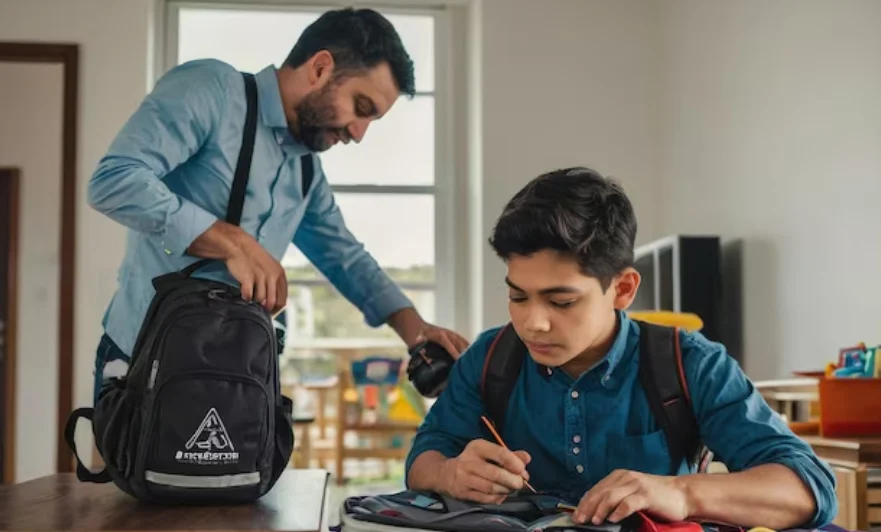
The Backpack of the Future
The traditional school backpack contains textbooks, notebooks, pens, calculators, and perhaps a laptop or tablet.
The backpack of the future may also contain a permanent digital learning companion.
It could help explain homework, practice languages, prepare for tests, explore new subjects, and identify areas that need improvement.
For students, the experience could feel less like using ordinary software and more like having a patient tutor available whenever curiosity or confusion appears.
Yet the success of this transformation will depend on how responsibly the technology is introduced.
Accuracy, privacy, access, academic integrity, and human involvement all matter.
Conclusion
Artificial intelligence is opening one of the most significant new chapters in personalized education.
For the first time, millions of students could potentially have access to individualized explanations, adaptive practice, and immediate feedback wherever they carry a connected device.
But technology alone will not create better education.
The real opportunity lies in combining AI’s speed and adaptability with the experience, empathy, creativity, and judgment of human teachers.
If that balance is achieved, the AI tutor in every backpack may become more than a convenient digital assistant. It could help create an education system where learning adapts to the student rather than expecting every student to adapt to the same learning path.
Read More : How to Build a Balanced Lifestyle for Better Physical and Mental Wellness



Pingback: Learning in the Wild: Why Outdoor Classrooms Are Making a Comeback
Pingback: The Future of Cloud-Based Software and Its Benefits for Growing Companies