Have you ever received a text that simply says “OIC” and wondered what the person actually meant?
Short texting abbreviations can be confusing, especially when someone sends only a few letters. The good news is that OIC is usually very easy to understand once you know the context.
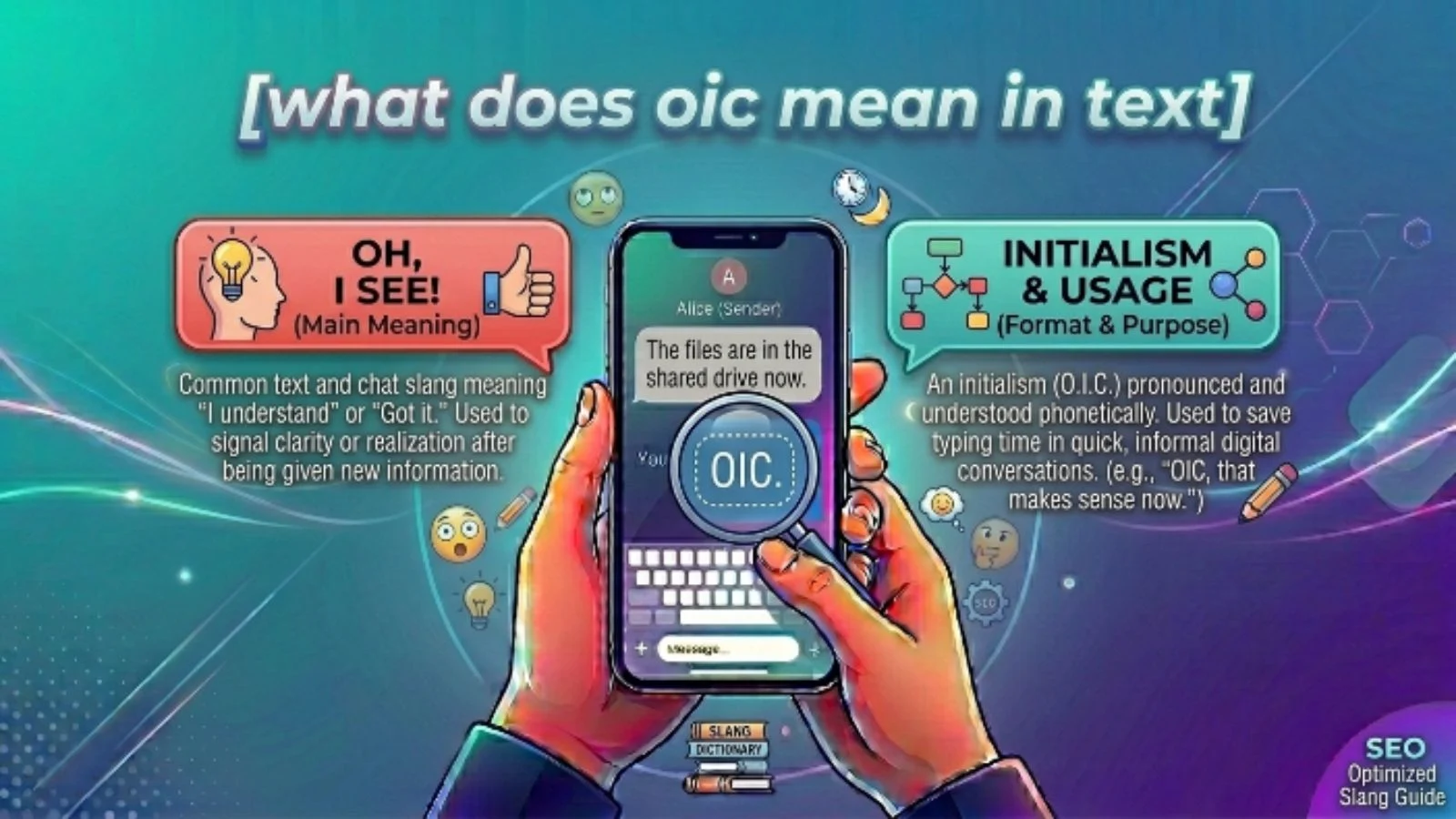
In texting, OIC most commonly means “Oh, I see.” People use it to show that they understand, acknowledge, or have just realized something.
But there is more to this abbreviation than its basic definition. The tone can change depending on the conversation, punctuation, and relationship between the people texting.
In this guide, you will learn exactly what OIC means in text, how people use it, what it sounds like in different situations, and when you should use it yourself.
What Does OIC Mean in Text?
OIC means “Oh, I see” in text messages and online conversations.
It is an informal abbreviation used when someone understands new information, realizes something, or acknowledges what another person has said.
For example:
Person 1: “I can’t come tonight because I have to work.”
Person 2: “OIC. No problem.”
Here, OIC simply means “Oh, I see.” The person understands the reason.
OIC Meaning at a Glance
| Abbreviation | Meaning | Common Use |
|---|---|---|
| OIC | Oh, I see | Understanding or acknowledgment |
| OIC! | Oh, I see! | Stronger realization |
| oic | Oh, I see | Casual texting |
| OIC? | Oh, I see? | Usually depends on context |
The abbreviation is generally casual and is most appropriate for texting, social media, chats, and informal conversations.
What Does “Oh, I See” Mean?
The phrase “Oh, I see” is commonly used when someone has just understood something that was previously unclear.
Imagine your friend tells you:
“I wasn’t ignoring you. My phone battery died.”
You might reply:
“OIC.”
You are essentially saying:
“Oh, I understand now.”
So, when someone sends OIC, they are often acknowledging information rather than asking a question.
Simple Meaning of OIC
In very simple English, OIC means: “I understand now.”
It can communicate several closely related ideas, such as:
- I understand.
- Now I get it.
- Oh, that makes sense.
- I didn’t know that.
- Now I understand what you mean.
- Okay, I see what happened.
The exact feeling depends on the conversation.
Sometimes OIC sounds friendly and interested. In other situations, it can sound short, neutral, or even slightly dismissive.
Where Is OIC Used?
You may see OIC in many types of informal online communication.
Text Messages
Friends and family members may use OIC when they are responding quickly to an explanation.
Example:
“The meeting was moved to Friday.”
“OIC, thanks for telling me.”
Here, the sender is simply acknowledging the update.
Social Media
OIC can appear in comments, direct messages, and replies on social platforms.
For example:
“I thought you lived in Lahore.”
“I moved last year.”
“OIC.”
The person has understood the new information.
Online Chats
Gamers, online communities, and casual chat groups may use OIC because abbreviations save time.
Example:
“You need to click the blue button first.”
“OIC, I was clicking the wrong one.”
Here, OIC indicates that the person has finally understood the instructions.
Dating and Personal Conversations
OIC can also appear in romantic or personal chats.
Example:
“I didn’t reply because I was with my family.”
“OIC.”
In this situation, the meaning is still “Oh, I see,” but the emotional tone depends heavily on the surrounding conversation.
Why Do People Use OIC?
People use texting abbreviations because they make communication faster and more casual.
Instead of typing:
“Oh, I see. Now I understand what you mean.”
Someone can simply write:
“OIC.”
Some common reasons people use it include:
- Saving time
- Keeping conversations casual
- Showing understanding
- Acknowledging an explanation
- Reacting quickly to new information
- Making messages shorter
It is especially common when the conversation does not require a long response.
OIC Examples in Real Conversations
Understanding OIC becomes easier when you see it in context.
Example 1: Understanding an Explanation
A: “I couldn’t call you because I was in class.”
B: “OIC. That’s fine.”
Meaning: B now understands why A could not call.
Example 2: Realizing Something
A: “Sarah isn’t coming because she’s traveling today.”
B: “OIC. I thought she was coming.”
Meaning: B has learned something new and now understands the situation.
Example 3: Understanding Instructions
A: “You have to submit the form before Friday.”
B: “OIC, I’ll do it tomorrow.”
Meaning: B understands the requirement.
Example 4: Casual Conversation
A: “I’m working from home today.”
B: “OIC. That’s why I didn’t see you.”
Meaning: B has connected the information and understands why they did not meet.
Example 5: A Short Response
A: “The store closes at 8, not 9.”
B: “OIC.”
Meaning: B acknowledges the correction.
Can OIC Sound Rude?
Yes, OIC can sometimes sound cold or dismissive, but that does not automatically mean the person is being rude.
A short response can be interpreted differently depending on the situation.
Compare these:
“OIC, thanks for explaining.”
This sounds friendly and appreciative.
Now compare:
“OIC.”
This may sound neutral, distant, or uninterested.
The difference is not necessarily the abbreviation itself. It is the context and tone.
If someone sends only “OIC” after a serious or emotional message, you may wonder whether they are annoyed or uninterested.
However, you should not assume that immediately. Some people naturally use short replies.
OIC vs Similar Texting Terms
OIC is similar to several other expressions, but they are not always interchangeable.
| Term | Meaning | Main Difference |
|---|---|---|
| OIC | Oh, I see | Shows understanding or realization |
| I see | I understand | More natural and slightly clearer |
| IK | I know | Shows that you already knew |
| Oh | Reaction or realization | Very broad and context-dependent |
| Got it | I understand | Often clearer and more direct |
| Ah, okay | Understanding or acceptance | Usually sounds more conversational |
| I understand | I understand | More formal and explicit |
OIC vs “I See”
These are almost identical in meaning.
OIC is simply the abbreviated texting version of “Oh, I see.”
For casual messages:
“OIC, thanks.”
For more formal communication:
“I see. Thank you for explaining.”
OIC vs “IK”
These two are easy to confuse.
OIC means:
“Oh, I see.”
IK usually means:
“I know.”
The important difference is that OIC often indicates new understanding, while IK indicates that the person already knew something.
For example:
“The test is tomorrow.”
“OIC.”
The person may have just learned this.
But:
“The test is tomorrow.”
“IK.”
The person already knew it.
When Should You Use OIC?
You can use OIC when you are having a casual conversation and want to show that you understand something.
It works particularly well after:
- An explanation
- A correction
- New information
- A reason for something
- Instructions
- A clarification
- A personal update
For example:
“I couldn’t answer because my phone was charging.”
You can respond:
“OIC, no worries.”
That sounds natural in a casual chat.
When Should You Avoid OIC?
Although OIC is useful in texting, it is not appropriate for every situation.
Avoid it in formal communication, such as:
- Job applications
- Business emails
- Academic assignments
- Professional reports
- Official letters
- Formal customer service messages
Instead of:
“OIC.”
Use:
“I understand.”
or:
“Thank you for clarifying.”
The full phrase sounds more professional and respectful.
How Does OIC Change With Context?
The same abbreviation can communicate slightly different feelings.
Friendly OIC
“OIC, that makes sense.”
This clearly shows understanding.
Neutral OIC
“OIC.”
This simply acknowledges the information.
Surprised OIC
“OIC! I didn’t know that.”
This shows genuine realization.
Slightly Cold OIC
“OIC.”
If the conversation is tense, the same response might feel distant or uninterested.
That is why you should consider the whole conversation instead of interpreting OIC by itself.
Common Misunderstandings About OIC
1. OIC Does Not Usually Mean “I Know”
A common mistake is assuming OIC means the same thing as IK.
It usually does not.
OIC = Oh, I see.
IK = I know.
They communicate different reactions.
2. OIC Is Not Usually a Question
When someone writes OIC, they are generally making a statement rather than asking you something.
They are saying that they understand.
However, punctuation and context can change the interpretation.
3. OIC Does Not Always Mean Agreement
Understanding something does not necessarily mean agreeing with it.
For example:
“I decided to leave the group.”
“OIC.”
The person understands the decision, but they are not necessarily saying they agree with it.
4. OIC Does Not Automatically Mean Someone Is Annoyed
A one-word response can feel cold, but that does not prove the sender is upset.
Some people simply prefer short messages.
Look at the rest of the conversation before deciding what they mean emotionally.
Is OIC Still Used in Texting?
Yes, OIC can still be understood in casual digital communication, although texting habits vary from person to person.
Some people prefer newer or more natural expressions such as:
- “Ohh, I see”
- “I see”
- “Got it”
- “Ah okay”
- “Makes sense”
- “Oh, okay”
You may therefore see OIC less often than some other texting expressions, especially in conversations where people prefer to type naturally.
Still, if someone sends you OIC, the intended meaning is usually clear from context.
OIC in Lowercase: “oic”
You may see the abbreviation written as oic rather than OIC.
There is generally no major difference in meaning.
For example:
“oic, thanks”
and
“OIC, thanks”
both mean:
“Oh, I see, thanks.”
Lowercase letters often make the message feel more casual.
Pro Tips for Using OIC Correctly
If you want your messages to sound natural, keep these tips in mind.
Use It After New Information
OIC works best when someone has just explained something to you.
“The appointment is next Monday.”
“OIC.”
Add a Few Words When You Want to Sound Friendlier
Instead of sending only:
“OIC.”
Try:
“OIC, thanks for explaining.”
This makes your response warmer and reduces the chance that it will sound dismissive.
Don’t Use It in Formal Writing
For professional situations, choose:
“I understand.”
or:
“Thank you for clarifying.”
Consider the Emotional Context
If someone is sharing something serious, simply saying “OIC” may feel too short.
A more thoughtful response might be:
“Oh, I see. I understand now. Thanks for telling me.”
This shows that you are actually engaged in the conversation.
Frequently Asked Questions
What does OIC mean in text messages?
OIC usually means “Oh, I see.” It is used to show that someone understands, realizes something, or acknowledges new information.
Is OIC rude in texting?
Not necessarily. OIC is normally neutral, but sending only “OIC” can sometimes sound short or cold depending on the conversation. Adding words such as “thanks” or “that makes sense” can make it friendlier.
What is the difference between OIC and IK?
OIC means “Oh, I see,” while IK usually means “I know.” OIC often indicates that someone has just understood something, whereas IK suggests they already knew it.
Can I use OIC in professional messages?
It is better to avoid OIC in formal communication. In professional emails or workplace messages, use “I understand,” “Got it,” or “Thank you for clarifying” instead.
Final Thoughts
So, what does OIC mean in text? In most texting and online conversations, it means “Oh, I see.” People use it when they understand an explanation, learn something new, or acknowledge information.
The meaning is simple, but the tone can change with context. A plain “OIC” may sound neutral, while “OIC, that makes sense” sounds warmer and more engaged.
If you receive OIC in a message, you can usually read it as “I understand now” rather than assuming something negative.
For casual conversations, it is a useful and easy abbreviation. For formal situations, however, spelling out the meaning is usually the better choice.