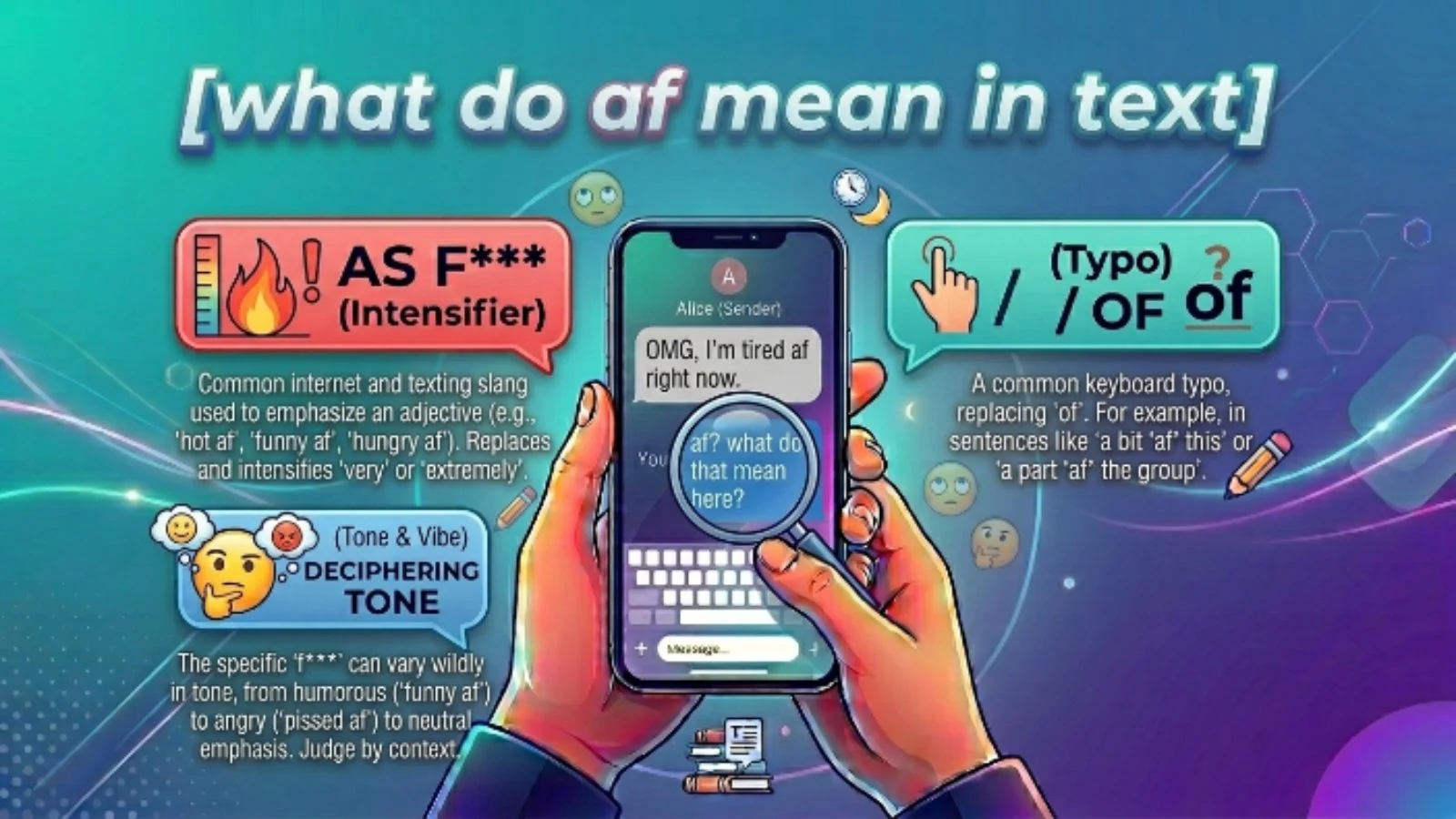
Have you ever received a text like “That movie was funny AF” or “I’m tired AF” and wondered what AF actually means?
You are not alone. AF is one of the most common slang abbreviations used in texting, social media, comments, and online conversations. It is short, casual, and often used to make a statement sound much stronger.
But there is an important detail: AF can be vulgar, depending on the context.
So, what do AF mean in text? What does it stand for, and when is it appropriate to use? Let’s break it down in simple terms.
What Do AF Mean in Text?
In text messages and online slang, AF usually stands for “as f*.”**
It is used after an adjective or description to emphasize how strongly someone feels about something.
For example:
- “I’m tired AF.” means “I’m extremely tired.”
- “That test was hard AF.” means “That test was extremely hard.”
- “She is funny AF.” means “She is extremely funny.”
The word represented by the “F” is a profanity, so AF is considered informal and sometimes offensive slang.
Although the phrase can sound strong, people often use AF casually among friends or online.
AF Meaning in Simple Words
The easiest way to understand AF in texting is:
AF = very, extremely, or really
It adds extra emphasis to the word or idea before it.
For example:
“I’m hungry.”
This simply tells someone that you want food.
“I’m hungry AF.”
This means you are extremely hungry.
The meaning is not usually literal. Instead, AF works as an intensifier, making the statement stronger.
Quick Definition
AF in text means “as f*” and is used as an informal way to emphasize something, usually meaning “very” or “extremely.”**
Because it contains profanity, it is best suited to casual conversations rather than professional or formal communication.
What Does AF Stand For?
AF stands for “as f*.”**
The full phrase contains a swear word, which is why people often write only the initials AF instead.
Using the abbreviation allows people to express strong emphasis without spelling out the profanity.
For example:
- “That food is good AF.”
- “I’m bored AF.”
- “This weather is hot AF.”
- “That was scary AF.”
In each sentence, AF increases the intensity of the description.
Where Is AF Used?
You can find AF across many parts of modern online communication.
Text Messages
Friends may use AF in casual text conversations.
For example:
“I’m sleepy AF. I’m going to bed.”
The speaker means they are very sleepy.
Social Media
AF is frequently used in captions, comments, and posts on social platforms.
Someone might write:
“This outfit is cute AF.”
They are saying that they think the outfit is extremely cute.
Online Chats
AF can also appear in gaming chats, group conversations, forums, and private messages.
For example:
“That boss fight was difficult AF.”
The person means the game was extremely difficult.
Memes and Internet Culture
AF is also common in memes and humorous online posts because it makes descriptions sound exaggerated and expressive.
For example:
“Monday mornings are exhausting AF.”
This gives the sentence a stronger and more humorous tone.
Why Do People Use AF?
People use AF mainly because it makes communication shorter, stronger, and more expressive.
Instead of saying:
“I am extremely tired.”
Someone might simply say:
“I’m tired AF.”
The second version sounds more casual and emotional.
Here are some common reasons people use it.
1. To Add Emphasis
AF makes a description much stronger.
“That was funny.”
is less intense than:
“That was funny AF.”
2. To Sound Casual
AF is strongly associated with informal internet language.
It can make a message sound like something you would naturally say to a close friend.
3. To Express Strong Feelings
People use AF when they want to show excitement, frustration, tiredness, surprise, or another strong emotion.
4. To Keep Messages Short
Texting is often about communicating quickly.
Using AF can replace longer phrases such as “extremely,” “very,” or “incredibly.”
Real-Life Examples of AF in Text
Understanding examples is one of the easiest ways to learn how AF works.
Example 1: “I’m tired AF.”
Meaning: I am extremely tired.
Here, AF emphasizes the person’s level of tiredness.
Example 2: “This coffee is strong AF.”
Meaning: This coffee is extremely strong.
The speaker is emphasizing how strong the coffee tastes.
Example 3: “That movie was scary AF.”
Meaning: That movie was extremely scary.
AF increases the intensity of “scary.”
Example 4: “I’m hungry AF.”
Meaning: I am extremely hungry.
This is a casual way to express strong hunger.
Example 5: “She is smart AF.”
Meaning: She is extremely smart.
The speaker is giving strong emphasis to the person’s intelligence.
Example 6: “This game is hard AF.”
Meaning: This game is extremely difficult.
It is common in gaming conversations and casual online discussions.
AF in a Text Conversation
Here is an example of how AF might naturally appear in a conversation:
Alex: “Are you coming to the party tonight?”
Sam: “I don’t think so. I’m tired AF.”
Alex: “Seriously? You were excited yesterday.”
Sam: “I know, but today has been exhausting.”
In this conversation, “tired AF” simply means extremely tired.
AF vs Similar Texting Terms
AF is not the only abbreviation people use to add emphasis. Several other expressions can have a similar meaning.
| Term | Meaning | Tone |
|---|---|---|
| AF | As f*** / very or extremely | Very informal |
| Very | To a high degree | Neutral |
| Really | To a great degree | Casual/neutral |
| Super | Very or extremely | Casual |
| Extremely | To a very high degree | Formal |
| OMG | Oh my God | Informal/excited |
| LOL | Laughing out loud | Informal/humorous |
The biggest difference is that AF contains profanity, even though the swear word may not be written out.
That makes it more appropriate for casual settings.
Is AF a Bad Word?
AF is not exactly a standalone swear word, but it comes from a profane phrase.
That means you should consider the audience before using it.
Among close friends, AF may be completely normal. On a professional platform, in a school assignment, or in a formal email, it may be inappropriate.
For example:
Casual:
“I’m busy AF today.”
Professional:
“I’m extremely busy today.”
The second version is better when communicating with a teacher, manager, client, customer, or professional contact.
When Should You Use AF?
AF is best used when you are having a casual conversation with people who understand internet slang.
You might use it with:
- Close friends
- People you regularly chat with online
- Social media followers
- Casual group chats
- Gaming communities
- Informal online conversations
The important thing is knowing your audience.
When You Should Avoid AF
Avoid AF in situations where language needs to remain professional or respectful.
For example, it is generally better not to use AF in:
- Job applications
- Cover letters
- Business emails
- School assignments
- Academic essays
- Professional reports
- Formal presentations
- Customer-service messages
Instead of:
“The project was difficult AF.”
Write:
“The project was extremely challenging.”
The second sentence communicates the same basic idea without slang or profanity.
Common Misunderstandings About AF
AF can sometimes confuse people because the abbreviation has more than one possible meaning.
AF Can Have Different Meanings
In texting and social media, AF usually means “as f*.”**
However, the meaning can change depending on the subject.
For example, in some contexts, AF may refer to:
- As f* — internet slang
- As fuck — the full, uncensored phrase
- Autofocus — photography or camera technology
- Air Force — a military reference
- Atrial fibrillation — a medical term
Therefore, context matters.
If someone writes:
“This picture is blurry AF.”
AF is clearly internet slang.
But if someone is discussing a camera and says:
“Turn AF on.”
they may be talking about autofocus.
Does AF Always Mean “As F***”?
No.
In casual texting, “as f***” is usually the intended meaning when AF appears after an adjective.
For example:
“Cold AF”
almost certainly means extremely cold.
But an abbreviation should always be interpreted according to the surrounding conversation.
The same two letters can mean different things in different communities or industries.
Is AF Rude?
It can be.
Whether AF sounds rude depends on the audience, relationship, and situation.
Among friends, saying:
“That was funny AF.”
may sound completely normal.
But saying the same thing to a client or during a formal meeting could appear unprofessional.
The issue is not only the abbreviation itself. It is also the profanity behind it.
When you are unsure, choose a cleaner alternative such as:
- Very
- Really
- Extremely
- Super
- Incredibly
- Seriously
How AF Changes the Tone of a Message
One interesting thing about AF is how much it can change the feeling of a sentence.
Compare these examples:
“I’m annoyed.”
This sounds relatively calm.
“I’m annoyed AF.”
This sounds much stronger and more emotional.
Another example:
“That was funny.”
This sounds ordinary.
“That was funny AF.”
This sounds more enthusiastic and expressive.
So, AF is not just about shortening words. It also gives a message a stronger emotional tone.
Pro Tips for Using AF Correctly
If you want to understand or use AF naturally, keep these points in mind.
1. Use It in Casual Situations
AF belongs mainly to informal communication.
2. Know Your Audience
Not everyone is comfortable with profanity or internet slang.
3. Don’t Use It in Formal Writing
Professional and academic writing should generally use standard language.
4. Look at the Word Before AF
AF commonly follows an adjective or description.
Examples include:
- Happy AF
- Tired AF
- Busy AF
- Cold AF
- Funny AF
- Strong AF
- Expensive AF
5. Remember That Context Matters
If AF appears in a technical conversation, it may have nothing to do with internet slang.
How to Reply When Someone Uses AF
Usually, you do not need to explain AF or respond differently because someone uses it.
For example:
Person 1: “I’m hungry AF.”
Person 2: “Same. Let’s get something to eat.”
The natural response is simply to continue the conversation.
If you are unsure what the person means, you can politely ask:
“What do you mean by AF?”
However, in most casual conversations, the meaning is easy to understand from context.
Frequently Asked Questions
What does AF mean in text?
AF usually means “as f*” in texting.** It is an informal slang expression used to emphasize something and usually means “very” or “extremely.”
Is AF a slang word?
Yes. AF is widely used as internet and texting slang. It is informal and contains an abbreviation of a profanity.
What does “tired AF” mean?
“Tired AF” means extremely tired. The AF adds strong emphasis to the word “tired.”
Can I use AF in a professional message?
It is better to avoid AF in professional communication because it comes from a profane expression. Use words such as very, really, extremely, or incredibly instead.
Final Thoughts
So, what do AF mean in text?
In most texting and social media conversations, AF means “as f*” and is used to make a statement much stronger**. It is similar to saying “very” or “extremely,” but it has a much more casual and sometimes vulgar tone.
You may see expressions such as “tired AF,” “happy AF,” “busy AF,” or “funny AF” in messages, comments, memes, and online conversations.
The most important thing is to understand the context. AF can be perfectly normal between friends but inappropriate in professional or formal communication.
If you understand the audience and situation, you can easily recognize what AF means and why someone used it.