Have you ever received a message like, “Please send the report by COB,” and wondered what those three letters actually mean?
You are not alone. COB is one of those abbreviations that can look like internet slang, but its most common meaning is actually connected to work and business communication.
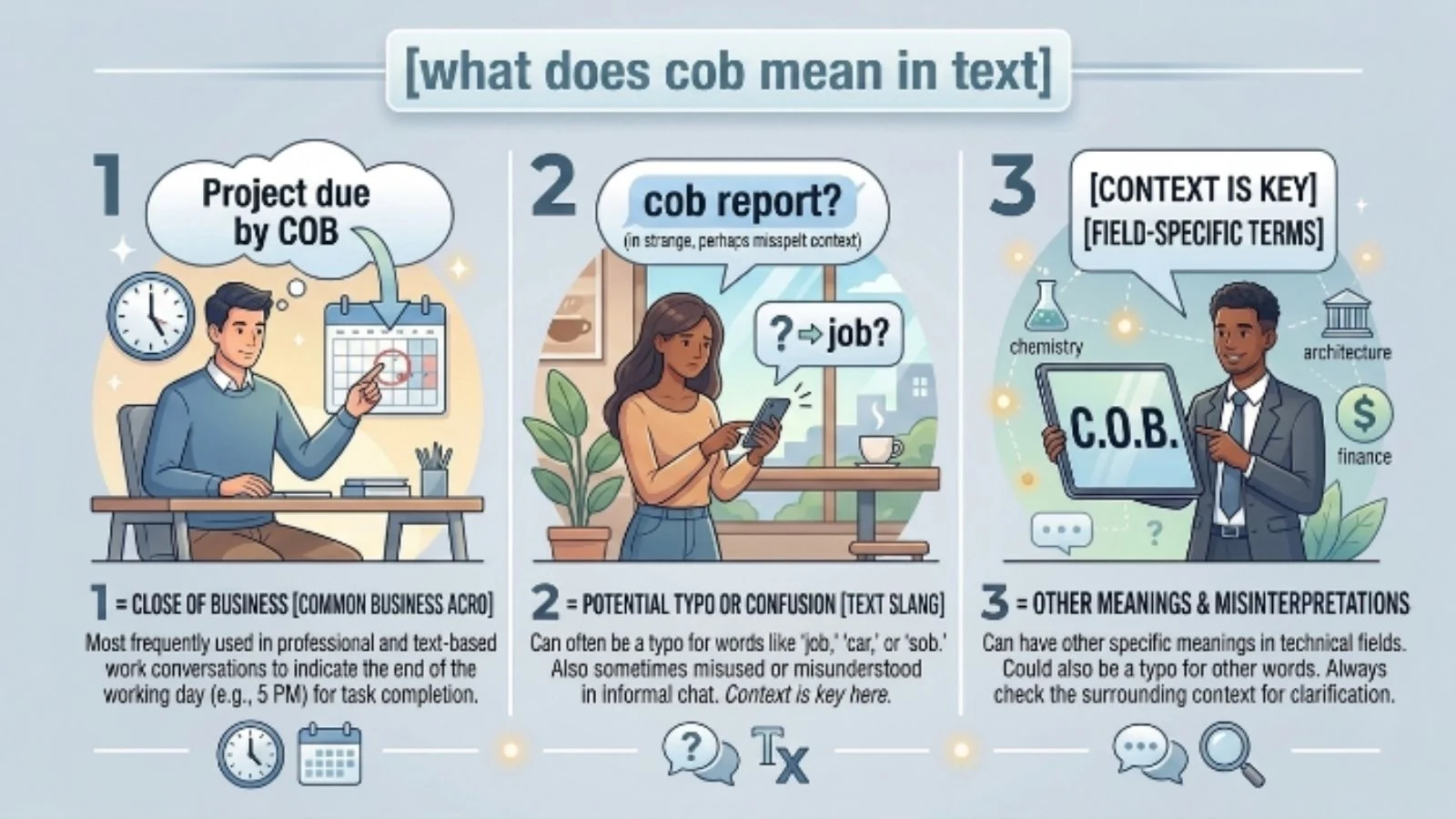
In most texts, emails, Slack messages, and workplace chats, COB means “Close of Business.” It refers to the end of the working or business day.
So, if your manager says, “I need this by COB,” they are usually asking you to finish or send it before the business day ends.
Let’s break down exactly what COB means, where you will see it, how to use it, and how it differs from similar terms.
What Does COB Mean in Text?
COB means “Close of Business.”
It usually refers to the end of the working day or business day, especially when someone is talking about a deadline. Oxford defines COB as the time when business ends for the day.
For example:
“Can you send me the document by COB?”
This means:
“Can you send me the document before the workday ends?”
COB is commonly used in professional emails and workplace messages, but it can also appear in texts and online chats when people are discussing work.
Quick Definition
COB = Close of Business = the end of the working day.
It is most often used to communicate a deadline.
COB Meaning in Simple Words
Think of COB as another way of saying:
“Before the workday is over.”
If someone tells you:
“Please finish this by COB.”
They are not necessarily asking you to finish it at a particular minute. They generally mean that the task should be completed before the relevant business day ends.
For example, if an office normally operates from 9 a.m. to 5 p.m., COB may be understood as around the end of that working period.
However, there is an important point: COB does not always mean exactly 5 p.m.
The exact meaning can depend on the organization, location, industry, or agreement between the people communicating. The safest approach is to ask for the exact time if the deadline is important.
Is COB Texting Slang?
Not exactly.
Although COB can appear in text messages, it is better described as a business abbreviation or workplace shorthand rather than trendy internet slang.
You are much more likely to see it in:
- Work emails
- Slack messages
- Microsoft Teams chats
- WhatsApp work groups
- Project-management messages
- Client communication
- Business documents
- Professional texts
A texting abbreviation such as “LOL” is generally used for casual conversation. COB is different because it is mainly connected to work, deadlines, and business communication.
Some internet slang dictionaries also classify COB as text-message shorthand because it can be used in online chats.
What Does “By COB” Mean?
This is one of the most common ways you will see the abbreviation.
“By COB” means “by the close of business.”
In simple terms, it means:
Have it completed or sent before the business day ends.
For example:
“Please submit the form by COB Friday.”
This means the person wants the form submitted before the working day ends on Friday.
Another example:
“Can you send the revised article by COB?”
The person is asking you to send the revised article before the agreed business-day deadline.
Where Is COB Used?
COB is especially common in professional communication.
1. Work Emails
This is probably one of the most common places you will encounter COB.
Example:
“Please send the final report by COB Thursday.”
The sender wants the report before the business day ends on Thursday.
2. Workplace Text Messages
A manager or coworker may use COB in a quick text.
Example:
“Need those figures by COB today.”
This means the figures are expected before the workday finishes.
3. Slack and Microsoft Teams
Teams often use abbreviations to communicate quickly.
Example:
“Let’s get approval by COB.”
The team needs approval before the working day ends.
4. WhatsApp Work Chats
COB can also appear in professional WhatsApp groups.
Example:
“Please check the document and reply by COB.”
The person wants a response before the end of the business day.
5. Client Communication
Businesses sometimes use COB when giving clients or partners a deadline.
Example:
“We will confirm your request by COB tomorrow.”
This means the business expects to provide confirmation before tomorrow’s working day ends.
Why Do People Use COB?
The biggest reason is speed and convenience.
Instead of writing:
“Please send the document before the end of the working day.”
Someone can simply write:
“Please send the document by COB.”
That saves time and makes the deadline immediately clear to people familiar with workplace terminology.
COB Helps Communicate Deadlines
One of its main purposes is to establish a time limit.
For example:
“I need your feedback by COB.”
The message tells the reader that the feedback is expected before the business day ends.
COB Keeps Workplace Messages Short
Professional communication often involves many deadlines and tasks.
Using COB allows people to communicate those deadlines in just three letters.
COB Sounds Professional
COB is associated with business communication, so it can sound more formal than simply saying:
“Send it before work ends.”
That does not mean you should use it everywhere, though. Context matters.
Real-Life Examples of COB in Text
Here are some examples you might actually encounter.
Example 1
Person A: Can you finish the spreadsheet today?
Person B: Yes, I’ll send it by COB.
Meaning: Person B plans to send the spreadsheet before the working day ends.
Example 2
Manager: Please send me the final draft by COB Friday.
Meaning: The manager wants the final draft before the business day ends on Friday.
Example 3
Coworker: Do you think you can review this by COB?
Meaning: The coworker is asking whether you can review it before the end of the working day.
Example 4
Client: Can you confirm the delivery date by COB?
Meaning: The client wants confirmation before the business day finishes.
Example 5
Freelancer: I’ll send the revised version by COB tomorrow.
Meaning: The freelancer plans to deliver the revised version before tomorrow’s workday ends.
COB vs. Similar Terms
COB is sometimes confused with other deadline abbreviations. Here is a simple comparison:
| Term | Meaning | Common Use |
|---|---|---|
| COB | Close of Business | End of the business day |
| EOD | End of Day | End of the day |
| EOB | End of Business | End of the business day |
| COP | Close of Play | End of the working/business period |
| EOW | End of Week | End of the workweek |
| ASAP | As Soon As Possible | As quickly as possible |
COB vs. EOD
These two are very similar, but there can be a subtle difference.
COB specifically points toward the end of the business or working day.
EOD means the end of the day and can be broader.
For example:
“Send the report by COB.”
This strongly suggests a business deadline.
“I’ll finish it by EOD.”
This can also mean the end of the person’s workday, but the exact interpretation depends on context.
COB vs. EOB
COB and EOB are extremely similar.
- COB = Close of Business
- EOB = End of Business
Both can refer to the end of the business day.
COB vs. ASAP
These are very different.
ASAP means as soon as possible.
COB gives you a deadline connected to the end of the business day.
For example:
“Send it ASAP.”
Means: Send it as soon as you can.
“Send it by COB.”
Means: Send it before the business day ends.
Does COB Mean Exactly 5 PM?
Not necessarily.
This is one of the most important things to understand.
People often associate COB with 5 p.m., but there is no universal rule that says COB always equals exactly 5 p.m.
Business hours vary between companies, industries, countries, and teams. Even modern workplaces may have different working schedules.
Because of that, if someone gives you an important deadline using only “COB,” you may want to clarify the expected time.
For example, you could ask:
“Just to confirm, what time would you like this by?”
That is especially useful when working across different time zones.
What Does COB Today Mean?
If someone says:
“I need this by COB today.”
They generally mean:
“I need this before the end of today’s working day.”
The important word is today.
If you are unsure what time they consider the end of the business day, check the company’s normal working hours or ask them directly.
What Does COB Tomorrow Mean?
If someone writes:
“Please send the invoice by COB tomorrow.”
They want the invoice before tomorrow’s business day ends.
This is a common way to communicate deadlines without specifying an exact clock time.
How Should You Reply to COB?
If someone sends you a message such as:
“Can you send this by COB?”
You can reply naturally.
If You Agree
“Sure, I’ll send it by COB.”
If You Need More Time
“I may need until tomorrow morning. Would that work?”
If You Are Unsure About the Deadline
“Sure. What time do you consider COB?”
If You Have Finished Early
“Done. I’ve sent it over.”
There is no special response required just because someone uses COB.
When Should You Use COB?
COB works best when you are communicating with people in a professional setting.
You can use it when:
- Giving a work deadline
- Asking for a report
- Requesting feedback
- Setting a project deadline
- Communicating with coworkers
- Messaging clients
- Discussing business operations
- Giving a delivery or approval deadline
For example:
“Please review the proposal by COB Wednesday.”
That sounds natural in a professional environment.
When Should You Avoid Using COB?
You probably do not need COB in a casual conversation.
For example, texting a friend:
“Can you bring pizza by COB?”
would sound strange unless you are intentionally joking about corporate language.
A normal friend-to-friend message would simply be:
“Can you bring pizza before tonight?”
COB is most useful when the conversation already involves work or business.
Common Misunderstandings About COB
Misunderstanding 1: COB Always Means 5 PM
Not necessarily.
COB generally means the end of the applicable business day, but the exact time can vary.
Misunderstanding 2: COB Is Pure Internet Slang
Not really.
COB is better understood as professional shorthand that is also used in online messages.
Misunderstanding 3: COB Means “Immediately”
It does not.
If someone says:
“Send it by COB.”
They are giving you a deadline, not necessarily asking you to send it immediately.
If they need something immediately, they may say ASAP instead.
Misunderstanding 4: COB Has Only One Possible Meaning
“Close of Business” is the standard meaning in workplace texting, but abbreviations can have different meanings in specialized settings.
For example, COB can appear in military or organizational contexts with other meanings.
That is why the surrounding conversation always matters.
A Note About Other Meanings
If you see COB in a conversation that has nothing to do with work, do not automatically assume it means “Close of Business.”
Abbreviations can have specialized meanings in different communities.
For ordinary texting, however, especially when the conversation involves deadlines, jobs, reports, projects, or clients, “Close of Business” is by far the meaning you should consider first.
The safest way to understand any abbreviation is to look at the words around it.
Pro Tips for Understanding COB
1. Look at the Context
If the message talks about a report, meeting, deadline, invoice, or project, COB almost certainly relates to the end of the workday.
2. Pay Attention to “By”
The phrase “by COB” almost always signals a deadline.
“Send it by COB.”
means:
“Send it before the business day ends.”
3. Ask When the Time Is Unclear
If you are working with someone in another country or time zone, clarify the exact deadline.
This can prevent unnecessary confusion.
4. Don’t Overuse It in Casual Chats
COB is useful, but it can sound overly formal when used with friends.
Choose words that match the relationship and situation.
5. Check Your Company’s Expectations
Different workplaces may interpret COB slightly differently.
If your manager or company has a specific definition, follow that rather than assuming it always means 5 p.m.
Is COB Still Used in 2026?
Yes.
COB remains a recognizable abbreviation in professional communication. It continues to appear in workplace emails, business chats, project discussions, and text-based communication. Current dictionary references still define COB as close of business.
It is not necessarily “trendy slang.” Instead, it is a practical piece of workplace shorthand that has remained useful because it communicates a deadline quickly.
Frequently Asked Questions
What does COB mean in text?
COB usually means “Close of Business.” It refers to the end of the working or business day and is commonly used when discussing deadlines.
What does “by COB” mean?
“By COB” means before the close of business. In simple terms, the person wants something completed or delivered before the working day ends.
Does COB mean 5 PM?
Not always. COB generally refers to the end of the relevant business day, but the exact time can vary by company, workplace, location, or agreement.
Is COB slang?
COB can be used in text messages and online chats, but it is more accurately described as workplace or business shorthand than casual internet slang.
Final Thoughts
If you were wondering what does COB mean in text, the answer is simple: COB usually means “Close of Business.”
When someone says, “Please send this by COB,” they are asking you to complete or send something before the business day ends.
You will most often see COB in professional emails, workplace chats, project updates, and messages about deadlines. It is similar to terms such as EOD and EOB, but COB specifically emphasizes the close of the business day.
The key thing to remember is that COB does not always mean exactly 5 p.m. If the deadline matters, confirm the expected time, especially when different workplaces or time zones are involved.
Once you know the context, COB is actually very easy to understand: it is simply a short way of saying “before the workday ends.”