Have you ever received a text that says “That’s OT” or “Sorry for going OT” and wondered what the person was talking about?
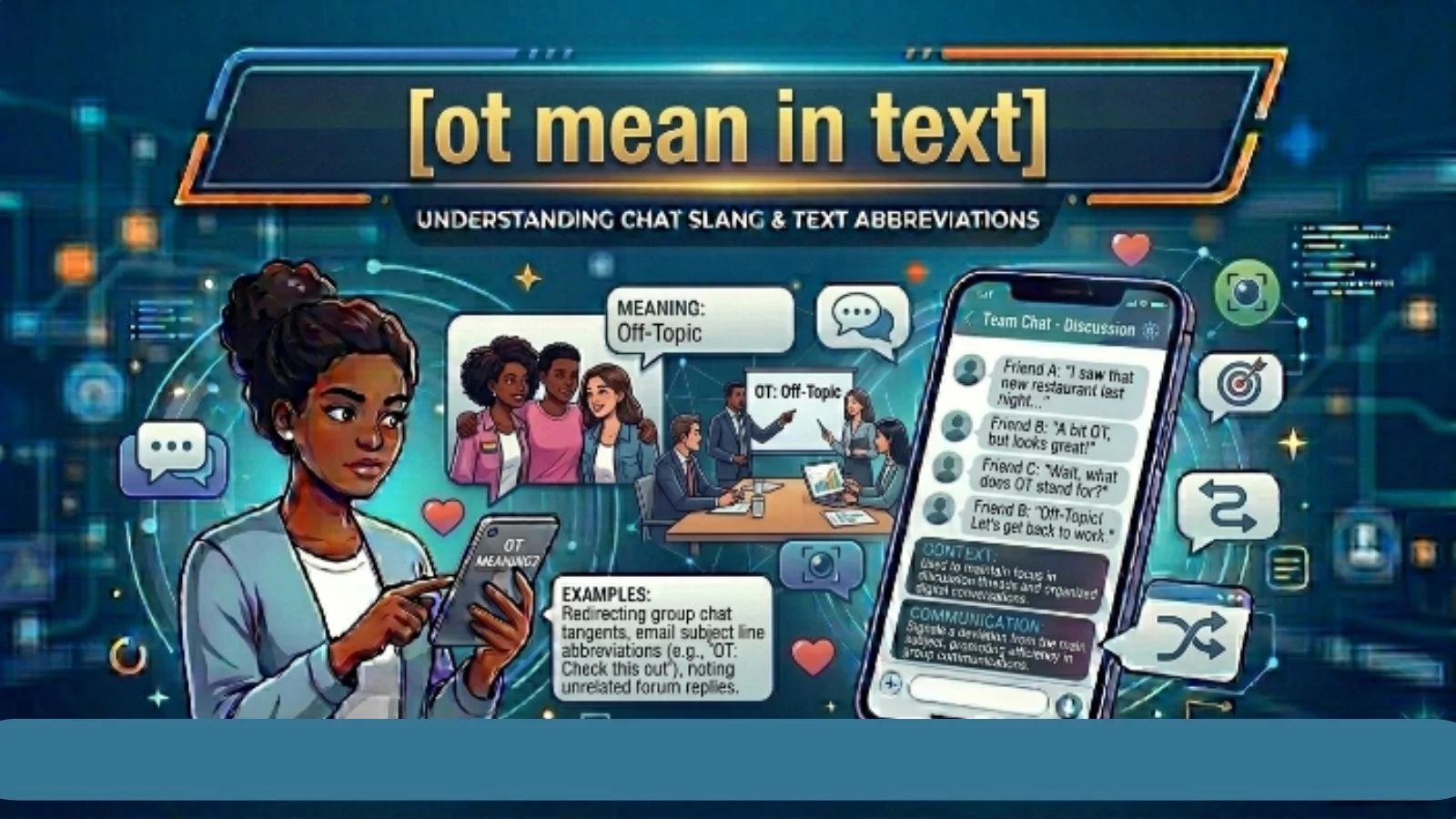
Texting abbreviations can be confusing because the same two letters can have different meanings depending on the conversation. OT is one of those abbreviations. In casual texting, online discussions, and social media, it most commonly means “off topic.”
When someone says something is “OT,” they usually mean that the conversation has moved away from the original subject.
But that is not the only possible meaning. In some situations, OT can also mean “overtime,” “occupational therapist,” or something specific to a particular community.
So, what does OT mean in text? Let’s break it down with simple explanations and real-life examples.
What Does OT Mean in Text?
In texting and online conversations, OT most commonly means “off topic.”
People use it when they want to point out that a message, comment, or discussion is not directly related to the main subject.
OT = Off Topic
For example:
“Sorry, this is OT, but did you watch the new movie?”
Here, the person is saying that their question is off topic because the current conversation was about something else.
You may see OT in group chats, forums, social media comments, gaming communities, and online discussions.
Quick Definition
OT in text usually means “off topic.” It is used when someone talks about something unrelated to the main subject of a conversation or discussion.
However, context matters because OT can have other meanings.
OT Meaning in Simple Words
The easiest way to understand OT is:
OT means the conversation has gone away from the original topic.
Imagine you and a friend are talking about your upcoming exam.
Your friend suddenly asks:
“By the way, what did you have for dinner last night?”
You might respond:
“That’s OT, but I had pizza.”
The dinner question has nothing to do with the exam, so it is off topic.
In many online communities, people use “OT” to quickly identify comments that do not relate to the discussion.
Where Is OT Used?
You can find OT in several types of online communication.
Common places include:
- Text messages
- Group chats
- Facebook comments
- Reddit discussions
- Online forums
- Gaming communities
- Discord conversations
- Social media comments
- Work-related chats
- Discussion boards
It is especially common when conversations have a specific subject.
For example, someone may create a discussion about smartphones. If another person starts talking about their vacation, someone might write:
“Getting a little OT here.”
That means the conversation is moving off topic.
Why Do People Use OT?
People use abbreviations because they make communication faster and more casual.
Instead of typing:
“This is unrelated to what we were discussing.”
Someone can simply write:
“This is OT.”
It saves time and fits naturally into online conversations.
There are several reasons people use OT:
1. It Saves Time
Typing two letters is quicker than writing “off topic.”
2. It Keeps Conversations Organized
In large online discussions, people may want to remind others to stay focused.
3. It Sounds Casual
“OT” feels less formal than saying, “This subject is not relevant to the current discussion.”
4. It Helps Introduce a Side Question
Someone may use OT before asking something unrelated.
For example:
“OT: Does anyone know when the store closes?”
This tells readers that the question is not connected to the main discussion.
Real-Life Examples of OT in Text
Understanding examples is one of the easiest ways to learn slang and abbreviations.
Example 1: Group Chat
Sarah: “We need to decide where to eat tonight.”
Mike: “How about the Italian restaurant?”
John: “OT, but has anyone seen my keys?”
Sarah: “No, I haven’t.”
Here, John uses OT because his question about his keys has nothing to do with dinner.
Example 2: Online Discussion
User 1: “I think this phone has the best camera.”
User 2: “I agree. The image quality is excellent.”
User 3: “OT, but does anyone know if the company is hiring?”
“OT” shows that the third person’s question is unrelated to the phone discussion.
Example 3: Texting a Friend
Friend: “Did you finish your homework?”
You: “Almost. OT, did you see my message yesterday?”
Here, the conversation changes from homework to a previous message.
Example 4: Gaming Chat
Player 1: “The new update made the game much harder.”
Player 2: “Definitely.”
Player 3: “OT: What headset are you using?”
The headset question is unrelated to the game update, so “OT” makes sense.
Example 5: Social Media
Someone may comment:
“OT, but your profile picture looks great.”
This means:
“This is unrelated to the current topic, but I wanted to mention something.”
The abbreviation can therefore be used politely when changing subjects.
OT vs Similar Terms
Although OT commonly means “off topic,” several other abbreviations can appear in similar conversations.
| Term | Meaning | Common Use |
|---|---|---|
| OT | Off Topic | Introducing an unrelated subject |
| BTW | By the Way | Adding another point or side comment |
| FYI | For Your Information | Giving useful information |
| IDC | I Don’t Care | Showing lack of concern |
| IMO | In My Opinion | Sharing a personal opinion |
| TMI | Too Much Information | Saying someone shared excessive personal details |
| OOT | Out of Topic | Less common variation of off-topic |
OT vs BTW
These two can sometimes look similar, but they are not exactly the same.
BTW means “by the way” and is commonly used to introduce an additional thought.
OT specifically points out that something is off topic.
For example:
“BTW, did you call Mom?”
This does not necessarily emphasize that the question is unrelated.
But:
“OT, did you call Mom?”
clearly signals that the subject has changed.
OT vs OOT
OOT can also be used to mean “out of topic,” but OT is generally more concise and recognizable in online discussions where “off topic” is intended.
Other Meanings of OT
Context is extremely important because OT does not always mean “off topic.”
Here are some other meanings you may encounter.
OT = Overtime
In workplace or sports conversations, OT can mean overtime.
For example:
“I have to work OT tonight.”
This usually means:
“I have to work overtime tonight.”
A sports fan might also say:
“The game went into OT.”
That means the game went into overtime.
OT = Occupational Therapist
In healthcare or professional conversations, OT can refer to an occupational therapist.
For example:
“My doctor recommended that I see an OT.”
In this context, “OT” has nothing to do with “off topic.”
OT = Original Text
In some online conversations, people may use OT to refer to an original text or wording, depending on the community and context.
This usage is less universal, so you should look at the surrounding conversation before deciding what it means.
How Can You Tell What OT Means?
The easiest method is to examine the context.
Ask yourself:
Is the conversation about work?
If yes, OT may mean overtime.
Is the conversation about healthcare?
It could mean occupational therapist.
Is someone changing the subject in a chat or forum?
It probably means off topic.
Is the conversation about sports?
OT may mean overtime.
Context usually gives you the answer.
When Should You Use OT?
You can use OT when you’re having a casual conversation and want to introduce something unrelated to the current subject.
For example:
“OT, but where did you buy that jacket?”
Or:
“Sorry for going OT, but I have a quick question.”
It works particularly well in:
- Casual texting
- Group conversations
- Online forums
- Social media discussions
- Gaming chats
- Community discussions
However, you may want to avoid it in highly formal writing.
Instead of writing:
“OT, I wanted to ask about the report.”
A professional email would usually be clearer if you simply introduced the new subject directly.
Common Misunderstandings About OT
Because OT has multiple meanings, people can easily misunderstand it.
Misunderstanding 1: OT Always Means Off Topic
Not necessarily.
In a workplace conversation, OT could mean overtime.
“Can you do OT tomorrow?”
This almost certainly refers to overtime rather than an unrelated topic.
Misunderstanding 2: OT Is Always Informal Slang
Not exactly.
Although “OT” is common in casual online communication, it is also used as a standard abbreviation in professional contexts, particularly for overtime and occupational therapy.
Misunderstanding 3: OT Means the Person Is Being Rude
Usually, no.
When someone says:
“OT, but…”
they are often simply warning you that they are changing the subject.
The tone depends on the conversation. In some communities, however, repeatedly going off topic may annoy people if they are trying to keep a discussion focused.
Misunderstanding 4: OT Has Only One Meaning
This is probably the biggest mistake.
Always consider the words surrounding OT before interpreting it.
Is OT a Good Abbreviation to Use?
Yes, OT can be useful in casual conversations, especially when everyone understands the context.
For example:
“OT, can I ask you something?”
This is short and natural.
But if you’re talking to someone who may not know the abbreviation, writing “off topic” is clearer.
This is especially important when communicating with people from different age groups, cultures, or online communities.
Pro Tips for Using OT Correctly
Here are a few practical tips to remember.
1. Check the Context
Before assuming OT means “off topic,” look at the conversation.
2. Use It Casually
OT works best in texts, chats, forums, and informal conversations.
3. Don’t Overuse It
If every message begins with “OT,” the conversation can become difficult to follow.
4. Consider Your Audience
Not everyone knows internet abbreviations. If there’s any chance of confusion, write “off topic” instead.
5. Watch for Workplace Context
If someone says:
“I’m doing OT tonight.”
they probably mean overtime, not “off topic.”
6. Pay Attention to Capitalization
People commonly write OT, but informal texting may also use ot. The capitalization usually does not change the intended meaning when the context is clear.
What Does OT Mean in a Text From a Friend?
If a friend sends you something like:
“OT, but are you free tomorrow?”
they probably mean “off topic, but are you free tomorrow?”
They are letting you know that they are moving away from the current subject.
You do not need to interpret it as anything negative.
A simple response could be:
“Sure, what’s up?”
or:
“Yeah, I’m free tomorrow.”
What Does OT Mean on Social Media?
On social media, OT usually means “off topic” when someone introduces a subject unrelated to the original post or discussion.
For example:
“OT, but your new haircut looks amazing.”
The person is acknowledging that the comment is not directly related to the original conversation.
In some communities, users may also use OT to mark comments that do not belong to the main discussion.
What Does OT Mean in Gaming?
Gaming communities commonly use abbreviations, and OT can have different meanings depending on the game and discussion.
If someone says:
“OT, what controller are you using?”
they probably mean off topic.
But if someone says:
“The match went into OT,”
they likely mean overtime.
Again, the surrounding words provide the clue.
Frequently Asked Questions
What does OT mean in text messages?
OT usually means “off topic” in casual text messages and online conversations. It tells someone that the speaker is moving away from the current subject.
What does OT mean on social media?
On social media, OT commonly means “off topic.” Someone may use it before making a comment or asking a question that is unrelated to the main discussion.
Can OT mean overtime?
Yes. OT can mean “overtime,” especially in work and sports conversations. For example, “I have to work OT” usually means “I have to work overtime.”
Is OT rude in texting?
No. OT is not automatically rude. It is generally a simple way to tell someone that you are changing the subject. However, repeatedly going off topic can be frustrating in focused discussions.
Final Thoughts
So, what does OT mean in text?
In most casual online conversations, OT means “off topic.” People use it when they want to introduce a question, comment, or idea that is not connected to the main subject.
For example, “OT, but did you see the news?” means that the speaker is changing the subject.
Still, remember that OT can have other meanings, including “overtime” and “occupational therapist.” The correct interpretation depends on the situation.
The best rule is simple: look at the context before deciding what OT means. Once you understand the conversation around it, this two-letter abbreviation becomes easy to recognize and use.