Have you ever received a message that says “CC me,” “I’ll CC you,” or simply “cc” and wondered what the person actually meant?
You are not alone. CC can have different meanings depending on the conversation, and the meaning used in texting is not always the same as the one you may see in email, school, work, or social media.
So, what’s CC mean in text?
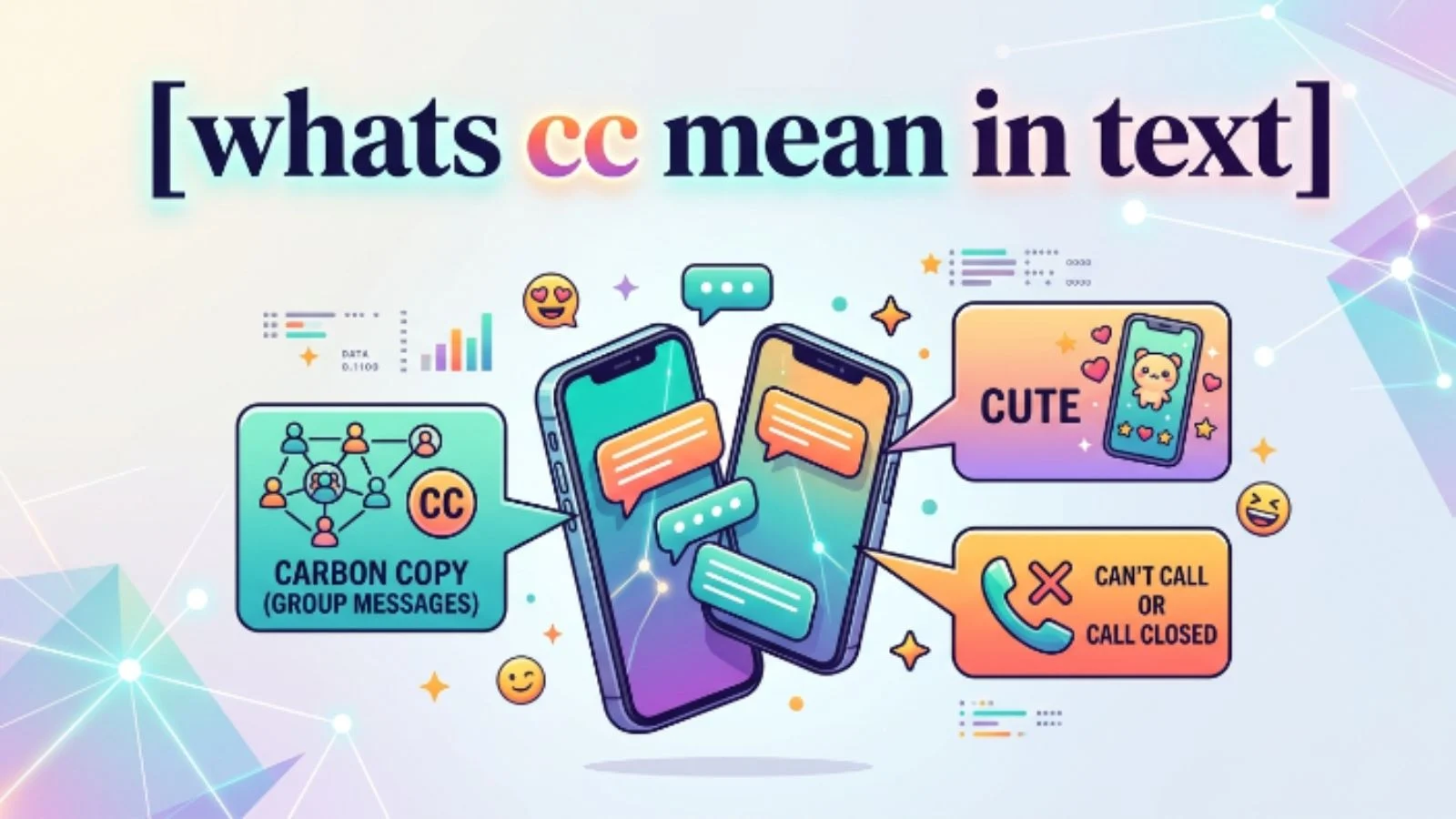
In casual texting, CC most commonly means “carbon copy,” especially when the conversation is connected to email or work. It can also have other meanings depending on the context, so understanding the surrounding message is important.
Let’s break down the meaning, examples, common uses, and possible misunderstandings so you can confidently understand CC whenever you see it.
What Does CC Mean in Text?
CC usually means “carbon copy.” It is commonly used when someone wants to include another person in a conversation, message, email, or communication.
For example:
“CC Sarah on that email.”
This means:
“Include Sarah in that email so she can receive a copy.”
Although CC originally comes from email terminology, people sometimes use it casually in text messages when discussing emails, work communication, school projects, or group conversations.
The exact meaning can change depending on the context.
Quick Definition
CC in text usually means “carbon copy,” meaning to include someone in a message or communication so they can see the information too.
For example:
“Can you CC me when you send it?”
This means the person wants to receive a copy or be included in the communication.
What Does “CC” Mean in Simple Words?
In simple English, CC means “include another person so they can see the message.”
Imagine you are sending an email to your manager and discussing a project with a coworker. Your coworker might say:
“CC me on the email.”
They are asking you to add them to the email so they know what is being discussed.
You can think of CC as “keep this person in the loop.”
That is why you may see CC used frequently in professional or school-related conversations.
Where Is CC Used?
CC is most strongly associated with email, but people can mention it in text messages and online conversations too.
You might encounter CC in:
- Email conversations
- Workplace chats
- Text messages
- School or university communication
- Group projects
- Business conversations
- Customer service discussions
- Professional messaging
- Social media conversations
For example, someone might text:
“I’m emailing the teacher now. Should I CC you?”
They are asking whether they should include you as a recipient of the email.
CC in Workplace Texts
CC is particularly common at work.
For example:
“I sent the report to the client and CC’d the manager.”
This means the manager was included in the email and received a copy.
Someone might also text:
“Please CC me when you reply.”
They want to be included in the email conversation.
Why Do People Use CC?
People use CC because it makes communication easier and more transparent.
There are several reasons someone might ask to be CC’d.
1. To Keep Someone Informed
You may not need to respond, but you still need to know what is happening.
For example:
“CC John so he knows about the schedule change.”
John does not necessarily need to take action. He simply needs the information.
2. To Keep Communication Transparent
CC can help make sure everyone involved has access to the same information.
For example:
“I’ll CC the team lead on the update.”
This lets the team lead see what was communicated.
3. To Include Someone in a Project
If multiple people are working on something, CC can keep everyone connected.
For example:
“CC me on future updates about the project.”
The person wants to receive future communication without being the main recipient.
4. To Create a Record
In professional situations, keeping someone copied on an email can also create a communication record.
For example:
“Please CC the finance department when you send the invoice.”
This ensures the relevant department receives the information.
Real-Life Examples of CC in Text
Understanding CC becomes much easier when you see it in realistic conversations.
Example 1: Workplace Conversation
Person A: “I’m sending the proposal to the client.”
Person B: “Okay, CC me.”
Meaning: Person B wants a copy of the email.
Example 2: School Communication
Student: “I’m emailing the professor about the assignment.”
Friend: “Can you CC me?”
Meaning: The friend wants to be included in the email.
Example 3: Business Communication
Manager: “Send the updated document to the client and CC me.”
Meaning: Send the document to the client while including the manager as a copied recipient.
Example 4: Keeping Someone Updated
Person A: “I’ll send the details tonight.”
Person B: “Please CC Sarah too.”
Meaning: Sarah should also receive the communication.
Example 5: Casual Texting
Friend: “I’m emailing everyone about the trip. Want me to CC you?”
You: “Yeah, please.”
Here, CC still means including you in the email.
CC vs BCC: What’s the Difference?
One of the most common sources of confusion is the difference between CC and BCC.
| Term | Meaning | Who Can See It? |
|---|---|---|
| CC | Carbon copy | Recipients can generally see who was CC’d |
| BCC | Blind carbon copy | Other recipients generally cannot see the BCC recipient |
| To | Main recipient | Used for the person or people directly receiving the message |
For example, if you send an email to Alex and CC Maria, Alex can generally see that Maria was included.
If you BCC Maria instead, Alex generally cannot see that Maria received a copy.
Why This Difference Matters
CC is normally used when you are comfortable with the included person’s presence being visible.
BCC is used when you want someone to receive the message without showing their address to the other recipients.
So, if someone texts:
“CC me, don’t BCC me.”
They are specifically asking to be visibly included in the communication.
Does CC Mean Something Different in Casual Texting?
Yes, it can.
Although “carbon copy” is the most relevant meaning when someone is talking about email or communication, abbreviations can have multiple meanings online.
The meaning depends heavily on the conversation.
For example, if someone says:
“CC me on the email.”
There is almost no ambiguity: they mean carbon copy.
But if you see “cc” in a gaming conversation, social media comment, or another specialized community, it could refer to something completely different.
This is why you should not automatically assume every use of “cc” means carbon copy.
Other Meanings of CC
Depending on the context, CC can represent different terms.
For example:
- Carbon copy — common in email and professional communication
- Closed captions — common when talking about videos, movies, or accessibility
- Crowd control — common in gaming
- Credit card — sometimes used as an informal abbreviation
- Cubic centimeter — commonly used as a unit of measurement
The surrounding words usually tell you which meaning is intended.
Example: Closed Captions
If someone says:
“Does this video have CC?”
They probably mean closed captions, not carbon copy.
Example: Gaming
If a gamer says:
“We need more CC.”
They may mean crowd control, referring to abilities that restrict or interrupt opponents.
Example: Credit Card
If someone says:
“I need a CC to complete the purchase.”
They may mean credit card, depending on the context.
This demonstrates why context matters when interpreting abbreviations.
When Should You Use CC?
Use CC when the conversation is clearly about email or another form of communication where someone is being included as a visible recipient.
It works particularly well in professional situations.
For example:
“Please CC me on the next update.”
“I’ll CC the manager.”
“Can you CC everyone involved?”
“Make sure to CC the finance team.”
In casual conversation, you can use it when the other person understands the email-related meaning.
However, if there is any possibility of confusion, simply saying “include me in the email” can be clearer.
When Should You Avoid Using CC?
You should avoid using abbreviations when the recipient may not understand them.
For example, if you are communicating with a customer who may not be familiar with email terminology, instead of:
“I’ll CC you.”
You could say:
“I’ll include you in the email.”
That version is clearer and more professional for a general audience.
The goal of communication is not to use as many abbreviations as possible. The goal is to make your meaning easy to understand.
Common Misunderstandings About CC
Misunderstanding 1: CC Always Means Carbon Copy
Not necessarily.
CC can mean several different things depending on the context.
If someone mentions an email, carbon copy is likely. If they are discussing a video, closed captions may be the intended meaning.
Misunderstanding 2: CC Means the Person Is the Main Recipient
Not usually.
The To field generally identifies the main recipient, while people in the CC field are included for awareness or involvement.
That does not mean a CC recipient is unimportant. It simply means they may not be the primary person expected to respond.
Misunderstanding 3: CC and BCC Are the Same
They are not.
The key difference is visibility.
CC recipients are generally visible to the other recipients, while BCC recipients are hidden from them.
Misunderstanding 4: CC Is Only Used in Formal Emails
Not exactly.
People can mention CC casually in texts, workplace chats, and conversations about email.
For example:
“CC me when you send it.”
This is a casual text, but the abbreviation still refers to carbon copy.
Pro Tips for Understanding CC in Text
Here are a few simple ways to figure out what CC means when you encounter it.
Look at the Topic
Ask yourself what the conversation is about.
If the person is discussing an email, CC almost certainly refers to carbon copy.
If they are discussing a movie or video, it could mean closed captions.
Read the Entire Sentence
Don’t interpret “cc” by itself.
Compare:
“CC me on the email.”
with:
“Turn on CC for this video.”
The first refers to carbon copy, while the second likely refers to closed captions.
Consider the Platform
The platform can provide useful clues.
Email and workplace communication strongly suggest carbon copy.
Video platforms may make closed captions more likely.
Gaming conversations can make crowd control more likely.
Don’t Overthink Common Workplace Usage
If someone says:
“Please CC me.”
in a conversation about an email, the meaning is straightforward.
They simply want to receive a copy of the communication.
Is CC Formal or Informal?
CC is a standard communication abbreviation rather than purely slang.
You will see it in professional emails, business communication, school correspondence, and everyday conversations.
Because it is widely understood in email contexts, using CC is generally acceptable in professional communication.
However, when writing for someone unfamiliar with the term, spelling it out can be more helpful.
For example:
More concise:
“Please CC me.”
More explicit:
“Please include me in the email.”
Both communicate essentially the same idea.
What Does “CC Me” Mean?
The phrase “CC me” means “include me as a copied recipient.”
For example:
“CC me when you send the proposal.”
The person is asking you to include them in the email so they can receive a copy.
It does not necessarily mean they want to be the person responsible for handling the message.
They may simply want to stay informed.
What Does “I’ll CC You” Mean?
When someone says:
“I’ll CC you.”
they mean:
“I’ll include you in the email or communication.”
For example:
Manager: “I’m contacting the supplier now.”
Employee: “Can you keep me updated?”
Manager: “Sure, I’ll CC you.”
The manager plans to include the employee in the email.
What Does “CC’d” Mean?
“CC’d” means someone was included as a carbon-copy recipient.
For example:
“I CC’d you on the email.”
This means the person has already included you.
You may also see:
“You were CC’d on the message.”
Again, it means you received a copy of the communication.
Quick Guide to CC
If you want a quick answer, remember this:
CC = Carbon Copy
In an email or text conversation about email, it usually means including another person so they receive a copy of the message.
But always check the context because CC can also mean things such as closed captions, crowd control, credit card, or cubic centimeter.
Frequently Asked Questions
What does CC mean in text messages?
In a text message, CC most commonly refers to “carbon copy” when the conversation is about email or communication. It means including someone so they receive a copy of the message.
What does “CC me” mean?
“CC me” means “include me in the email or communication.” The person usually wants to receive a copy and stay informed.
Is CC the same as BCC?
No. CC recipients are generally visible to other recipients, while BCC recipients are generally hidden from the other recipients.
Can CC have other meanings?
Yes. Depending on context, CC can mean closed captions, crowd control, credit card, cubic centimeter, and other terms. The surrounding conversation determines the intended meaning.
Final Thoughts
So, what’s CC mean in text?
When someone is talking about email, CC usually means “carbon copy.” It simply means including another person in a communication so they can receive a copy and stay informed.
You may see phrases such as “CC me,” “I’ll CC you,” or “I CC’d Sarah.” All of these usually relate to adding someone to an email conversation.
Just remember that context matters. In videos, gaming, shopping, or other situations, CC can have completely different meanings.