Have you ever received a message that starts with “PSA:” and wondered what those three letters actually mean?
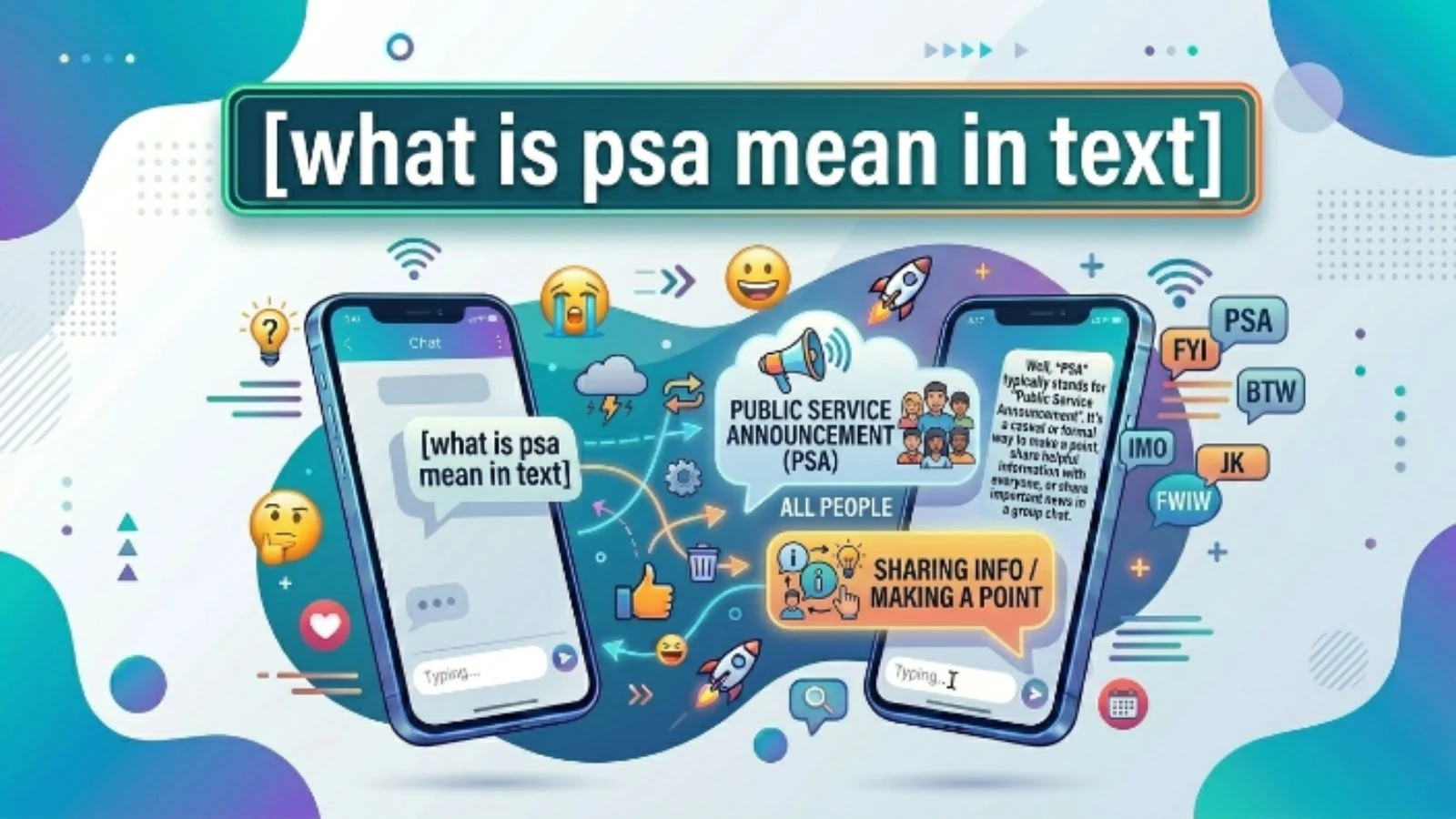
You are not alone. PSA is a common abbreviation you may see in texts, group chats, social media posts, comments, and online communities. In most casual conversations, it means “Public Service Announcement.”
But there is a little more to it than that. When someone types “PSA” in a message, they are usually trying to get your attention before sharing something important, useful, funny, or worth remembering.
In this guide, you will learn exactly what PSA means in text, how people use it, what it sounds like in different situations, and how to respond when someone sends you a PSA.
What Does PSA Mean in Text?
In texting and online conversations, PSA usually means “Public Service Announcement.”
It is used when someone wants to make an important announcement, reminder, warning, tip, or piece of information that they think other people should know.
Simple definition:
PSA in text means “Public Service Announcement” and is commonly used to introduce information, advice, reminders, or warnings that the sender wants others to notice.
For example:
“PSA: The store closes at 6 PM today.”
Here, the person is simply highlighting useful information that everyone should know.
The phrase originally comes from public announcements intended to inform people about issues affecting the public. Online, however, PSA has become much more casual and conversational.
What Does PSA Mean in Simple Words?
In simple English, PSA can mean:
“Hey, everyone, pay attention to this.”
That is often the feeling behind a PSA in a text message.
Someone might use it before:
- A helpful reminder
- An important warning
- A useful tip
- An announcement
- A correction
- A funny observation
- Information they believe others need to know
For example:
“PSA: Back up your photos before deleting them from your phone.”
The sender is not necessarily making a formal announcement. They are simply emphasizing something important.
Where Is PSA Used?
You can see PSA in many forms of digital communication.
It is especially common on:
Text Messages
Someone may send a quick reminder to friends or family.
Example:
“PSA: Bring an umbrella tomorrow.”
The sender is giving everyone a useful reminder.
Group Chats
PSA is particularly useful when one person wants several people to notice the same information.
Example:
“PSA: Our meeting has been moved to Friday.”
This helps make the announcement stand out.
Social Media
You may see PSA at the beginning of posts, captions, comments, or threads.
Example:
“PSA: Please check the opening hours before visiting.”
Here, the person wants the information to be noticed by a larger audience.
Online Communities
People also use PSA when sharing community reminders, rules, warnings, or helpful advice.
Example:
“PSA: Don’t share your password with anyone.”
The abbreviation gives the message an announcement-like tone.
Why Do People Use PSA in Texts?
There are several reasons people use PSA.
1. To Get Attention
A message beginning with “PSA” immediately signals that something is worth noticing.
Compare:
“Remember to charge your phone.”
with:
“PSA: Remember to charge your phone.”
The second version sounds more like an announcement.
2. To Share Important Information
People often use PSA when they believe the information could help others.
Example:
“PSA: Save important documents somewhere other than your phone.”
The sender wants people to take the advice seriously.
3. To Give a Reminder
PSA can introduce a simple reminder about something people may have forgotten.
Example:
“PSA: Tomorrow is a public holiday.”
The information may be simple, but the sender wants everyone to remember it.
4. To Give a Warning
PSA can also introduce a warning.
Example:
“PSA: Don’t click suspicious links in random messages.”
This use is especially common online.
5. To Be Funny or Dramatic
Not every PSA is serious.
People frequently use PSA jokingly to make an ordinary opinion sound like an official announcement.
For example:
“PSA: Pizza tastes better when it’s shared.”
Obviously, this is not an official public announcement. The person is using PSA for humor.
Real-Life Examples of PSA in Text
Understanding examples is one of the easiest ways to understand how PSA works.
Example 1: Important Reminder
Friend: “PSA: Don’t forget we have class tomorrow morning.”
Meaning: The friend is reminding everyone about the class.
The message is casual, but “PSA” makes the reminder stand out.
Example 2: Helpful Advice
Friend: “PSA: Always save your work before restarting your laptop.”
Meaning: The person is giving practical advice.
They are presenting it as something everyone should know.
Example 3: Warning
Message: “PSA: Don’t give your verification code to anyone.”
Meaning: The sender is warning people about a potentially dangerous situation.
In this context, PSA makes the warning more noticeable.
Example 4: Group Announcement
Group chat: “PSA: The dinner location has changed to the restaurant downtown.”
Meaning: Everyone in the group needs to know about the change.
Example 5: Funny Use
Text: “PSA: Nobody should talk to me before coffee.”
Meaning: The person is jokingly presenting their personal preference as an important public announcement.
This is a very common informal use.
Example 6: Social Media Style
Post: “PSA: Read the instructions before starting the application.”
Meaning: The writer is giving general advice to other people.
PSA vs. Similar Terms
PSA can sometimes seem similar to other abbreviations and expressions.
| Term | Meaning | Typical Use |
|---|---|---|
| PSA | Public Service Announcement | Important information, advice, reminder, or warning |
| FYI | For Your Information | Sharing information someone may find useful |
| BTW | By The Way | Adding another point or casual detail |
| Reminder | Something to remember | Directly reminding someone about something |
| Announcement | Information being officially shared | Formal or informal news |
| Heads up | A warning or advance notice | Alerting someone about something coming |
PSA vs. FYI
These two are especially easy to confuse.
PSA: “PSA: The deadline is tomorrow.”
FYI: “FYI, the deadline is tomorrow.”
Both provide information, but PSA usually puts more emphasis on the message.
FYI often means, “I wanted you to know.”
PSA can feel more like, “Everyone should know this.”
PSA vs. “Heads Up”
“Heads up” usually warns someone about something specific.
“Heads up, the teacher is coming.”
PSA is broader:
“PSA: The assignment deadline is Friday.”
Both can alert people, but they have slightly different tones.
When Should You Use PSA?
You can use PSA when you want to make information noticeable without sounding overly formal.
It works well when:
- You are sharing a useful reminder.
- You want people to pay attention.
- You are giving practical advice.
- You are warning others about something.
- You are making an announcement in a group chat.
- You are sharing a funny observation.
- You want to emphasize something that people often forget.
For example:
“PSA: Check your email before leaving for work.”
This sounds natural in an informal conversation.
When Should You Not Use PSA?
Although PSA is common online, it is not appropriate for every situation.
Avoid using it when you need a highly formal or professional tone unless the context makes the abbreviation appropriate.
For example, in a formal business document, instead of:
“PSA: The meeting has been canceled.”
you might simply write:
“Please note that the meeting has been canceled.”
The meaning is similar, but the second version sounds more professional.
You should also avoid using PSA for every small piece of information. If every message begins with “PSA,” the expression can lose its impact.
Common Misunderstandings About PSA
PSA Does Not Always Mean Something Serious
A PSA can be completely playful.
Someone might say:
“PSA: Fries are better with ketchup.”
They are not making an official announcement. They are being humorous or dramatic.
PSA Does Not Mean “Urgent” by Definition
PSA signals that something is worth noticing, but it does not automatically mean there is an emergency.
For example:
“PSA: The new season is finally available.”
That may be exciting, but it is not necessarily urgent.
PSA Can Be Used for Personal Opinions
Online, people sometimes use PSA before expressing an opinion.
“PSA: Morning workouts are underrated.”
The person is treating their opinion like a public announcement for humorous effect.
Context Still Matters
Although “Public Service Announcement” is the most common meaning of PSA in casual texting, abbreviations can have different meanings in other contexts.
For example, PSA can refer to prostate-specific antigen in a medical context.
Therefore, always consider the surrounding conversation before deciding what an abbreviation means.
If someone texts:
“My PSA test results came back.”
they are almost certainly not using PSA to mean “Public Service Announcement.”
How Does PSA Sound in a Conversation?
The tone of PSA depends heavily on the message that follows it.
Serious Tone
“PSA: Never share your banking password with anyone.”
This sounds like genuine advice or a warning.
Friendly Tone
“PSA: The café is offering free coffee today.”
This sounds like helpful information.
Funny Tone
“PSA: I am not responsible for what happens after three cups of coffee.”
This is clearly playful.
Dramatic Tone
“PSA: We need to stop pretending pineapple pizza isn’t amazing.”
The person is deliberately exaggerating an ordinary opinion for humor.
How to Respond When Someone Says PSA
Usually, you do not need a special response to “PSA.”
Simply respond to the information they shared.
For example:
Them: “PSA: The deadline is Monday.”
You: “Thanks for letting me know.”
Or:
Them: “PSA: Bring your charger tomorrow.”
You: “Good reminder. I’ll bring it.”
If the PSA is funny, you can respond casually:
Them: “PSA: Coffee is basically a survival tool.”
You: “Honestly, true.”
The best response depends on the actual message rather than the abbreviation itself.
Pro Tips for Understanding PSA
Here are a few practical tips to remember:
- Look at the words after PSA. They usually reveal the intended meaning immediately.
- Consider the platform. A social media post may use PSA humorously, while a serious message may use it as a warning.
- Don’t assume every PSA is urgent. It can simply be a reminder or opinion.
- Pay attention to capitalization. “PSA” is commonly written in uppercase, especially when introducing an announcement.
- Consider the context. In medical or professional conversations, PSA may have a completely different meaning.
- Don’t overuse it. PSA works best when the information genuinely deserves attention.
What Does PSA Mean on Social Media?
On social media, PSA usually means “Public Service Announcement.”
However, the phrase is often used casually rather than officially.
A person might write:
“PSA: Stop comparing your life to people online.”
Or:
“PSA: Check the ingredients before buying something new.”
In these cases, PSA introduces advice or an observation intended for a wider audience.
Social media users also use the abbreviation to make humorous statements appear more official than they really are.
What Does PSA Mean in Snapchat or Instagram Messages?
If someone sends you “PSA” on Snapchat, Instagram, or another messaging platform, it will generally mean “Public Service Announcement” when used as an introduction to a message.
For example:
“PSA: Don’t forget about the party tonight.”
The person is simply saying, in effect, “Here’s something everyone should know.”
The exact tone can be serious, friendly, sarcastic, or funny depending on what follows.
Is PSA Slang?
PSA is not exactly slang.
It is better described as an abbreviation that has become common in informal online communication.
The original phrase, “Public Service Announcement,” is a standard English term. Internet users have adapted it into a shorter and more casual expression.
That is why you can see PSA in texts, comments, social media captions, forums, and group conversations.
Final Thoughts
So, what is PSA mean in text? In most texting and social media conversations, PSA means “Public Service Announcement.”
People use it to draw attention to information, reminders, warnings, advice, announcements, and sometimes humorous opinions.
The easiest way to understand it is to think of PSA as “Hey, everyone, pay attention to this.”
Whether someone is warning you not to click a suspicious link, reminding you about tomorrow’s deadline, or joking about their love of coffee, the meaning comes from the context.
When you see “PSA:” at the beginning of a message, simply read what comes next. That will usually tell you exactly what the sender wants you to notice.
Frequently Asked Questions
1. What does PSA stand for in texting?
In texting, PSA usually stands for “Public Service Announcement.” It is commonly used before a reminder, warning, helpful tip, announcement, or opinion that the sender wants people to notice.
2. Is PSA slang?
PSA is more accurately described as an abbreviation rather than traditional slang. It comes from the phrase “Public Service Announcement” and is now widely used in informal digital communication.
3. What does PSA mean on social media?
On social media, PSA generally means “Public Service Announcement.” Users often put it before advice, reminders, warnings, or humorous statements to make their message stand out.
4. Can PSA have another meaning?
Yes. PSA can have different meanings depending on the context. In medical conversations, for example, it can refer to prostate-specific antigen. In ordinary texting and social media, however, “Public Service Announcement” is usually the intended meaning.