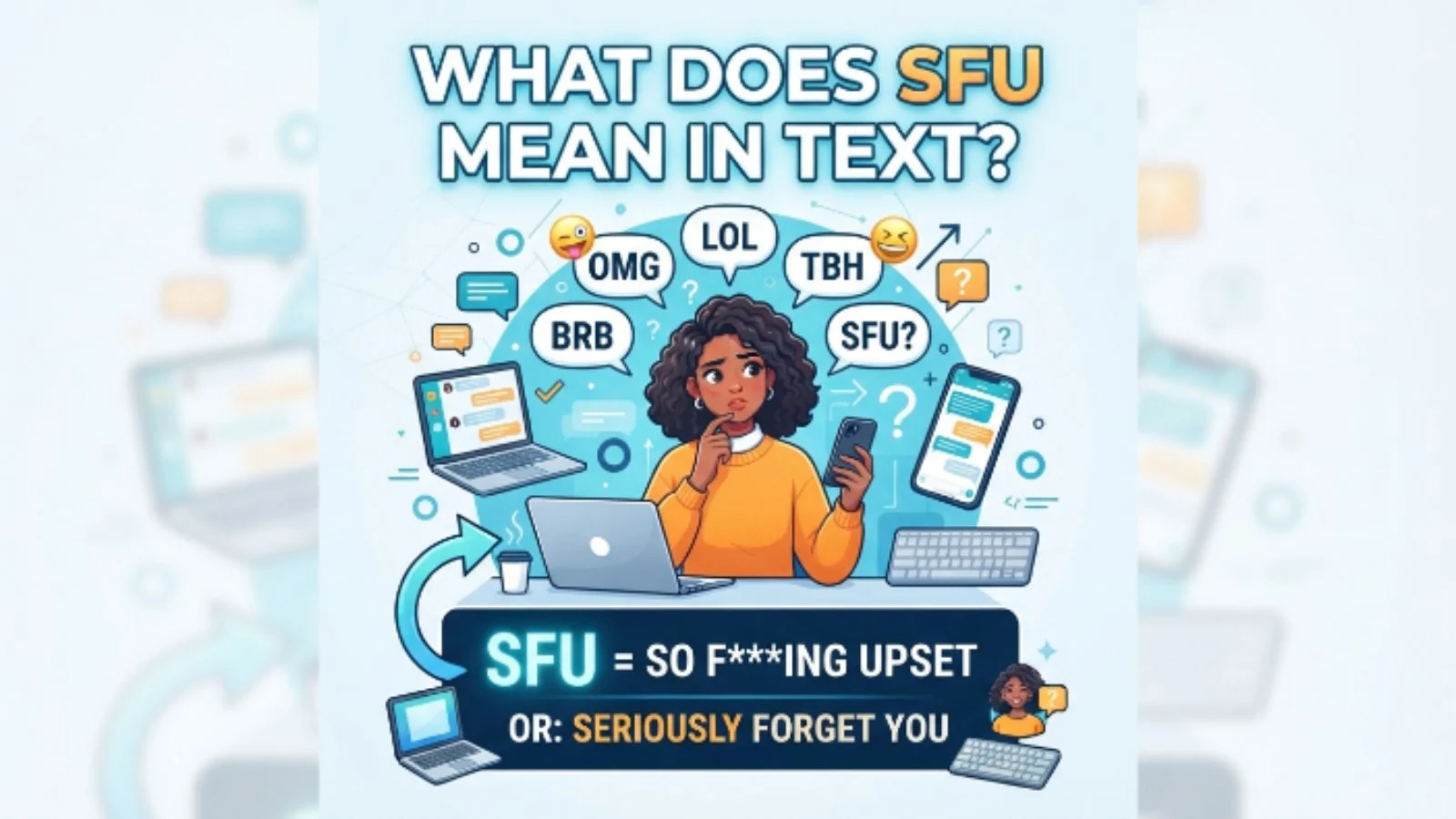
Have you ever been in the middle of a fast-paced texting session, only for the other person to drop a three-letter acronym that completely changes the vibe? You sit there staring at your screen, wondering if you just got complimented, roasted, or told to shut up.
If someone recently sent you SFU, you are likely experiencing that exact confusion.
Internet acronyms move incredibly fast. By the time you master one, three more take its place. What makes SFU particularly tricky is that it does not just have one universal meaning. Depending on who is texting you, it could mean something incredibly aggressive, a casual complaint about workload, or a simple geographic location.
Let’s break down exactly what SFU means in text, look at the different contexts so you never misread the room, and discover how to use it properly without accidentally starting an argument.
What Does SFU Mean in Text?
In modern text messages and across social media platforms like TikTok, Snapchat, and Instagram, SFU most commonly stands for “Shut Fuck Up” or “Shut the Fuck Up.”
Yes, it is a direct, unfiltered, and highly aggressive way of telling someone to stop talking. It drops the “T” from the traditional “STFU” acronym simply because it is faster to type, or because of local slang variations.
However, because the internet loves double meanings, SFU can also stand for “So Fucked Up” or refer to Simon Fraser University if you happen to live in Canada.
To help you remember the primary digital meaning, here is a quick summary designed for a featured snippet:
SFU Meaning: In text messaging and social media, SFU most frequently stands for “Shut the Fuck Up” or “So Fucked Up.” It is used to express extreme frustration, disbelief, or a direct demand for someone to stop talking.
The Simple Meaning and Nuances
To truly understand SFU, you have to look at the tone behind the screen. Text messages lack vocal inflection, which means three letters can carry vastly different weights.
1. The Aggressive Demand (Shut The Fuck Up)
When used as a command, SFU is a blunt tool. It is meant to cut a conversation short or express intense annoyance. If you are arguing with someone and they hit you with this, they are done listening to you.
2. The Shocked Disbelief (No Way!)
Just like how people say “Shut up!” when they hear a wild piece of gossip, SFU is frequently used to express shock. If you tell your best friend that your mutual crush just asked you out, they might reply with “SFU!” They do not actually want you to stop talking; they are just completely blown away by the news.
3. The Emotional Reaction (So Fucked Up)
The second most common slang definition is “So Fucked Up.” In this context, it describes a situation that is deeply unfair, tragic, or morally wrong. For example, if a company lays off its entire staff right before the holidays, a text reading “That is so SFU” expresses deep disapproval of the situation.
Where Is It Used?
You will rarely find SFU in a formal email or a LinkedIn message unless someone is having a very bad day at the office. Instead, it thrives in informal, fast-paced digital spaces.
- Snapchat and TikTok: These platforms rely heavily on rapid, short-form communication. Users drop SFU in video captions, text overlays, or direct messages to react to viral drama or shocking content.
- iMessage and WhatsApp: In personal group chats, friends use it as a casual, albeit vulgar, way to tease each other or react to daily gossip.
- Gaming Lobbies: In competitive gaming environments like Discord or in-game text chats, SFU is often used during heated moments as toxic trash talk when a player is frustrated with a teammate or opponent.
Why Do People Use It?
The primary reason anyone uses internet slang is efficiency. Typing out a full phrase takes time, whereas a three-letter shortcut conveys an entire emotional state in a fraction of a second.
Furthermore, typing “SFU” instead of the full phrase can sometimes soften the blow slightly among close friends. It turns a harsh phrase into a casual piece of internet jargon. It allows younger generations to communicate boundaries or reactions without needing to write out long sentences.
Real-Life Examples and Context Analysis
Because context is everything with this acronym, let’s examine exactly how it looks in real conversations so you can recognize the speaker’s true intent.
Example 1: Pure Frustration (Meaning: Shut Up)
- Person A: You really need to clean your room, it looks terrible, and honestly your cooking was bad last night too.
- Person B: SFU, I don’t want to hear your criticism today.
Analysis: Here, Person B is genuinely annoyed. The acronym is used defensively to stop an influx of unwanted criticism.
Example 2: Shock and Excitement (Meaning: Shut Up / No Way)
- Person A: Guess who just won two free tickets to the festival this weekend?
- Person B: SFU!!! Are you serious right now?
Analysis: In this scenario, Person B is thrilled. The exclamation points indicate excitement, transforming the acronym into an expression of joyful disbelief.
Example 3: Describing a Situation (Meaning: So Fucked Up)
- Person A: Did you hear that Mark stole Sarah’s art project and claimed it as his own to get an A?
- Person B: Wow, that is SFU. I can’t believe he did that.
Analysis: Person B is using the acronym as an adjective to describe Mark’s behavior. It modifies the word “situation” or “action,” showing moral disapproval.
SFU vs. Similar Terms
It is easy to confuse SFU with other common text abbreviations. The table below compares SFU against its closest digital cousins to help you keep them straight.
| Acronym | Full Phrase | Tone / Usage | Main Difference |
| SFU | Shut (the) Fuck Up / So Fucked Up | Highly casual, can be aggressive or shocked | Missing the “T”, often used regionally or by younger demographics |
| STFU | Shut The Fuck Up | Direct, aggressive, standard internet staple | The traditional, globally recognized version of the command |
| SMH | Shaking My Head | Disappointed, disapproving | Expresses judgment rather than telling someone to stop talking |
| GTFO | Get The Fuck Out | Shocked disbelief or angry banishment | Focuses on making someone leave, though it shares the same shock value |
When Should You Use It?
You should only use SFU if you are fully aware of your audience. Because it contains profanity, it belongs strictly in casual settings.
Safe to use when:
- You are texting a close friend who understands your sense of humor.
- You are reacting to a piece of gossip that leaves you completely shocked.
- You are venting in a private journal or a secure group chat about a situation that is genuinely unfair.
Avoid using when:
- You are speaking to a supervisor, teacher, or parent.
- You are communicating with someone who takes things literally and might get deeply offended.
- You are trying to de-escalate an actual, serious argument. Sending SFU to someone who is already angry will only add fuel to the fire.
Common Misunderstandings
The biggest risk with SFU is misinterpretation. If you send “SFU” intending it to mean “So Fucked Up” regarding a bad situation, the recipient might misread it as a direct command telling them to shut up.
Scenario:
- Friend: I had such a terrible day, my dog got sick and I missed my bus.
- You: SFU.
If your friend does not know that you mean “That is so fucked up,” they might think you are telling them to stop complaining about their sick dog. To avoid this, always add a few words of context, such as: “Wow, that is SFU.”
Another common misunderstanding occurs in Canada, particularly in British Columbia. If a student says, “I have to spend all weekend at SFU,” they are not complaining about a bad situation; they are simply stating that they are going to the library at Simon Fraser University.
Pro Tips for Slang Mastery
- Watch the Punctuation: If you mean “Shut up” in a fun, shocked way, always add exclamation marks (SFU!!!). If you use a single period (SFU.), it looks cold, calculated, and genuinely angry.
- When in Doubt, Use STFU: If you are worried the other person won’t understand what SFU means, sticking to the classic STFU reduces the chances of a confusing text exchange, as it is much more widely recognized.
- Read the Room: If the conversation is already tense, assume any acronym sent to you is defensive. If the vibe is lighthearted, assume it is playful.
Final Thoughts
The digital world moves fast, and text abbreviations like SFU are designed to match that speed. While it most frequently means “Shut the fuck up” or “So fucked up,” the true meaning always depends on who is holding the phone and what you were talking about right before the message arrived. Use it carefully, keep an eye on your context, and you will never have to worry about causing an accidental digital argument.
FAQ Section
Is SFU a rude word?
Yes, in most cases. Because the core phrase relies on the F-word, it is considered vulgar and inappropriate for professional, academic, or polite conversation. However, among close friends, it can be used playfully without causing offense.
What is the difference between STFU and SFU?
They essentially mean the same thing. STFU stands for “Shut The Fuck Up,” which includes the letter T for “The.” SFU drops the T for brevity, making it “Shut Fuck Up.” Some communities also use SFU specifically to mean “So Fucked Up,” whereas STFU only ever means “Shut the fuck up.”
Can SFU mean a school?
Yes. Outside of text slang, SFU is the official acronym for Simon Fraser University, a major public research university located in British Columbia, Canada. If the context involves classes, degrees, or campuses, it refers to the school.