Have you ever received a message that says “reaction” or someone tells you to “react to the message” and wondered what they actually mean?
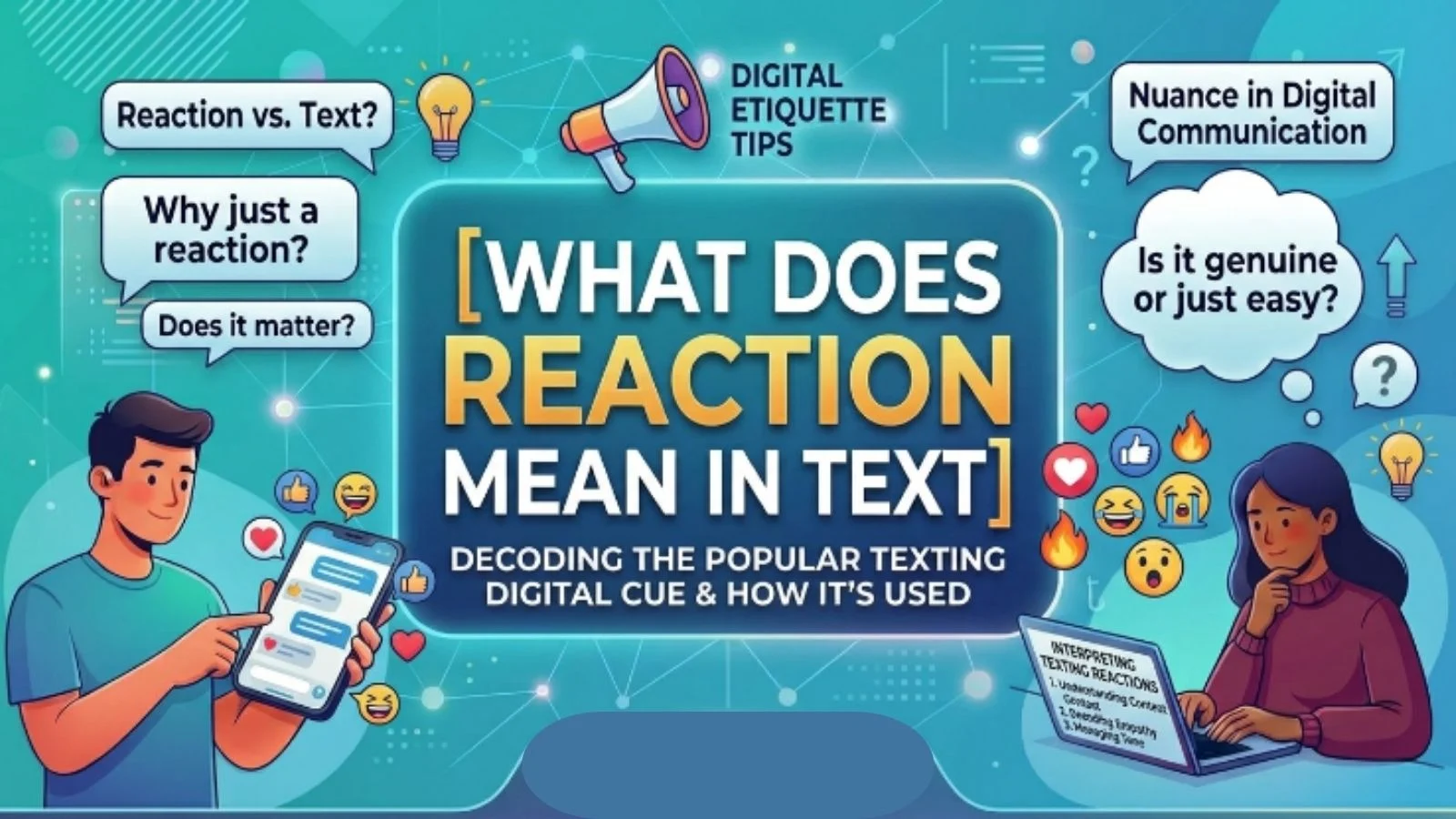
In texting, reaction usually refers to a quick response you give to a message without typing a full reply. It can be a heart, laugh, thumbs-up, sad face, or another emoji reaction.
But there is more to it than just tapping an emoji. A reaction can show agreement, appreciation, amusement, surprise, support, or even a quiet acknowledgment. The meaning often depends on the message, the relationship between the people, and the reaction that was chosen.
What Does Reaction Mean in Text?
In text messaging, a reaction means a quick response to someone’s message, usually shown through an emoji or small symbol attached to that message.
For example, if someone sends you:
“I finally finished my project!”
You might react with a heart to show support or a thumbs-up to acknowledge it.
Unlike a normal text reply, a reaction lets you respond without writing another message.
Simple Definition
Reaction = a quick visual response to a text message.
It can communicate feelings or acknowledgment without requiring a written answer.
Common reactions include:
- Heart
- Thumbs up
- Laughing face
- Sad face
- Surprised face
- Angry face
- Celebration
- Fire
- Check mark
The available reactions depend on the messaging app you are using.
What Does “React to My Message” Mean?
If someone says “react to my message,” they are usually asking you to respond to their message using one of the available reactions.
For example:
Person A: “I sent you the information.”
Person B: “Got it.”
Person A: “Can you react to my message?”
Here, Person A probably wants a quick acknowledgment, such as a thumbs-up.
It does not necessarily mean they want a detailed answer.
What Is a Reaction on Social Media and Messaging Apps?
The word reaction is commonly used on messaging and social media platforms.
Instead of typing a response, you can select a small emoji or symbol that appears directly on the message or post.
The exact system varies between platforms.
You may see message reactions on apps such as:
- Facebook Messenger
- iMessage
- Google Messages
- Discord
- Slack
- Microsoft Teams
Some platforms offer only a few basic reactions, while others provide a larger selection.
Why Do People Use Reactions?
People use reactions because they make conversations faster and easier.
Imagine someone sends you ten messages in a group chat. You may want to show that you saw an important message without sending ten separate replies.
A reaction solves that problem.
1. To Acknowledge a Message
A reaction can simply mean:
“I saw this.”
For example:
Friend: “I will meet you at 7 PM.”
You: 👍
Your reaction can mean that you received and understood the information.
2. To Show Appreciation
A heart reaction can communicate warmth or appreciation.
Friend: “I saved you a seat.”
You: ❤️
This may mean:
“Thank you.”
3. To Show Agreement
A thumbs-up or similar reaction can mean:
“I agree.”
For example:
Coworker: “Let’s use this version for the presentation.”
You: 👍
You have acknowledged the suggestion without writing a full sentence.
4. To Show Amusement
A laughing reaction usually means that something was funny.
Friend: “I walked into the wrong classroom again.”
You: 😂
The reaction communicates that you found the situation amusing.
5. To Show Support
A heart or supportive reaction can be useful when someone shares something emotional.
Friend: “I finally reached my goal.”
You: ❤️
The reaction can communicate encouragement and happiness for them.
Examples of Reactions in Text
The meaning of a reaction depends heavily on the context.
Here are some everyday examples.
Example 1: Thumbs-Up Reaction
Message:
“Okay, I’ll call you tonight.”
Reaction: 👍
Meaning:
“Okay,” “Sounds good,” or “I understand.”
The thumbs-up reaction is often used as a simple acknowledgment.
Example 2: Heart Reaction
Message:
“I’m really proud of you.”
Reaction: ❤️
Meaning:
“I appreciate that,” “Thank you,” or “That means a lot.”
A heart can feel warmer and more personal than a thumbs-up.
Example 3: Laughing Reaction
Message:
“My cat knocked my coffee over again.”
Reaction: 😂
Meaning:
“That is funny.”
It does not necessarily mean the person is laughing at you in a negative way.
Example 4: Surprised Reaction
Message:
“I just won two tickets to the concert!”
Reaction: 😮
Meaning:
“Wow!” or “That’s surprising!”
The reaction adds emotion without requiring a written response.
Example 5: Sad Reaction
Message:
“My flight was canceled.”
Reaction: 😢
Meaning:
“I’m sorry,” “That’s sad,” or “I feel bad for you.”
The exact meaning depends on the conversation.
Does a Reaction Count as a Reply?
Usually, a reaction counts as a response, but it is not the same as a traditional written reply.
For example:
Person A: “Are you coming at 8?”
Person B: 👍
Person B has responded, but the message does not clearly explain whether they mean “yes,” “okay,” or “I saw this.”
That is why reactions can sometimes cause confusion.
If the information is important, a written response is usually clearer.
Reaction vs Reply
| Term | Meaning | Example |
|---|---|---|
| Reaction | Quick visual response | ❤️ |
| Reply | Written response to a message | “Thank you!” |
| Like | Shows approval or appreciation | 👍 |
| Comment | Written response to a post or message | “This is great!” |
| Emoji | Visual symbol used in communication | 😂 |
A reaction can contain an emoji, but not every emoji is technically a message reaction.
For example, sending 😂 as a separate text is different from reacting to someone’s message with 😂.
Reaction vs Like
These terms are sometimes used interchangeably, but they are not always identical.
A like is usually a specific type of positive response.
A reaction is a broader category that can include different emotions.
For example, someone might react to a message with:
- Like
- Love
- Laugh
- Sad
- Angry
- Surprise
So, a like can be a reaction, but a reaction does not always mean a like.
What Does a Reaction Mean From a Friend?
If a friend reacts to your message, the meaning usually depends on the reaction.
A thumbs-up may simply mean:
“Got it.”
A heart may mean:
“I appreciate this.”
A laughing emoji may mean:
“That’s funny.”
However, you should avoid assuming too much from one reaction.
People have different texting habits. Some people use reactions frequently, while others rarely use them.
What Does a Reaction Mean From Someone You Like?
This is where things can become confusing.
A heart reaction may feel meaningful when it comes from someone you like, but it does not automatically mean romantic interest.
For example:
You: “Good luck with your interview!”
Them: ❤️
This could simply mean “Thank you” or “I appreciate your support.”
Context matters more than one emoji.
Look at the overall conversation instead of trying to decode one reaction by itself.
When Should You Use a Reaction?
Reactions work well when you want to give a quick response.
You can use them when:
- Someone gives you useful information.
- You want to acknowledge a message.
- Someone sends something funny.
- You appreciate someone’s words.
- You want to show support.
- You agree with something.
- You are in a busy group conversation.
- A full written reply is unnecessary.
For casual conversations, reactions can make communication feel natural and less repetitive.
When Should You Send a Written Reply Instead?
A reaction is not always enough.
You should consider writing a proper response when the message:
- Asks an important question.
- Requires a detailed answer.
- Contains instructions.
- Involves plans or appointments.
- Discusses a serious issue.
- Could be misunderstood.
- Requires confirmation.
For example, if someone asks:
“Can you send me the document before 5 PM?”
A thumbs-up may not clearly communicate whether you agreed to do it.
A better response would be:
“Yes, I’ll send it before 5 PM.”
That removes uncertainty.
Common Misunderstandings About Text Reactions
A Reaction Does Not Always Have One Fixed Meaning
The same reaction can mean different things in different conversations.
A thumbs-up could mean:
“Okay.”
But in another situation, it could feel like:
“Fine.”
The relationship and tone matter.
A Heart Does Not Always Mean Romance
A heart reaction can express:
- Appreciation
- Friendship
- Support
- Love
- Gratitude
- Agreement
Do not automatically interpret it as flirting or romantic interest.
A Laughing Reaction Is Not Always Insulting
Someone may use a laughing reaction because your message genuinely made them laugh.
However, in certain conversations, it can also be interpreted as mocking.
The surrounding messages provide important context.
No Reaction Does Not Necessarily Mean Something Is Wrong
Someone may not react because they are busy, did not notice the message, or simply do not use reactions often.
It is risky to create a strong interpretation from the absence of a reaction.
How to Understand the Meaning of a Reaction
If you are unsure what someone’s reaction means, consider these factors:
1. Read the Message First
The message itself provides the most important context.
A heart on a joke may have a different meaning from a heart on an emotional message.
2. Consider Your Relationship
A reaction from a close friend may feel different from the same reaction from a coworker.
3. Look at Previous Conversations
Does this person regularly use the same reaction?
If they use ❤️ with many friends, it may simply be part of their normal texting style.
4. Look at the Whole Conversation
Do not interpret one emoji separately from everything else.
The messages before and after the reaction can help clarify its purpose.
Pro Tips for Using Reactions Naturally
Use reactions when a quick response is enough.
If someone sends simple information, a reaction can save time.
Choose a reaction that matches the tone.
A laughing reaction is appropriate for a joke, while a sad reaction may fit disappointing news.
Do not overthink every reaction.
Digital communication can be ambiguous. A single emoji rarely provides enough information to understand someone’s complete feelings.
Use words when clarity matters.
If a message requires confirmation, write a clear response rather than depending only on an emoji.
Remember that people have different texting styles.
Some people react to almost every message. Others rarely use reactions at all.
Why Reactions Are So Common in Modern Texting
Modern digital conversations are often fast.
People may not have time to write a full response to every message. Reactions provide a quick way to acknowledge what someone said.
They also add emotion to conversations.
A simple “Okay” can feel neutral, while a reaction can show appreciation, humor, excitement, or sympathy.
This makes reactions useful in both personal and group conversations.
Frequently Asked Questions
What does reaction mean in text messaging?
A reaction in text messaging is a quick response attached to someone’s message, usually using an emoji or symbol. It can show acknowledgment, agreement, appreciation, humor, surprise, or another emotion.
What does it mean when someone reacts to your text?
It usually means they wanted to respond quickly without sending a separate written message. The exact meaning depends on the reaction and the context.
Is a reaction the same as a reply?
Not exactly. A reaction is usually a quick visual response, while a reply is a written message. A reaction can acknowledge a message without explaining anything in detail.
Does a heart reaction mean they like you?
Not necessarily. A heart can show appreciation, support, friendship, affection, or agreement. Its meaning depends on the person and the context of the conversation.
Final Thoughts
So, what does reaction mean in text? It usually means a quick visual response to someone’s message.
A reaction can help you say “I saw this,” “I agree,” “That’s funny,” “Thank you,” or “I support you” without typing a full sentence.
The most important thing is context. A single emoji does not always have one fixed meaning. Consider the message, your relationship with the person, and their usual texting habits before reading too much into a reaction.
When you need to communicate something important or clear, use words. But for quick everyday conversations, reactions are an easy and natural way to keep the conversation moving.