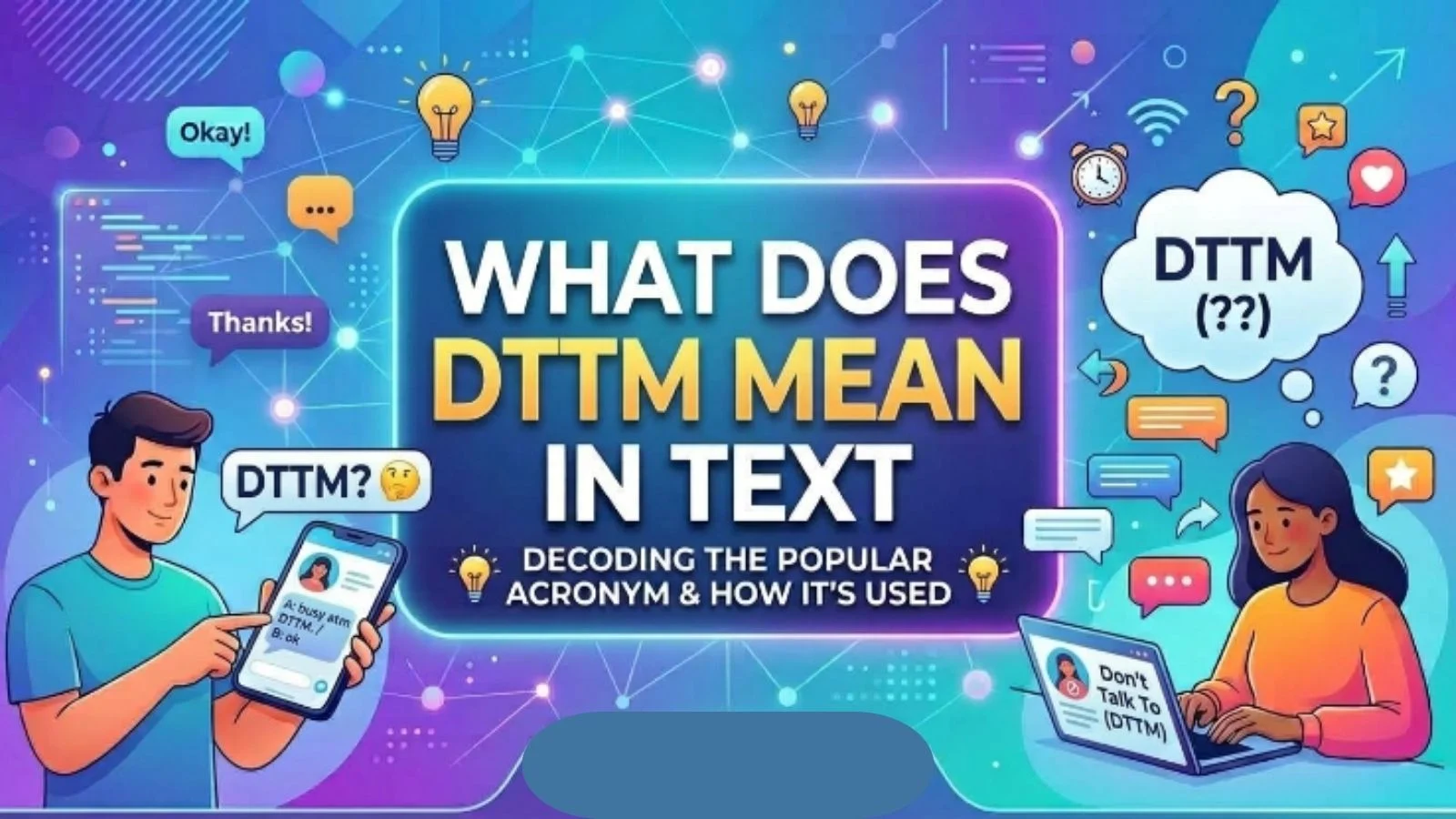
Have you ever opened a message and seen “DTTM” with no explanation?
Those four letters can feel confusing. Is the person angry? Are they joking? Do they actually want you to stop talking to them?
In most texting and social media conversations, DTTM means “Don’t Talk To Me.” It is usually used when someone wants space, feels annoyed, is embarrassed, or simply does not want to continue a conversation at that moment.
But there is an important detail: the tone depends on the situation.
A friend saying “DTTM 😂” after you make a silly joke may be playing around. Someone sending only “DTTM” during an argument may be seriously asking you to back off.
So, before you assume the worst, look at the conversation around it.
What Does DTTM Mean in Text?
DTTM most commonly means “Don’t Talk To Me.”
It is a texting abbreviation made from the first letters of:
- D = Don’t
- T = Talk
- T = To
- M = Me
In simple words, DTTM means “I don’t want to talk right now” or “Please give me some space.”
People use it in text messages, DMs, group chats, comments, and other casual online conversations. It is an informal expression and can sound either serious or playful depending on the relationship and context.
Quick Definition
DTTM = Don’t Talk To Me.
It is used to tell someone that you do not want to talk, need some space, or are temporarily annoyed. Between friends, it can also be used jokingly or dramatically.
Simple Meaning of DTTM
Think of DTTM as a short digital version of saying:
“Please leave me alone for a little while.”
For example:
Friend: “Are you still mad about yesterday?”
You: “DTTM.”
Here, the sender is probably saying that they do not want to discuss the issue right now.
However, DTTM does not always mean serious anger.
Imagine this:
Friend: “I told your crush you like them.”
You: “DTTM 😭”
In this case, you may not actually want your friend to disappear. You are probably embarrassed and jokingly saying, “I cannot deal with you right now!”
That difference is why context matters so much when reading internet slang.
Where Is DTTM Used?
DTTM is mainly found in casual digital communication.
You may see it in:
- Text messages
- WhatsApp chats
- Instagram DMs
- Snapchat conversations
- TikTok comments
- Group chats
- Discord conversations
- Casual social media posts
The abbreviation works especially well when people want to express an emotional reaction quickly.
Instead of typing:
“Please do not talk to me right now because I am extremely annoyed.”
Someone can simply type:
“DTTM.”
Four letters can communicate the same basic idea much faster.
Why Do People Use DTTM?
There are several reasons someone might type DTTM.
1. They Are Annoyed
The most direct use is to show irritation.
Example:
“DTTM. You knew I was busy.”
Here, the sender probably wants the other person to stop the conversation.
2. They Need Some Space
Sometimes DTTM is not about anger at all.
A person may be tired, stressed, overwhelmed, or simply not interested in talking.
Example:
“I’ve had the longest day ever. DTTM for a bit.”
The person may only want some quiet time.
3. They Are Embarrassed
DTTM can also be a funny reaction to an embarrassing situation.
Example:
Friend: “I just showed everyone your old school photo.”
You: “DTTM 😭”
The message can mean, “I am so embarrassed right now that I cannot deal with you.”
4. They Are Being Dramatic
Friends often use slang dramatically for humor.
Example:
Friend: “Your favorite restaurant closed.”
You: “DTTM.”
The sender is not necessarily angry. They may simply be exaggerating their reaction for fun.
5. They Want to End a Conversation
Sometimes DTTM is a clear signal that the conversation should stop.
If someone sends it during a serious argument, it may be better to respect the request rather than continuing to message them.
Real-Life Examples of DTTM
Here are some natural examples showing how the meaning can change.
Example 1: Serious
Alex: “Can we talk about what happened?”
Sam: “Not right now. DTTM.”
Here, DTTM is a serious request for space.
Example 2: Playful
Alex: “I ate the last slice of pizza.”
Sam: “DTTM 😂”
Sam is probably joking rather than genuinely ending the friendship.
Example 3: Embarrassment
Mia: “I accidentally sent your private message to the group.”
Sara: “DTTM 😭”
Sara is embarrassed and annoyed, but the phrase may be playful.
Example 4: Frustration
Tom: “Did you finish the project?”
Jake: “DTTM. I haven’t even started.”
Here, Jake may be frustrated and does not want more questions.
Example 5: Needing Quiet
Friend: “Want to call?”
You: “DTTM for an hour. I need some quiet.”
In this situation, the meaning is very clear: the person needs temporary space.
What Does DTTM Mean From a Girl?
If a girl sends you “DTTM,” the basic meaning is still usually “Don’t Talk To Me.”
However, you should not try to determine her feelings from the abbreviation alone.
Look at the conversation.
If she sends:
“DTTM 😂”
after a funny or embarrassing moment, she may be joking.
If she sends:
“DTTM. I’m really upset right now.”
then the message is much more serious.
The safest approach is to consider the full context, previous messages, punctuation, and relationship rather than assuming a hidden meaning.
What Does DTTM Mean From a Guy?
If a guy texts DTTM, it generally has the same meaning: “Don’t Talk To Me.”
He may be annoyed, tired, embarrassed, frustrated, or joking.
For example:
You: “Bro, I told everyone about your crush.”
Him: “DTTM 😭”
That could be playful embarrassment.
But:
You: “Why are you ignoring me?”
Him: “DTTM.”
That is more likely to be a direct request for space.
Again, context is more important than gender.
DTTM vs Similar Texting Terms
DTTM can look similar to several other short expressions, but they are not exactly the same.
| Term | Meaning | Common Tone |
|---|---|---|
| DTTM | Don’t Talk To Me | Annoyed, serious, playful |
| DTM | Don’t Text Me / sometimes “Doing Too Much” depending on context | Firm or casual |
| STFU | Shut the f*** up | Much harsher |
| IDC | I Don’t Care | Dismissive or indifferent |
| BRB | Be Right Back | Temporary absence |
| GTG | Got To Go | Ending a conversation |
| NVM | Never Mind | Dropping a topic |
The important difference is that DTTM directly focuses on not wanting communication.
It can be much softer than a profanity-based expression, but it can still sound cold if used without context.
Is DTTM Rude?
It can be.
DTTM is not automatically rude, but the way you use it matters.
Between close friends, it may be completely harmless.
For example:
“DTTM 😂 You really posted that?”
This can sound playful.
But sending:
“DTTM.”
to someone without any context can sound harsh or dismissive.
If you genuinely need space but want to sound polite, you could say:
“I need some time alone right now.”
or:
“Can we talk later? I need a little space.”
These alternatives make your intention clearer.
When Should You Use DTTM?
DTTM is best for casual conversations with people who understand your texting style.
You might use it when:
- You are joking with a close friend.
- You are reacting dramatically to something funny.
- You are embarrassed.
- You are temporarily annoyed.
- You genuinely need some personal space.
- You want to pause a casual conversation.
When You Should Avoid It
Be careful using DTTM with:
- Your boss
- A teacher
- A customer
- A professional contact
- Someone you barely know
- Someone who may misunderstand your humor
In professional communication, phrases such as “I’m unavailable right now” or “Can we continue this later?” are much clearer.
How Do You Reply to DTTM?
Your response should depend on the tone.
If They Are Seriously Upset
Give them some space.
You could say:
“Okay, I understand. Message me when you’re ready.”
If They Are Clearly Joking
You can respond playfully.
“Fine, fine. I’ll leave you alone 😂”
If You Are Unsure
Ask gently:
“Are you serious, or are you joking?”
This is better than immediately assuming they are angry.
If You Accidentally Upset Them
A simple apology can help.
“Sorry, I didn’t mean to upset you. I’ll give you some space.”
The goal is to understand the person’s intention instead of escalating the conversation.
Common Misunderstandings About DTTM
Misunderstanding 1: DTTM Always Means Permanent Rejection
Not necessarily.
Someone may use DTTM to ask for temporary space rather than permanently ending a relationship or friendship.
Misunderstanding 2: DTTM Always Means Anger
Not always.
It can be used as a humorous or dramatic reaction, especially between friends.
Misunderstanding 3: The Meaning Is Always the Same
The most common meaning is “Don’t Talk To Me,” but abbreviations can have other meanings in different communities or contexts. One slang reference, for example, also records a less common interpretation, “Don’t Text The Mobile.”
This is why the surrounding conversation should always be considered.
Misunderstanding 4: DTTM Is Appropriate Everywhere
It is mainly informal internet and texting slang.
It is not a good choice for formal emails, professional messages, or serious workplace communication.
DTTM and Tone: Why Context Matters
The same abbreviation can communicate completely different emotions.
Compare these messages:
“DTTM.”
This can feel cold or serious.
Now compare:
“DTTM 😂”
This may sound playful.
And:
“DTTM 😭”
This can communicate embarrassment, frustration, or dramatic humor.
Even punctuation can change the feeling:
“DTTM!”
can sound more forceful than:
“dttm lol”
The relationship between the people also matters.
A close friend may understand your humor immediately. Someone you barely know may interpret the same message as genuinely rude.
Pro Tips for Using DTTM Correctly
1. Know your audience.
Use DTTM mainly with people who understand casual slang.
2. Check the mood.
If the conversation is serious, DTTM may be taken literally.
3. Use context when joking.
An emoji or extra phrase can make a playful meaning easier to understand.
4. Respect a serious DTTM.
If someone clearly asks for space, do not keep sending messages.
5. Avoid it in professional settings.
Choose clear and polite language instead.
6. Do not assume the meaning without reading the conversation.
The same four letters can express anger, embarrassment, humor, or exhaustion.
Final Thoughts
So, what does DTTM mean in text?
The most common meaning is “Don’t Talk To Me.” People use it when they want space, feel annoyed, are frustrated, or simply do not want to communicate for a while.
But DTTM is not always serious. Among friends, it can be a funny or dramatic reaction to an embarrassing moment, bad news, or a silly situation.
The best way to understand it is to look at the context. Check the messages before and after it, notice the tone, and consider your relationship with the person.
When used carefully, DTTM is a quick way to express a strong reaction without typing a full sentence.
Frequently Asked Questions
What does DTTM mean in text?
DTTM usually means “Don’t Talk To Me.” It can express annoyance, frustration, embarrassment, or a need for space. Among friends, it may also be used jokingly.
Is DTTM rude?
DTTM can sound rude or dismissive, especially when sent by itself. However, close friends may use it playfully. The meaning depends on the context and tone.
What does DTTM mean on Snapchat or Instagram?
On Snapchat, Instagram, and similar platforms, DTTM generally means “Don’t Talk To Me.” It can be used in DMs, comments, captions, or casual conversations.
How should I respond to DTTM?
If the person seems serious, give them some space. If it is clearly a joke, you can respond playfully. When the tone is unclear, politely ask whether they are serious.