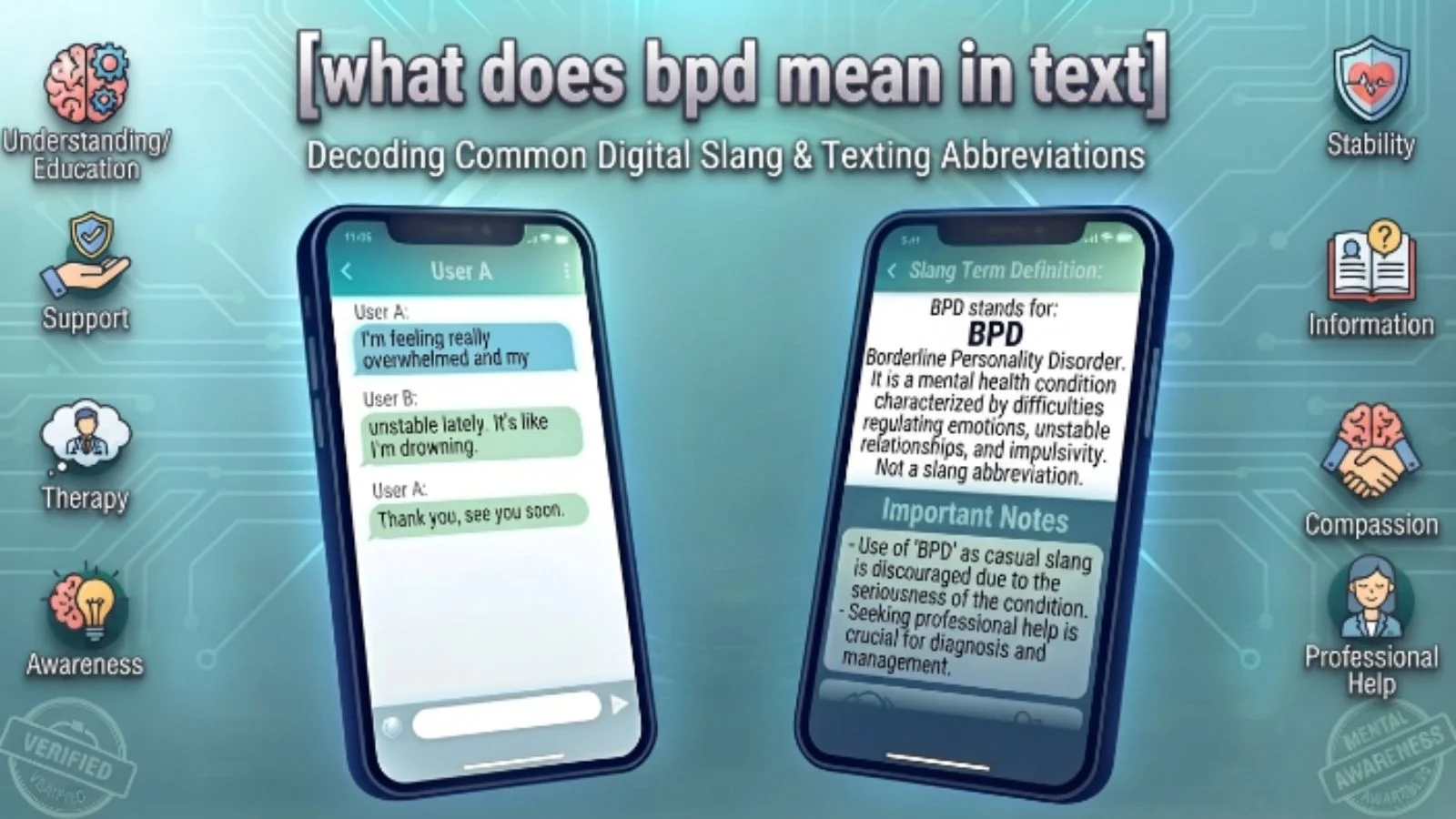
Have you ever received a message with “BPD” and wondered what it meant? You’re not alone.
Texting abbreviations can be confusing because the same letters often have different meanings depending on the conversation. In one chat, BPD might refer to a mental health condition. In another, it could mean something completely different.
If you want to understand what does BPD mean in text, this guide explains everything in simple English. You’ll learn its meaning, where people use it, when to use it, and how to avoid common misunderstandings.
What Does BPD Mean in Text?
BPD most commonly stands for Borderline Personality Disorder in text messages, online conversations, social media, and mental health discussions.
Quick Definition
BPD is an abbreviation for Borderline Personality Disorder, a mental health condition that affects a person’s emotions, relationships, self-image, and behavior.
However, depending on the conversation, BPD can also have other meanings. That is why you should always look at the context before deciding what someone means.
Featured Snippet Answer
BPD usually means Borderline Personality Disorder in text messages and online conversations. It refers to a mental health condition that affects emotional regulation, relationships, and behavior. In some professional fields, BPD may have different meanings, so context is important.
Simple Meaning of BPD
In everyday texting, BPD is simply a short way of saying Borderline Personality Disorder.
People may use it when:
- Talking about mental health
- Sharing personal experiences
- Discussing therapy
- Reading awareness posts
- Asking for advice
- Supporting friends or family
For example:
Person A: I was diagnosed with BPD last year.
Person B: Thanks for trusting me. I’m here if you need someone to talk to.
Here, BPD clearly refers to the mental health condition.
What Is Borderline Personality Disorder?
Borderline Personality Disorder is a mental health condition that may affect:
- Emotional control
- Relationships
- Self-image
- Impulsive behavior
- Fear of abandonment
People living with BPD may experience emotions more intensely than others. With proper treatment, therapy, and support, many people with BPD live healthy and fulfilling lives.
It is important not to use the term as an insult or joke.
Where Is BPD Used?
You may see BPD on many online platforms.
Text Messages
Friends may discuss mental health or personal experiences.
Example:
“I’ve been learning more about my BPD.”
Social Media
People often share:
- Personal recovery stories
- Mental health awareness posts
- Educational content
- Therapy experiences
Reddit Forums
Mental health communities frequently use BPD when discussing symptoms, coping strategies, and recovery.
Online Support Groups
Support communities often use the abbreviation instead of writing the full term repeatedly.
Medical Discussions
Doctors, therapists, psychologists, and healthcare professionals commonly use BPD in notes and conversations.
Why Do People Use BPD Instead of Writing It Out?
There are several reasons.
It Saves Time
Typing three letters is quicker than writing Borderline Personality Disorder every time.
Easier in Conversations
When discussing mental health, abbreviations make conversations smoother.
Common Medical Abbreviation
Healthcare professionals have used BPD for years.
Widely Recognized
Many people interested in mental health already understand what BPD means.
Real-Life Examples of BPD in Text
Example 1
“I’ve recently been diagnosed with BPD.”
Meaning:
The person is talking about their mental health diagnosis.
Example 2
“My sister has BPD, and we’re learning how to support her.”
Meaning:
The speaker is discussing a family member’s condition.
Example 3
“I watched a documentary about BPD today.”
Meaning:
The conversation is about learning more about the disorder.
Example 4
“There are great therapy options for people with BPD.”
Meaning:
The discussion focuses on treatment and support.
Example 5
“I joined a BPD support community.”
Meaning:
The person became part of a mental health support group.
Other Meanings of BPD
Although Borderline Personality Disorder is the most common meaning, BPD may also represent other terms in specific industries.
Some examples include:
| BPD Meaning | Used In |
|---|---|
| Borderline Personality Disorder | Mental health |
| Barrels Per Day | Oil and gas industry |
| Biparietal Diameter | Pregnancy and ultrasound reports |
| Business Process Design | Business management |
If you’re chatting with friends, the mental health meaning is usually the correct one.
BPD vs Similar Mental Health Terms
Many people confuse BPD with other abbreviations.
| Abbreviation | Meaning | Same as BPD? |
|---|---|---|
| BPD | Borderline Personality Disorder | Yes |
| BD | Bipolar Disorder (sometimes abbreviated) | No |
| PTSD | Post-Traumatic Stress Disorder | No |
| OCD | Obsessive-Compulsive Disorder | No |
| ADHD | Attention-Deficit/Hyperactivity Disorder | No |
| MDD | Major Depressive Disorder | No |
Each condition is different and should not be confused with another.
Why Context Matters
The same abbreviation can mean different things.
Consider these examples.
Conversation About Therapy
“I’ve started therapy for BPD.”
Meaning:
Borderline Personality Disorder.
Oil Industry Meeting
“Our BPD increased by 10,000.”
Meaning:
Barrels Per Day.
Pregnancy Report
“The baby’s BPD measurement looks normal.”
Meaning:
Biparietal Diameter.
The surrounding conversation tells you which meaning is correct.
When Should You Use BPD?
You can use BPD when:
- Talking about mental health
- Discussing awareness
- Sharing educational information
- Communicating with people familiar with the abbreviation
- Participating in support groups
If your audience may not understand it, write the full phrase first.
Example:
“Borderline Personality Disorder (BPD) affects emotional regulation.”
After that, using BPD alone is perfectly fine.
When Should You Avoid Using BPD?
Avoid using BPD:
- As a joke
- As an insult
- To label someone’s personality without a diagnosis
- To make assumptions about someone’s behavior
Mental health deserves respectful and accurate language.
Common Misunderstandings About BPD
Many myths exist online.
Myth 1: BPD Means Someone Is “Crazy”
False.
People with BPD have a recognized mental health condition and deserve compassion, respect, and proper treatment.
Myth 2: Everyone With BPD Acts the Same
False.
Symptoms and experiences vary from person to person.
Myth 3: BPD Cannot Be Treated
False.
Many people improve significantly through therapy, support, healthy coping strategies, and appropriate treatment.
Myth 4: BPD and Bipolar Disorder Are the Same
False.
These are different mental health conditions with different symptoms and treatment approaches.
Pro Tips for Using BPD Correctly
Keep these tips in mind.
- Always consider the conversation before assuming the meaning.
- Use respectful language when discussing mental health.
- Avoid spreading myths or stereotypes.
- Write the full term first in professional writing.
- Remember that BPD can have different meanings in medical and technical fields.
- Never use the abbreviation to mock or judge someone.
- If you’re unsure what someone means, politely ask for clarification.
Why BPD Is Common Online
Mental health awareness has grown significantly over the past several years.
People now openly discuss:
- Therapy
- Emotional well-being
- Recovery journeys
- Coping strategies
- Self-care
- Mental health education
Because of these conversations, abbreviations like BPD appear much more often across social media, discussion forums, blogs, and text messages.
How to Respond If Someone Mentions BPD
If someone tells you they have BPD, a supportive response is usually the best approach.
Helpful responses include:
- “Thank you for sharing that with me.”
- “I’m here if you need someone to listen.”
- “I appreciate your trust.”
- “I hope you’re getting the support you need.”
Avoid dismissive comments or making assumptions about their experiences.
Final Thoughts
If you’ve been wondering what does BPD mean in text, the answer is usually Borderline Personality Disorder. It is a widely recognized abbreviation used in texting, social media, online communities, and healthcare discussions.
Because BPD can have different meanings in fields like medicine, business, and engineering, always pay attention to the context before interpreting it. Most importantly, when discussing mental health, use respectful language and avoid stereotypes. Understanding abbreviations like BPD not only helps you communicate better but also encourages empathy and awareness in everyday conversations.
Frequently Asked Questions
What does BPD stand for in text messages?
In most text conversations, BPD stands for Borderline Personality Disorder.
Does BPD always mean Borderline Personality Disorder?
No. While it usually refers to Borderline Personality Disorder, it can also mean Barrels Per Day, Biparietal Diameter, or Business Process Design, depending on the context.
Is BPD the same as bipolar disorder?
No. Borderline Personality Disorder and bipolar disorder are two different mental health conditions with different symptoms and treatments.
Is it okay to use the abbreviation BPD?
Yes. It is commonly used in conversations about mental health, especially after writing the full term once. Always use it respectfully and avoid using it as a joke or insult.