Have you ever received a text that simply says “luv” and wondered what the person really meant?
You are not alone. “Luv” is a common texting and social media term, but its meaning can change slightly depending on who sends it, the conversation, and the tone.
Sometimes it is a casual way to say “love.” Other times, it can show affection, friendship, appreciation, or emotional closeness. In some situations, it may simply be a playful spelling used to make a message feel more relaxed.
So, what do luv mean in text? Let’s break it down in simple terms and look at the different ways people use it.
What Do Luv Mean in Text?
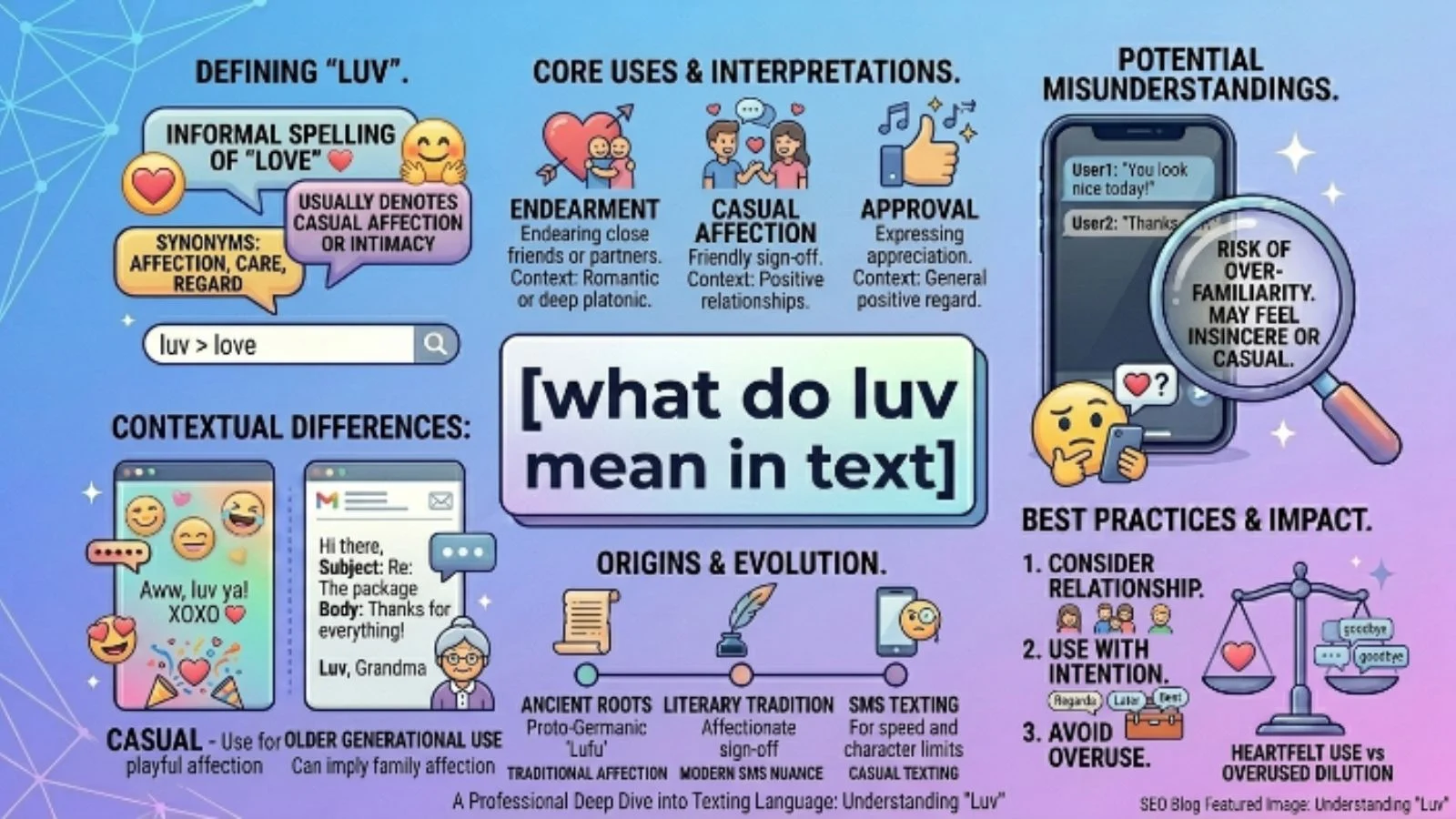
In text messages, “luv” usually means “love.” It is an informal and shortened spelling of the word “love.”
People often use luv when they want their message to sound casual, friendly, sweet, or affectionate.
For example:
“Luv you!”
This can mean:
“Love you!”
However, it does not always mean romantic love. The exact meaning depends heavily on the relationship between the people texting.
A friend might say:
“Luv ya, bestie!”
Here, “luv” expresses friendship and affection rather than romantic feelings.
A romantic partner might write:
“Goodnight, luv.”
In that situation, it may be a more intimate or affectionate expression.
Simple Definition
Luv = love.
In texting, “luv” is an informal spelling of “love” that people use to express affection, warmth, friendship, appreciation, or closeness.
What Does “Luv” Mean in Simple Words?
The easiest way to understand luv is to think of it as a casual version of love.
Instead of typing:
“I love you.”
Someone might write:
“Luv you.”
Instead of:
“Thanks, love.”
They might say:
“Thx luv.”
The word makes the message feel less formal and often more conversational.
It can communicate feelings without sounding overly serious.
Is “Luv” a Romantic Word?
Not necessarily.
This is one of the biggest misunderstandings about luv meaning in text.
The word can be romantic, but it can also be completely friendly.
Consider these examples:
Romantic:
“Miss you, luv.”
A partner may use “luv” as a term of affection.
Friendly:
“Luv your new profile pic!”
A friend may simply be complimenting you.
Appreciative:
“You helped me so much today. Luv ya!”
This could express gratitude and emotional warmth.
The relationship and surrounding words are important. You should not automatically assume that someone has romantic feelings just because they used “luv.”
Where Is “Luv” Used?
You can see luv across many informal digital conversations.
Common places include:
- Text messages
- Instagram DMs
- Snapchat
- TikTok comments and messages
- Facebook Messenger
- Group chats
- Online communities
- Casual social media posts
It is especially common when people are communicating with friends, partners, family members, or people they already know well.
Because “luv” is informal, it is generally more appropriate for casual communication than professional conversations.
Why Do People Use “Luv” Instead of “Love”?
There are several reasons people choose luv.
1. It Sounds More Casual
“Luv” can make a message sound relaxed and natural.
Compare:
“Love your outfit.”
with:
“Luv your outfit.”
The second version often feels more casual and conversational.
2. It Shows Affection
People may use “luv” to make a message feel warmer.
For example:
“Take care, luv.”
This can sound caring without necessarily being romantic.
3. It Is Short and Easy to Type
Texting is full of shortened words and informal spellings.
Words such as “you,” “your,” “thanks,” and “love” may be shortened or altered depending on the person’s texting style.
4. It Can Feel Playful
Sometimes people use “luv” simply because they like the way it looks or sounds.
It can give a message a softer or more playful tone.
Real-Life Examples of “Luv” in Text
Understanding examples is one of the easiest ways to understand the term.
Example 1: “Luv you!”
Meaning: “Love you!”
If a close friend sends this, it may express friendship. If a romantic partner sends it, it is more likely to have romantic meaning.
Example 2: “Luv your dress!”
Meaning: “I love your dress!”
Here, “luv” is simply being used to emphasize a strong positive opinion.
It does not mean the person is romantically interested in you.
Example 3: “Thanks, luv.”
Meaning: “Thanks, love.”
This can be a warm way to thank someone. Depending on the person’s communication style, it may be friendly, affectionate, or slightly flirty.
Example 4: “Goodnight luv.”
Meaning: “Goodnight, love.”
This usually sounds more affectionate than a simple “goodnight,” particularly when sent between romantic partners.
Example 5: “You’re the best, luv ya!”
Meaning: “You’re the best, love you!”
This can be used between close friends or romantic partners.
The surrounding conversation tells you more than the word itself.
“Luv” vs. “Love” vs. “Love You”
These expressions are related, but their tone can be different.
| Term | Common Meaning | Typical Tone |
|---|---|---|
| Luv | Love | Casual, warm, informal |
| Love | Love or affection | More standard and flexible |
| Love you | Expresses affection or love | Personal and direct |
| Luv ya | Casual version of “love you” | Friendly, playful, or affectionate |
| My love | A term of affection | More intimate or romantic |
The important thing to remember is that context determines meaning.
For example, “luv ya” from your best friend can be completely different from “luv ya” from someone you are dating.
“Luv” vs. “Hun” and “Babe”
You may also see “luv” alongside other affectionate terms such as hun, honey, babe, or dear.
These words can all communicate warmth, but their meanings depend on the relationship.
Luv usually comes directly from “love” and can be used casually.
Hun or honey can be affectionate but may also be used casually between friends or acquaintances.
Babe is often more romantic, although some friends use it playfully.
Therefore, you should look at the complete message instead of interpreting one word by itself.
When Should You Use “Luv”?
You can use luv when you’re having a relaxed conversation with someone who is comfortable with informal language.
Good situations include:
- Talking to a close friend
- Messaging your partner
- Sending a casual compliment
- Showing appreciation
- Talking with family members
- Writing an informal social media comment
For example:
“Luv your new haircut!”
or:
“Take care, luv.”
Both sound casual and friendly.
When Should You Avoid “Luv”?
Because “luv” is informal, it is usually better to avoid it in professional or formal communication.
For example, you probably would not write:
“Luv your proposal!”
to your manager or a business client.
Instead, use something more professional:
“I really appreciate your proposal.”
Likewise, avoid assuming that everyone understands “luv” in the same way.
Some people may see it as affectionate, while others may view it as overly familiar.
Common Misunderstandings About “Luv”
Misunderstanding 1: “Luv Always Means Romantic Love”
This is not true.
A friend, sibling, parent, or even someone making a casual compliment may use “luv.”
The relationship matters.
Misunderstanding 2: “Luv Means the Person Is Flirting”
Not necessarily.
Someone saying:
“Luv your shoes!”
is probably just complimenting your shoes.
Look at the entire conversation before deciding whether someone is flirting.
Misunderstanding 3: “Luv Is Always a Serious Expression”
It can be serious, but it can also be playful or casual.
A person might type “luv ya” without intending to make a deep emotional statement.
Misunderstanding 4: “Everyone Uses Luv the Same Way”
People have different texting habits.
For one person, “luv” may be reserved for romantic partners. For another, it may be something they say to nearly everyone they are close to.
How to Understand “Luv” Based on Context
If you’re unsure what someone means by “luv,” consider these factors.
Look at Who Sent It
A message from a romantic partner will usually carry a different meaning from the same message sent by a friend.
Look at the Previous Messages
The conversation leading up to “luv” can provide important clues.
For example:
“You looked amazing tonight. Luv you.”
has a different tone from:
“Luv your new shoes!”
Look for Other Affectionate Words
Words such as “miss you,” “babe,” “sweetheart,” or “xoxo” can provide additional context.
One word rarely tells the whole story.
Consider the Person’s Normal Texting Style
If someone regularly says “luv” to everyone, it may simply be part of their vocabulary.
If they suddenly start using it with you when they never did before, the change in tone may be worth noticing.
Is “Luv” Flirty?
It can be, but it isn’t automatically flirty.
For example:
“Luv your smile.”
could potentially be flirtatious depending on the situation.
But:
“Luv this song!”
is clearly not romantic.
Similarly:
“Thanks luv.”
could be affectionate, friendly, or simply someone’s habitual way of speaking.
The safest approach is to interpret the whole conversation, not just the abbreviation.
Pro Tips for Using “Luv” Correctly
If you want to use “luv” naturally in your own messages, keep these tips in mind:
- Use it mainly in casual conversations.
- Consider your relationship with the other person.
- Do not assume “luv” automatically sounds romantic.
- Match the other person’s texting style when appropriate.
- Avoid it in formal business communication.
- Use the surrounding words to make your intended tone clear.
- If you’re unsure how someone means it, ask rather than guessing.
A simple message such as:
“Aww, luv you too!”
can sound warm and natural when you’re responding to someone you already have a close relationship with.
What Does “Luv” Mean on Snapchat and Social Media?
On platforms such as Snapchat, Instagram, TikTok, and Facebook, luv generally has the same basic meaning: “love.”
However, social media conversations tend to be highly informal, so people may use the word in many different ways.
Someone might comment:
“Luv this!”
meaning they really like a post.
Another person might message:
“Luv ya!”
meaning they care about you or feel close to you.
A creator might even use “luv” when addressing followers casually.
Therefore, the platform itself usually does not change the basic definition. The context changes the tone.
Quick Guide: What Does “Luv” Mean?
If you want the shortest possible explanation:
“Luv” is an informal texting version of “love.”
It can express romantic affection, friendship, appreciation, warmth, or simply strong approval. Its exact meaning depends on the person, relationship, and context.
Frequently Asked Questions
1. What does luv mean in text from a girl?
If a girl texts you “luv,” it usually means “love” and may express affection, friendliness, appreciation, or romantic interest.
However, it does not automatically mean she likes you romantically. Look at the rest of the conversation and her usual texting style.
2. What does luv mean from a guy?
A guy using “luv” may simply be saying “love” in a casual way.
It can be friendly, affectionate, playful, or romantic depending on your relationship and the context of the conversation.
3. Does “luv” mean love?
Yes. “Luv” is an informal spelling of “love.”
People commonly use it in texting and social media because it feels casual and conversational.
4. Is “luv” romantic?
Sometimes, but not always.
“Luv” can be romantic when used between partners or in a flirtatious conversation. It can also be completely friendly, so you should consider the context before assuming romantic feelings.
Final Thoughts
So, what do luv mean in text? In simple terms, “luv” is a casual way of writing “love.” People use it in texts, social media messages, comments, and everyday online conversations to express affection, appreciation, friendship, or romantic feelings.
The most important thing to remember is that “luv” does not have one fixed emotional meaning. A close friend might use it casually, while a romantic partner might use it affectionately.
If someone sends you “luv,” don’t immediately assume they are flirting or declaring romantic feelings. Look at the conversation, your relationship, and the person’s normal communication style.
In short, luv usually means love, but context tells you what kind of love or affection the person intends.