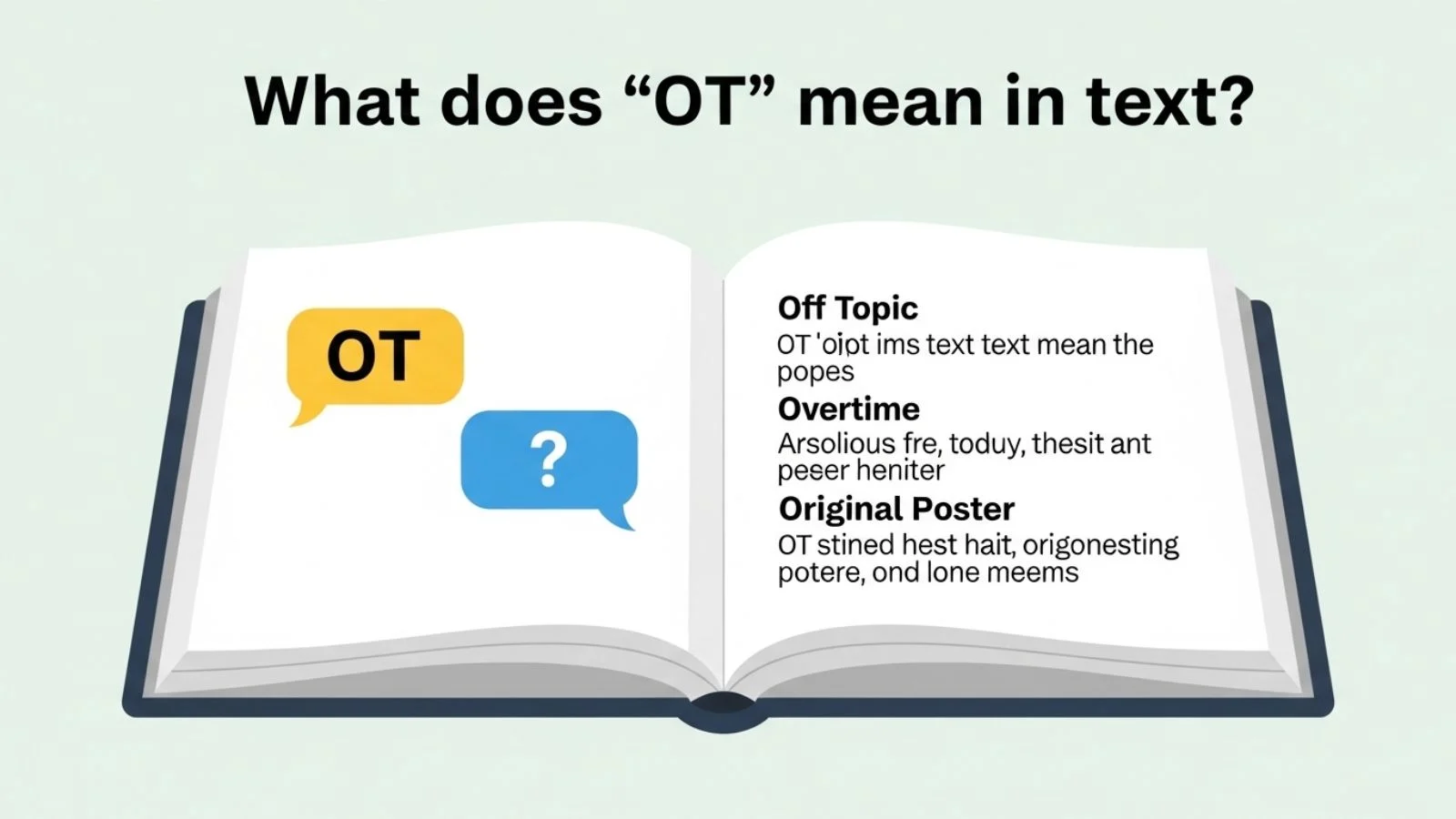
The acronym OT is widely used in texting, social media, and online messaging. It can have multiple meanings depending on the context. The most common definitions are:
- Off Topic: Used to indicate that a comment, message, or discussion is not related to the main subject.
- Over Time: Used in work-related conversations to indicate extra working hours.
Understanding OT requires looking at the context of the conversation, as it can change meaning based on where and how it is used.
Off Topic
When someone writes OT, they often mean Off Topic. This is usually seen in forums, chat groups, or comment sections.
Example:
- Person A: I love this new movie! What did you think?
- Person B: OT, but did anyone watch the game last night?
Explanation: Person B is changing the subject. They acknowledge it’s off topic but still want to share their thought.
Over Time
In professional or work-related texts, OT usually stands for Over Time. It is related to extra hours worked beyond regular work schedules.
Example:
- Boss: Can you finish this report today?
- Employee: I might need some OT to complete it.
Explanation: The employee is indicating that they will work extra hours to finish the report.
Origin and History of OT
The abbreviation OT originated from professional and academic contexts. Initially, it was commonly used in workplaces to indicate Over Time hours. Later, with the rise of online forums and messaging platforms, OT began to mean Off Topic, helping users signal a shift in conversation.
Timeline:
| Year | Usage of OT | Context |
|---|---|---|
| 1980s | OT = Over Time | Workplaces, HR records |
| 1990s | OT = Off Topic | Online forums, bulletin boards |
| 2000s | OT widely used | Social media, chat apps |
| 2020s | OT common in all digital conversations | Text, Discord, Reddit, Slack |
Real-Life Examples and Short Dialogues
Understanding OT in real situations can help beginners use it confidently.
Example 1: Off Topic
- Person A: Did you finish the project?
- Person B: OT, did you see the new café that opened downtown?
Explanation: Person B is shifting the topic intentionally but labels it as Off Topic.
Example 2: Over Time
- Colleague A: How many hours are you working today?
- Colleague B: 9 regular hours plus 2 OT.
Explanation: OT refers to extra work hours.
Example 3: Online Discussion
- User 1: I love reading mystery novels.
- User 2: OT, but has anyone tried fantasy books this month?
Explanation: User 2 signals a topic change by using OT.
Personality Traits and Usage Context
Using OT in conversations often reflects certain personality traits or communication styles:
- Organized: People use OT to clarify that they are changing topics.
- Professional: In workplaces, OT signals extra effort and commitment.
- Socially Aware: Using OT shows awareness of conversation flow.
Usage Contexts:
- Forums: OT is common in discussion boards to mark unrelated comments.
- Work Emails or Chat: OT refers to extra working hours.
- Social Media: People use OT to separate personal thoughts from ongoing discussions.
Common Mistakes or Misconceptions
Many beginners make mistakes when using OT. Here are the most common:
- Confusing OT meaning: Assuming OT always means Over Time.
- Misplacement: Using OT in the middle of a conversation without context.
- Overuse: Constantly labeling off-topic messages can confuse readers.
- Ignoring tone: OT should be polite, especially in professional settings.
Modern and Relatable Examples (Updated for 2026)
In 2026, OT is used in multiple digital spaces like chat apps, social media, and collaborative platforms.
Example 1: Discord Server
- Member A: I love this game!
- Member B: OT, but has anyone tried the new VR experience?
Explanation: OT signals a change in conversation without confusing members.
Example 2: Slack Chat at Work
- Team Lead: Please update the spreadsheet.
- Employee: I’ll finish it tonight with 1 hour OT.
Explanation: OT indicates extra working hours, showing professionalism.
Example 3: TikTok Comment
- Commenter 1: This dance is amazing!
- Commenter 2: OT, check out my latest video challenge.
Explanation: The commenter acknowledges being Off Topic to avoid disturbing the main conversation.
Lists and Tables for Quick Reference
OT Meanings Summary
| Abbreviation | Full Form | Context | Example Dialogue |
| OT | Off Topic | Online chats/forums | OT, but did you see the new café? |
| OT | Over Time | Work-related texts | I’ll need 2 hours OT to finish the report. |
Usage Tips
- Always consider the context.
- Use OT sparingly in social settings.
- In professional settings, clearly indicate OT hours.
- Avoid confusing OT with other acronyms.
FAQs About OT in Text
1. What does OT mean in texting for teenagers?
- Teenagers usually use OT to mean Off Topic, signaling a shift in conversation.
2. Can OT mean other things online?
- Yes, but Off Topic and Over Time are the most common meanings.
3. Is OT used in professional emails?
- Rarely in emails, but common in workplace chat tools to indicate Over Time hours.
4. How do I use OT politely in a forum?
- Start with OT, followed by your off-topic message to avoid confusing readers.
5. Can OT be misunderstood?
- Yes, context is important. Make sure your audience understands whether you mean Off Topic or Over Time.
6. Is OT still used in 2026?
- Absolutely. OT remains popular in digital communication, both social and professional.
7. Are there alternatives to OT?
- For Off Topic, alternatives include “side note” or “different topic.” For Over Time, you can say “extra hours.”
Conclusion
In summary, OT is a versatile acronym used in both social and professional contexts. It primarily stands for Off Topic in online discussions and Over Time in work-related conversations. By understanding the meaning, context, and proper usage, you can communicate more clearly and effectively. Remember to use OT sparingly, provide context, and be aware of your audience. Next time you type OT in a message, you will do so confidently and accurately, making your digital communication more organized and professional.