If you spend time reading text messages, social media comments, or online chats, you have probably seen the word “tryna.” It looks informal. It sounds casual. And for many people, it creates confusion.
You might wonder: Is it a real word? Is it correct English? Or is it just slang?
This confusion is normal. Language is changing fast, especially in texting and online conversations. Words like “tryna” help people talk faster and sound more natural.
In this guide, you will learn the exact meaning of “tryna,” where it came from, and how real people use it in everyday life.
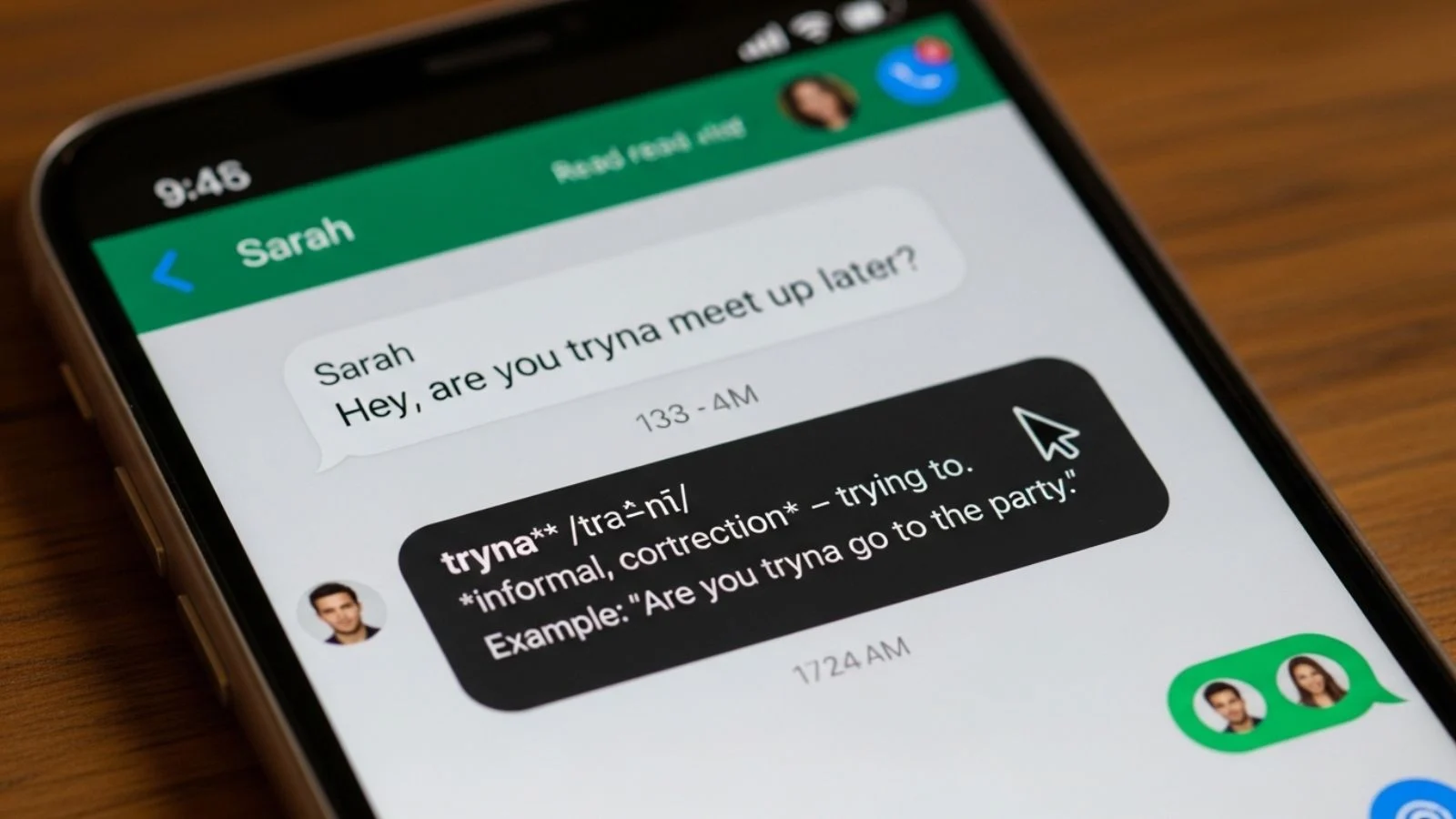
Tryna Meaning in Text – Quick Definition
“Tryna” simply means “trying to.”
It is an informal, shortened form used mostly in casual conversations.
Simple definition:
- Tryna = Trying to
- Used in texting and speech
- Shows intention, effort, or desire
Example sentences:
- “I’m tryna finish my work.”
- “She’s tryna call you.”
- “We tryna help you.”
In all these examples, “tryna” replaces “trying to.”
Origin and Background of Tryna
“Tryna” did not appear suddenly. It developed naturally from spoken English.
When people speak fast, “trying to” often sounds like:
Trying to → Tryin to → Tryna
This pronunciation became popular in casual speech, especially in American urban culture.
Music played a big role in spreading it. Many hip-hop and pop songs used natural spoken language. Fans copied those words in real life and online.
Later, texting and social media made it even more common. People prefer shorter words because they are faster and easier.
Today, “tryna” is widely understood across the world.
Real-Life Conversations Using Tryna
Here are real examples based on everyday chats.
WhatsApp Conversation
Person A: Where are you?
Person B: I’m tryna find your location.
Person A: Okay, I’ll send it again.
This shows effort.
Instagram DM Conversation
Person A: Why are you awake so late?
Person B: I’m tryna fix my sleep schedule.
Person A: Same problem here.
This shows personal intention.
TikTok Comment Conversation
Person A: This workout is hard.
Person B: I’m tryna do this every day.
Person A: Respect. That’s discipline.
This shows motivation.
These examples reflect natural, modern communication on WhatsApp, Instagram, and TikTok.
Emotional and Psychological Meaning
“Tryna” is not just a shortcut. It also carries emotional meaning.
It shows effort.
It shows intention.
It shows personal struggle sometimes.
For example:
“I’m tryna stay strong.”
This sentence feels more emotional than:
“I am trying to stay strong.”
Why?
Because “tryna” feels more human and real. It sounds natural, not formal.
People use it when they want to sound honest and open.
It reflects modern personality traits like:
- Being real
- Being informal
- Being emotionally expressive
- Being relatable
Usage in Different Contexts
Social Media
This is where “tryna” is most common.
Examples:
- I’m tryna grow my account.
- He tryna go viral.
It helps people sound casual.
Friends and Relationships
Very common between friends.
Examples:
- I’m tryna help you.
- She tryna talk to you.
It feels friendly.
Work or Professional Settings
This is important.
You should NOT use “tryna” in professional writing.
Wrong:
I’m tryna finish the report.
Correct:
I am trying to finish the report.
Professional settings require formal English.
Casual vs Serious Tone
Casual:
I’m tryna learn English.
Serious:
I am trying to improve my English skills.
Both are correct, but used in different situations.
Common Misunderstandings
Many people misunderstand “tryna.”
Misunderstanding 1: Thinking it is incorrect
It is not incorrect in casual speech.
But it is not formal English.
Misunderstanding 2: Using it everywhere
Do not use it in:
- Job applications
- Emails
- Academic writing
Misunderstanding 3: Thinking it means something different
It always means “trying to.”
Nothing else.
Comparison Table: Tryna vs Similar Words
| Word | Meaning | Usage Level |
|---|---|---|
| Tryna | Trying to | Informal |
| Trying to | Full correct form | Formal and informal |
| Wanna | Want to | Informal |
| Gonna | Going to | Informal |
| Attempting to | Trying to | Formal |
| Avoiding | Opposite meaning | Formal |
Key Insight:
Tryna is casual. Trying to is universal.
Variations of Tryna (Common Types)
Here are common variations people use.
1. Ima tryna
Meaning: I am trying to
Example: Ima tryna call you.
2. He tryna
Meaning: He is trying to
Example: He tryna win.
3. She tryna
Meaning: She is trying to
Example: She tryna help.
4. We tryna
Meaning: We are trying to
Example: We tryna improve.
5. They tryna
Meaning: They are trying to
Example: They tryna fix it.
6. You tryna
Meaning: You are trying to
Example: You tryna leave?
7. Still tryna
Meaning: Still trying
Example: Still tryna learn.
8. Just tryna
Meaning: Just trying
Example: Just tryna understand.
9. Really tryna
Meaning: Strong effort
Example: Really tryna change.
10. Always tryna
Meaning: Continuous effort
Example: Always tryna grow.
How to Respond When Someone Uses Tryna
Your reply depends on tone.
Casual Replies
- That’s good.
- Keep trying.
- I understand.
Funny Replies
- Try harder.
- You better succeed.
- No excuses.
Mature and Confident Replies
- I respect your effort.
- That shows dedication.
- Stay consistent.
Respectful Replies
- I appreciate that.
- Thank you for trying.
- That means a lot.
Regional and Cultural Usage
Western Culture
Very common.
Used daily in speech and texting.
Especially among younger people.
Asian Culture
Popular mainly online.
Less common in spoken English.
Used by social media users.
Middle Eastern Culture
Mostly used in texting.
Younger generation understands it.
Less used in formal speech.
Global Internet Culture
Now universal.
Social media made it global.
People worldwide use it.
Even non-native speakers understand it.
Why People Prefer Using Tryna
From real experience teaching English learners, I noticed something interesting.
Students use “tryna” when they feel relaxed.
They use “trying to” when they feel formal.
“Tryna” feels easier.
It removes pressure.
It makes communication faster.
It feels natural.
This is why it is popular.
When You Should NOT Use Tryna
Avoid using it in:
Job interviews
Office emails
School assignments
Professional communication
Always use full form in serious situations.
This protects your professional image.
Real-Life Emotional Examples
Example 1:
“I’m tryna change my life.”
This shows personal struggle.
Example 2:
“I’m tryna make my parents proud.”
This shows emotional motivation.
Example 3:
“I’m tryna stay positive.”
This shows mental effort.
These sentences carry emotional depth.
Frequently Asked Questions
What does tryna mean in text?
It means trying to.
Is tryna real English?
It is informal English slang.
Not formal.
Is tryna rude?
No.
It is casual.
Can I use tryna in exams?
No.
Use trying to.
Why do people say tryna?
Because it is faster and easier.
Is tryna used worldwide?
Yes.
Mostly online.
Is tryna professional?
No.
It is informal.
Expert Insight: Why Understanding Tryna Matters
Understanding words like “tryna” helps you understand modern English.
Language is alive.
It changes with people.
If you understand slang, you understand people better.
This improves communication.
It builds connection.
It builds confidence.
Conclusion
“Tryna” simply means “trying to.”
But its importance is bigger than its definition.
It represents modern communication.
It represents real emotion.
It represents natural conversation.
People use it to express effort, intention, and feeling.
Use it with friends.
Avoid it in professional settings.
Understanding it helps you understand real English.
Because real English is not just grammar.
It is people.
And people are always tryna express themselves.